The video lasts 52 seconds. It was posted by Volodymyr Zelensky himself on his X account at 7:19 a.m. on November 23 and attracted more than two million views in a single day.
Filmed at night by the drones’ onboard cameras, it shows their approach through the port of Benghazi, followed by explosions against the hull. The Ukrainian president describes it as an “exemplary operation” conducted by the Ukrainian security services “off the coast of Libya.”
Seven drones, a corvette and a helicopter
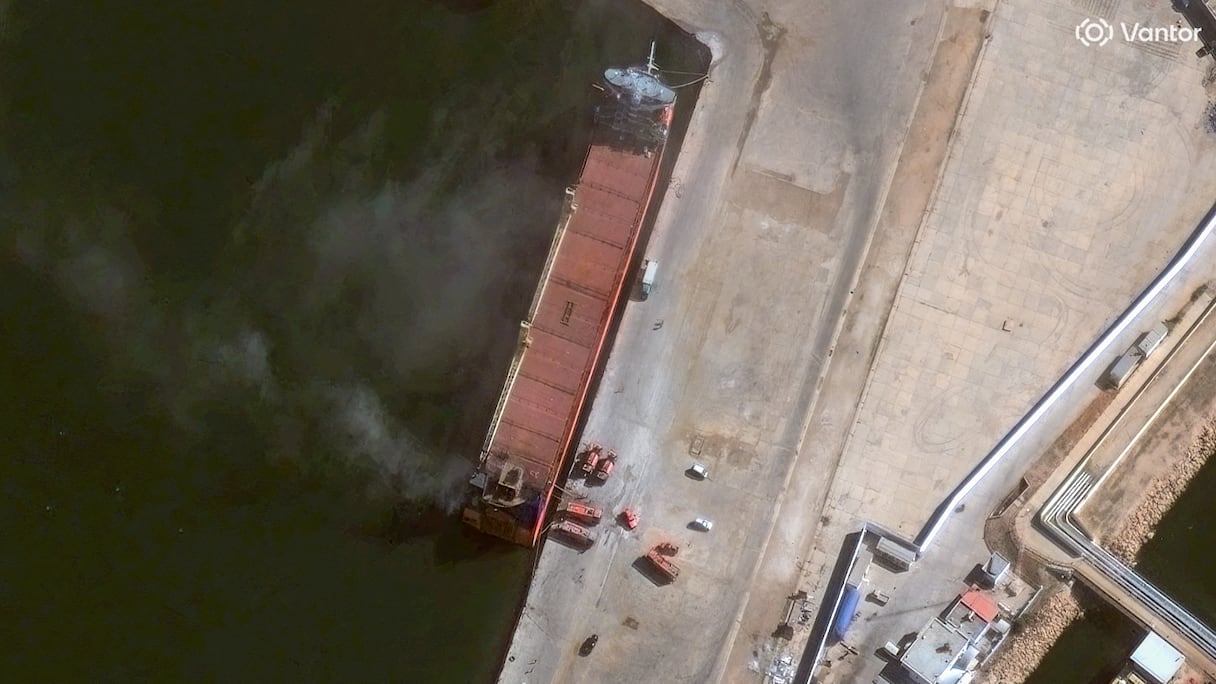
The toll he claims is substantial. “Our warriors deployed seven Ukrainian-made naval drones,” he writes. The corvette Merkury, “one of their newest ships, commissioned in 2023,” was sunk at its berth, along with the Ka-27 combat helicopter it was carrying. The Ukrainian specialist defense website Militarnyi identifies it as a Project 20380 corvette armed with Kh-35 Uran anti-ship missiles.
According to Radio Free Europe, ten Russian and Libyan crew members were injured. Moscow has not confirmed the loss. The Kremlin merely referred questions to the Ministry of Defense. The authorities in eastern Libya have denounced a violation of their sovereignty. The government in Tripoli has also condemned the attack while reiterating that it does not want “illegal foreign forces” on Libyan soil.
This was no isolated strike. According to a tally compiled by Al Jazeera, it was the fifth attack on Russian-linked vessels off the Libyan coast in eleven months. The central Mediterranean has become a theater of the war in Ukraine.
The cargo ship that came from Oran
The second target is of greater interest to Algeria. Zelensky claims to have struck the Russian cargo ship MV Angara, “which the enemy used to transport weapons.” The 127-meter roll-on/roll-off vessel is under sanctions imposed by the United States, the European Union, the United Kingdom and four other countries. According to Kyiv, it is among the vessels supplying Russia’s Africa Corps in Libya and the Sahel.
An open-source investigation published by Al Jazeera, however, reconstructs its last voyage. Having left St. Petersburg on October 26, the Angara reached the Oran anchorage on November 8, berthed on the morning of November 9 and did not depart until the evening of November 10. Its last tracking signal was picked up on November 11 off the Algerian coast, east of Oran. Then nothing, until it reappeared in flames in Benghazi. What it unloaded or took aboard in Oran remains unknown. But a sanctioned vessel suspected of carrying weapons spent a day and a half alongside a quay in an Algerian port, just a few kilometres from the major naval base at Mers El Kebir.
The Algerian press reported the Benghazi attack in a brief news dispatch, without a word about that port call. There has been no recorded official reaction from Algiers. The regime, ordinarily so quick to comment on the affairs of its neighbors, has remained silent.
The customer bankrolling the war
There is an explanation for this silence. Algeria is no mere spectator in the war in Ukraine. It is one of its financiers. Russia remains its largest arms supplier. In 2021, Algiers signed an arms deal with Moscow worth more than $7 billion, including Su-57 fighter jets, which Washington described as “deeply problematic,” as Le360 reported.
Algiers keeps its arms purchases under wraps, but its military budget does not lie: $25.4 billion in 2025, equivalent to 8.8% of GDP. Every dollar spent on a Russian aircraft or air defense system feeds Moscow’s war machine. Kyiv knows it.
The nightmare Algiers never saw coming
Only a few days ago, the press close to the regime was revelling in the notion that Field Marshal Haftar had received the message “loud and clear,” following Tebboune’s threats to strike “at the source.” The message Haftar received on Sunday did not come from Algiers. It came from Kyiv, by sea, and sank a Russian warship in his own port.
It takes little imagination to transpose the scene. Substitute Oran for Benghazi, a Russian vessel calling at Mers El Kebir for the corvette Merkury, or a sanctioned cargo ship off the Algerian coast, and the regime finds itself confronted with a scenario it had never contemplated: that of a country whose ports become targets because they serve Moscow’s logistics network. Kyiv has demonstrated that it can strike far beyond its own shores. It has also demonstrated that it can track a cargo ship all the way to Oran.
The Algerian regime has long seen itself as a major ally of Russia, a favored customer and a partner in naval exercises. It is discovering that such status comes at a price. In a war in which Ukraine now strikes Russian logistics wherever it finds them, being Moscow’s best customer in Africa is no longer an insurance policy. It is an address.
