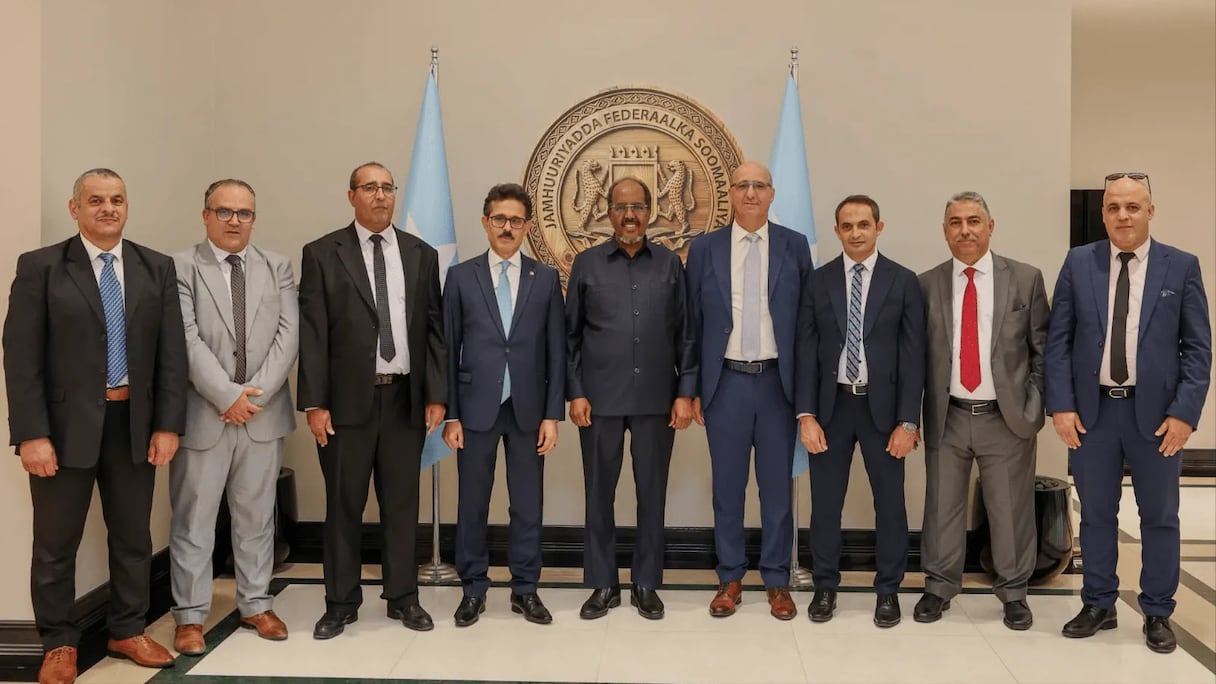
Some visits are remarkably well timed. On Sunday, November 22, Somali President Hassan Sheikh Mohamud welcomed a Sonatrach delegation to his office in Mogadishu. On the agenda, according to the Somali presidency, as cited by Dawan Africa, were “joint projects in oil and natural resources.” A week earlier, on November 15, another “high-level” delegation from the Algerian company, led by Mohamed Ghrab, director of laboratories in its exploration and production division, had already met Somalia’s deputy petroleum minister, Abdulwahab Abdi Omar, according to the Algerian news website Awras. Two delegations in a single week. Sonatrach, ordinarily so slow to deliver on its refinery promises, can move remarkably quickly when the occasion demands.
The timing, of course, was no accident.
The price of an abstention
On October 31, 2025, Somalia, then a non-permanent member of the UN Security Council, voted in favor of Resolution 2797, which established autonomy under Moroccan sovereignty as the basis for resolving the Sahara dispute. Somalia was among the eleven countries that supported the resolution, as Le360 reported. Algeria, meanwhile, had preferred not to participate in the vote, its customary way of losing without having to count the votes.
Read also : Sahara: In Rabat, Mike Waltz doubles down on US support for Morocco and puts Polisario on notice
The regime then set about courting Somalia. As early as the summer of 2025, it had rolled out the red carpet for the inauguration of the new Somali embassy headquarters in Algiers, a charm offensive already aimed at securing Mogadishu’s vote, as Le360 noted. In November 2025, Hassan Sheikh Mohamud was received in Algiers with full honors. He and Tebboune signed a raft of agreements covering oil, gas, mining, higher education, agriculture, fisheries, animal health and even visa exemptions for diplomatic passport holders. The complete package, delivered ready to use.
A year later, the investment paid off. On October 30, 2026, Somalia abstained on the US draft resolution to renew MINURSO’s mandate, arguing that it “could prejudge the outcome of negotiations,” before voting in favor of Russia’s proposal for a straightforward technical extension. Moscow’s text secured just three votes in favor, one against and eleven abstentions. Somalia cast one of those three votes. The American draft, backed by eleven members, fell to a Russian veto.
Three weeks after that vote, Sonatrach came knocking at the Somali presidency’s door. A coincidence, naturally. Much like the coincidences that see Algeria’s friends receive gas at preferential prices, scholarships and planeloads of aid, while its dwindling band of supporters on the Security Council suddenly discover the attractions of an oil partnership. A bill had to be settled.
Drilling for hope
There is, however, one small detail: Somalia’s oil industry does not yet exist. The country produces not a single barrel of crude. The Algerian company is therefore offering its “joint projects” in a country with no known oil deposits. Sonatrach, which cannot refine enough diesel for Algeria’s own motorists, is setting off in search of oil where nobody has yet found any. In Algiers, this is called strategic vision.
The political partner is scarcely more stable than the ground beneath it. In Mogadishu, the president’s mandate has been disputed since a Supreme Court ruling, while the national forum he convened for November 14–18 failed to take place after the opposition refused to attend. It is with this faltering administration that the Algerian regime is entering into oil commitments. When it falls, Algiers can always blame the Makhzen.
Algeria’s open checkbook, Algerians’ empty shelves
There is nothing new about the method. For fifty years, Algiers has poured money into the Polisario with no prospect of a return: the Tindouf camps, weapons, travel, lobbying, the recognition of the self-proclaimed SADR that must be maintained and the votes that must be secured. The sums have never been disclosed. They are subject to no parliamentary scrutiny, and no Algerian has ever been shown the accounts for this largesse, which runs into tens of billions of dollars.
For while the national oil company goes knocking on doors in Mogadishu, it is importing diesel for Algeria, just a year after declaring an end to fuel imports. In the markets, potatoes have become a matter of state, to the point that the interior minister dismissed the shortage as a foreign-spread “rumor.” Cooking oil, semolina, milk, bananas: shortages remain the regime’s one consistent policy, from Chadli to Tebboune. The Algerian citizen may have no potatoes, but at least he can take comfort in knowing his country has a friend in Mogadishu.
If only that friend were of any use. Somalia’s vote, so expensively courted, went to a resolution that secured just three votes out of fifteen. It prevented nothing, achieved nothing and changed nothing. The autonomy plan continues to advance, MINURSO is gone, and the Polisario has never been more isolated. Algiers paid for a front-row seat to watch its own defeat. The bill will be picked up by Sonatrach. Which means, ultimately, by the Algerian people.