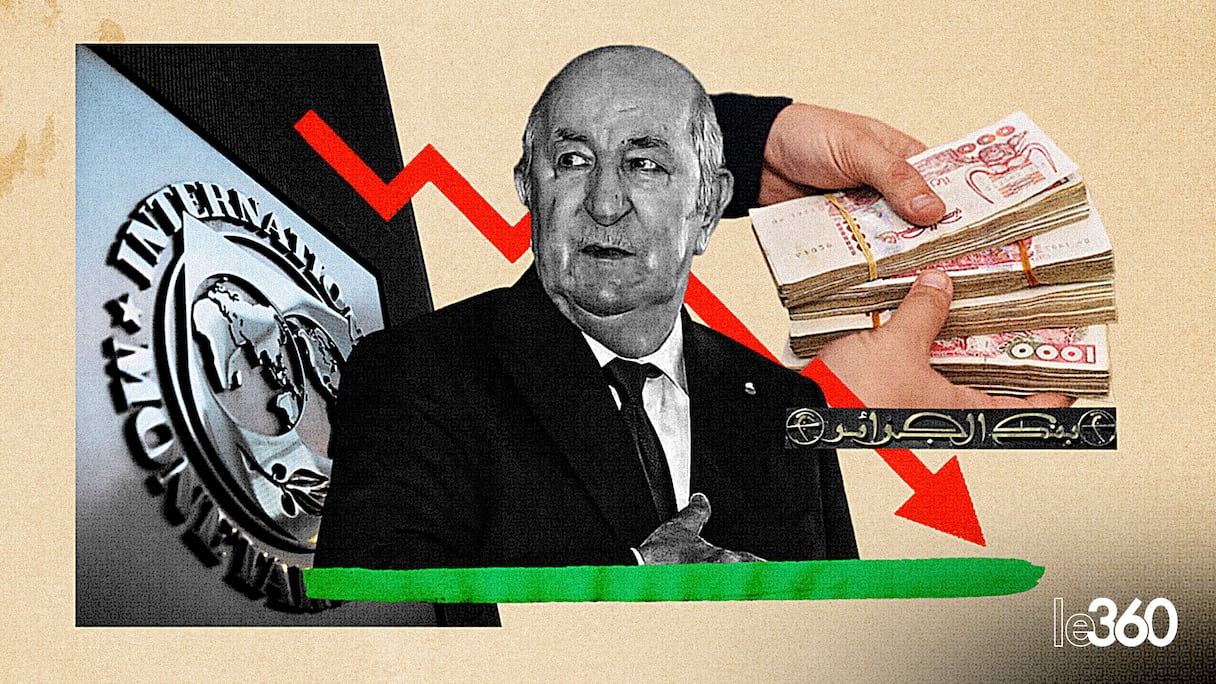
The Bank of Algeria itself has given the game away. According to its 2024 annual report, domestic public debt stands at 17.2434 trillion dinars. At the official exchange rate of 136.9 dinars to the dollar, published on the bank’s own website, that amounts to $126 billion. But ordinary Algerians cannot buy dollars at that rate. At Square Port-Saïd in Algiers, the greenback changes hands for around 246 dinars, as Le360 has reported: 80% more than at the bank counter.
In other words, on the street, the dinar is worth barely half its official value. The printing press is no abstract accounting device. It comes at a price, and that price is displayed every morning on the pavements of the square: the Algerian worker’s wages are shrinking while the state’s debt keeps growing.
The figure was highlighted by Abdou Semmar, an Algerian journalist living in exile in France, in a video published on his YouTube channel on November 18. Economist Abdelrahmi Bessaha, who has examined the same report in detail, puts the increase into perspective: from 9.423 trillion dinars in 2020 to 17.243 trillion in 2024, a rise of 83%. Those four years were Tebboune’s first term in office. The president who insists in speech after speech that Algeria has no debt has almost doubled the country’s domestic debt in a single term.
Read also : Algeria’s money-printing machine has turned the dinar into Monopoly money
Bessaha points out that 99.5% of this debt is domestic and denominated in dinars. The state owes it to banks it owns and to a central bank operating under the presidency’s thumb, as Le360 has previously reported. Imagine a father borrowing money from his own children, setting the interest rate himself, deciding when he feels like paying them back and, when the piggy bank runs dry, printing fresh banknotes to fill it. That is exactly how the system works. Semmar calls it a “glaring anomaly” that risks “jeopardizing the future of generations to come.”
Three taps, one reservoir
Algiers has three taps through which to finance itself, and all draw from the same reservoir: the Bank of Algeria. The first is the Treasury bond, sold to banks that are overwhelmingly state-owned. There is nothing unusual about governments issuing debt. What makes Algeria different is that no independent investor is there to assess the state’s creditworthiness. Lender and borrower are effectively the same person, sitting on opposite sides of the table.
“The Algerian state sells what are known as debt securities to banks such as BNA, CPA, BEA, BADR and other state-owned banks, essentially public banks, which lend it money in return for repayment at a later date, generally with interest,” Semmar explains.
“What makes the Algerian state different is that it borrows exclusively in dinars, from banks it owns. So it repays them whenever it likes, at whatever interest rate it chooses. If it does not repay them, those banks can wait. And when they run into trouble, it repays them urgently to replenish their coffers,” he continues.
The second tap is direct financing: the Bank of Algeria creates money out of thin air and advances it to the Treasury. This is money printing in its purest form. The central bank “provides advances to the Treasury, which then finances the various state institutions: ministries, government bodies such as Social Security and the National Pension Fund,” the journalist explains.
The third is the most hypocritical of all: a financial shell game. A state-owned bank running short of cash sells its Treasury bonds to the central bank, which hands over freshly created money. The cup changes hands, but the pea stays in the state’s pocket. Officially, no money has been printed, allowing the authorities to swear that the presses have not started rolling again. “Officially, there is no money creation. But in reality, it is indirect money printing, because the public banks belong to the state and the debt is public. The central bank uses money that is supposed to belong to the state to give it back to the state,” Semmar concludes, describing a “vicious circle.”
2017: The original sin
Tebboune did not invent the practice. In autumn 2017, Ahmed Ouyahia’s government amended the law on money and credit to allow the central bank to lend directly to the Treasury. Law 17-10 was presented as an exceptional measure lasting five years. Ouyahia admitted at the time that without the printing presses, the state would no longer be able to pay salaries. The arrangement was christened “unconventional financing,” a euphemism intended, according to Semmar, “not to frighten the population,” because “when a state prints money, it means it is weak.”
By the end of September 2018, money creation had already reached 4.005 trillion dinars, equivalent to $34 billion at the time. By January 31, 2019, the Bank of Algeria had created 6.556 trillion dinars, roughly a third of GDP: the equivalent of one dinar in every three produced by the entire country over a year, conjured up by a printing press. Yet the IMF had warned Algiers.
Read also : Algeria: Tebboune promises to double wages as the black market halves their value
The money financed not a single factory, dam or hospital. Instead, it went towards settling the unpaid bills of a state that could no longer even cover its own running costs. Ministries, provincial government headquarters and the presidency itself had stopped paying their electricity bills, Semmar recalls. In return, the central bank received securities with maturities ranging from five to 30 years and interest rates of between 0.5% and 1%. A virtually interest-free, 30-year loan from the state to itself: in other words, a debt nobody has any real intention of repaying.
Tebboune: The promise, then the spiral
In June 2019, at the height of the Hirak protest movement, the government announced an end to unconventional financing. Appointed rather than elected that December, Tebboune pledged to resort neither to foreign borrowing nor to the printing presses. He went on to do precisely the opposite, in three stages.
First, he repaid nothing. According to Semmar, citing the Bank of Algeria’s 2024 accounts, the legacy of 2017 “still appears” on the institution’s balance sheet: “In 2024, the Bank of Algeria acknowledged that Treasury bonds and similar securities amounted to 5.4834 trillion dinars.” That is $40 billion at the official exchange rate. Seven years on, the debt is still on the books.
Then he restarted the presses, simply changing the label on the bottle. In July 2021, the Bank of Algeria launched a “special refinancing program” worth 2.1 trillion dinars, more than $15 billion at the official exchange rate. It marked a quiet return to money printing against a backdrop of dwindling foreign exchange reserves, as Le360 reported when the program was announced. The operation amounted to around 8.3% of GDP in a single year and pushed public debt to 54.5% of GDP by the end of 2021, according to Maghreb Emergent.
Finally, he legalized the very practice he had sworn never to pursue. The 2026 Finance Act doubled the ceiling on Bank of Algeria advances to the Treasury, from 10% to 20% of budget revenue, and extended their duration. The finance minister described the measure as “normal,” according to Maghreb Emergent. The central bank can now intervene at its discretion, as Le360 has shown. What was an exception in 2017 has become the rule in 2026. And there is no cushion left: the Revenue Regulation Fund, where the state once deposited surplus oil revenues, has been empty since 2017.
Under Bouteflika, the printing presses settled arrears. Under Tebboune, they pay the bills at the end of every month. According to the IMF, central bank financing of the Treasury rose from 3.7% of GDP in 2025 to a projected 5.5% in 2026, while gross public debt is expected to climb from 52.1% of GDP in 2025 to 79% in 2031. The 2027 Finance Act, adopted by the National People’s Assembly on November 16, completes the picture: spending of 17.883 trillion dinars, or $131 billion at the official exchange rate, against revenue of just 9.251 trillion.
The shortfall exceeds 8.6 trillion dinars, or $63 billion. Put that in household terms: imagine a family earning 100,000 dinars a month and spending 193,000. The state spends almost two dinars for every dinar it takes in, then disguises the deficit by measuring it against a GDP figure inflated by $62 billion compared with IMF estimates.
The public sector’s lame ducks
Semmar describes another, even less conspicuous arrangement. When a state-owned company can no longer repay its bank, the government takes over the debt and hands the bank Treasury bonds instead of cash. The company continues losing money, the bank dresses up its balance sheet, and the debt ends up on the taxpayer’s shoulders. The authorities call it “financial restructuring.” It is rather like giving a building a fresh coat of paint while its foundations crumble.
Citing Bank of Algeria figures, the journalist puts the bonds issued to buy up these loans at 2.635 trillion dinars, more than $19 billion at the official exchange rate. State support for economic sectors rose from 6.6% of domestic debt in 2020 to 30.6% in 2024, according to Bessaha. Nearly one dinar in every three of public debt is therefore being used to keep clinically dead companies on life support. That is the price of refusing to restructure or close loss-making enterprises that serve as reservoirs of jobs and political patronage for the regime.
The Bank of Algeria has thus become the state’s biggest creditor, holding an estimated 42% of public debt, according to Semmar, citing the IMF. For the journalist, what follows is inevitable. Dinars created without any corresponding production, exports or growth amount to “Monopoly money.” The gulf between the bank counter and the pavement tells the story: 137 dinars to the dollar at the bank, 246 in the square. Every newly printed dinar eats further into the civil servant’s salary, the pensioner’s income and the family’s shopping basket. And the bill is coming due: servicing this debt alone will cost the equivalent of $6 billion in 2027, he says.
By printing ever more “Monopoly money”, the regime has forgotten one of the rules of the game: when the game is over, the banknotes go back into the box, worthless. Except that in Algeria, it is not the players who lose. It is the Algerian people.
