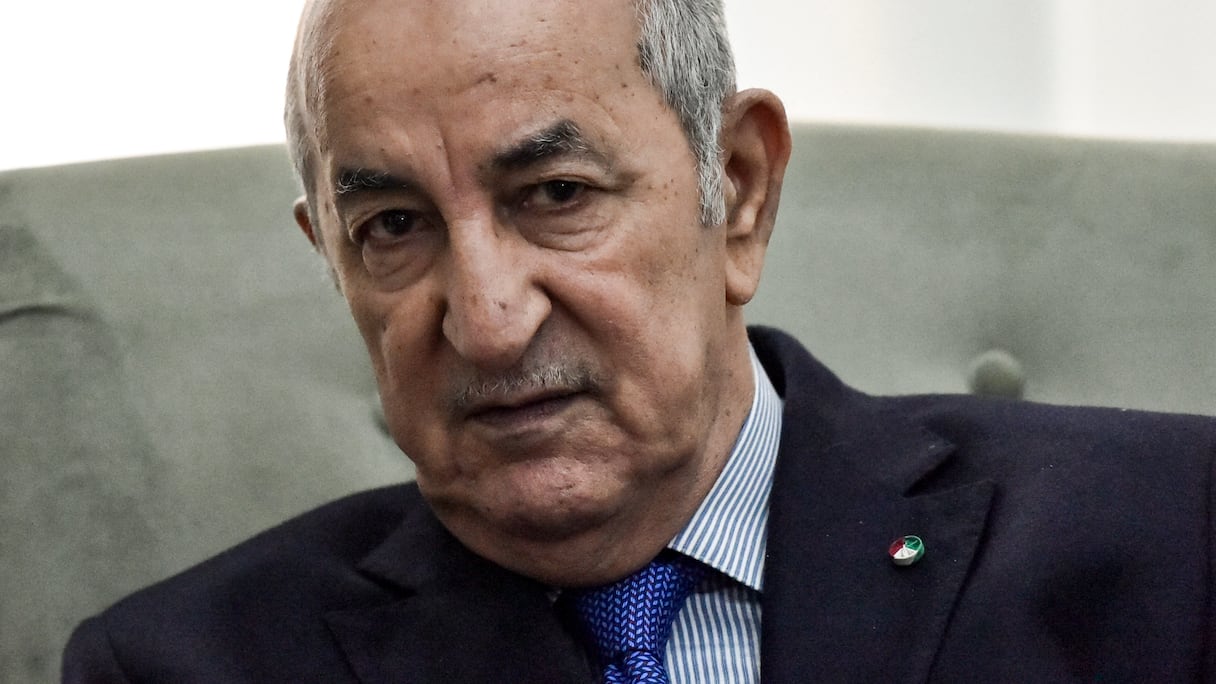
In Algeria’s ruling establishment, a presidential promise is not open to question. It is seldom kept and very often dressed up to look as though it has been. On October 3, during his regular meeting with the national press, Abdelmadjid Tebboune personally set the deadline for the Tébessa integrated phosphate project: “We will meet the deadline, God willing, by the end of the first quarter of 2027, perhaps a month or twenty days ahead of schedule.”
Six months earlier, on April 19, he had “ordered” the start of phosphate exports from the Bled El Hadba mine “by March 2027 at the latest,” according to Algeria’s official news agency, APS.
During the same appearance, the president outlined the first phase: some of the phosphate would be sold as concentrate, with impurities removed, while the rest would be processed into fertilizer. The foundation stone for the processing plant had just been laid, he said. In other words, with six months to go before the deadline, the factory that was supposed to produce the fertilizer still existed only as a foundation stone.
A project promised since 2018
This project is hardly new. Launched in 2018 with Chinese partners, it was supposed to enable Algeria to produce 10 million tonnes of phosphate by 2022 and compete with Morocco’s OCP Group. In 2021, Le360 reported that the project was still “at square one.”
In November 2023, Tebboune was still promising that Algeria would rank “at least second or third” in the world, even as its phosphate output remained stuck at around one million tonnes.
Construction eventually got under way. On August 12, 2026, Sonatrach awarded Italy’s Saipem the construction of mining facilities at Bled El Hadba, in Tébessa province, and fertilizer production units at Oued Keberit, in Souk Ahras province, while China Harbour Engineering Company (CHEC) was entrusted with the port facilities at Annaba. According to Sonatrach, the first phase envisages annual output of 5.5 million tonnes of phosphate rock, 3.2 million tonnes of concentrate, 2.4 million tonnes of phosphate fertilizers and 570,000 tonnes of urea. Saipem signed a preliminary agreement worth approximately €500 million, covering engineering, mobilization and the “procurement of long-lead equipment,” pending the definitive contract.
Designing, ordering, building and commissioning a fertilizer complex in seven months would be an extraordinary feat. In this industry, delivery of the heavy equipment alone often takes more than a year. And that is precisely where Saïd Bensedira’s allegations come in.
An “old plant” brought in from Milan
During his November 21 livestream, the commentator said he had received a “detailed report” from engineers at Sonarem, Algeria’s state-owned mining group. According to Bensedira, the officials overseeing the project, under pressure to meet the president’s deadline, opted for the quickest solution. “To lie to the president (...), they decided to strike a deal with the Italian company Saipem.”
Saipem, he continued, allegedly reached an agreement with a Chinese company “to bring in an old, old plant, which they repainted and cleaned up, and brought over from Milan.” The installation reportedly has an annual capacity of 800,000 tonnes. With no time to order new equipment, which would take two years, “they bought an old machine,” and the invoice might even describe it as new.
The YouTuber also raised a technical objection. The supplier of the plant had allegedly warned that it could process only the deposit’s middle geological layer, the richest, containing more than 25% phosphate. The upper and lower layers, which a modern installation would be capable of exploiting, would be left untouched. “Billions and billions” would be wasted, he claimed, “just to fulfill the promise made to the president of the Republic.”
Saipem returns
The choice of Saipem is no minor detail. The Italian group was at the center of the Sonatrach affair, in which former energy minister Chakib Khelil’s name featured. Convicted at first instance in Milan in 2018 over bribes paid in Algeria, the company was acquitted on appeal in 2020. Saipem had not secured a major contract in Algeria for sixteen years. Its August 12 press release, tellingly, celebrated its “return to Algeria.”
The regime that made the fight against the Issaba—the corrupt clique of the Bouteflika era—its very raison d’être has therefore entrusted its flagship project to a company whose name remains associated with one of that period’s biggest scandals. And, if Bensedira is to be believed, it has done so under circumstances that bear an uncanny resemblance to the practices it claims to have consigned to history.
A Potemkin village under construction
The Saipem contract, its value, the presidential timetable and the March 2027 deadline are all documented in official sources. The allegation concerning a second-hand plant, however, rests for now solely on Saïd Bensedira’s testimony and the report he claims to possess.
The exiled YouTuber, a mouthpiece for generals who played leading roles during Algeria’s Black Decade, has often proved well informed about the inner workings of Algerian power. His allegations call for a simple answer: where is the equipment Saipem is supposed to deliver to Oued Keberit coming from, and is it new? A serious state would answer by publishing the contracts and invoices. But in Algiers, transparency is a foreign threat and doubt is a conspiracy. The response will therefore take its customary form: a campaign against the “enemies of the New Algeria,” followed, in March 2027, by a lavish ceremony, complete with flags, ribbons and state television cameras, in front of a freshly repainted factory. Nobody will ask how old the machinery is. The global phosphate giant promised by Tebboune is still a long way off. The Potemkin village, on the other hand, is already under construction.
