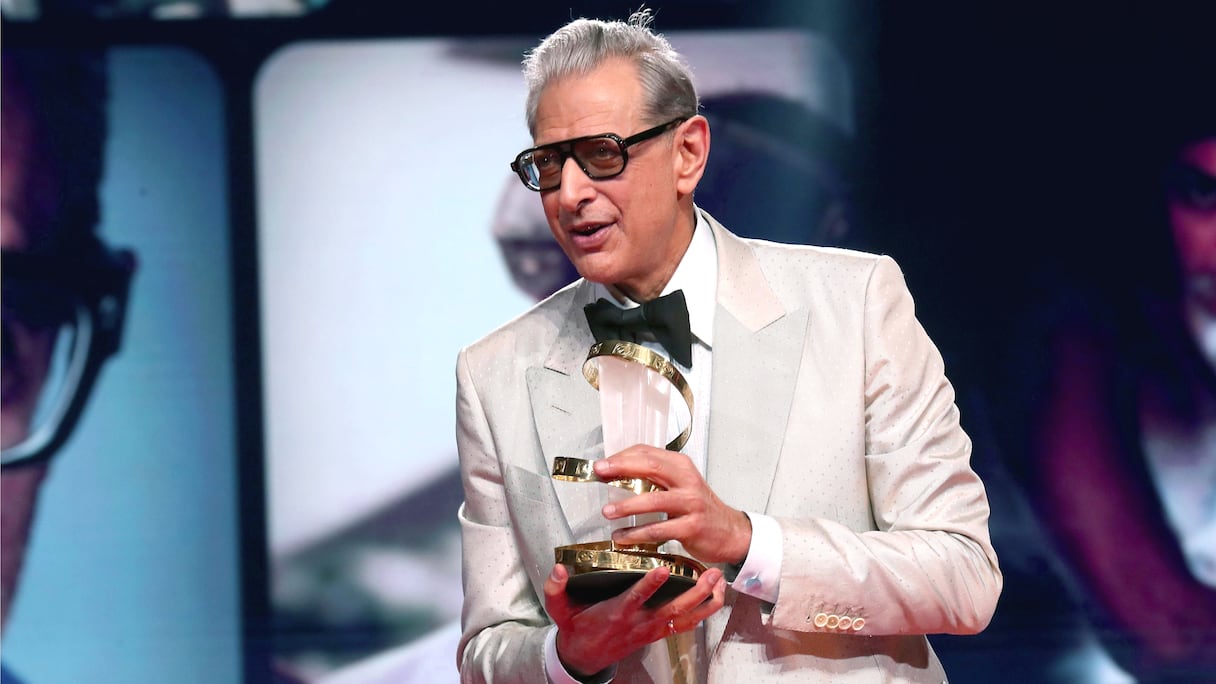
On Saturday, November 21, 2026, Jeff Goldblum received the Golden Star at the Palais des Congrès from Tilda Swinton, his co-star in three Wes Anderson films: “Isle of Dogs,” “Asteroid City” and “The Grand Budapest Hotel.”
On his first visit to Morocco, the American actor also took part in the festival’s Conversations program, a day after attending filmmaker James Gray’s session with his wife, Emilie. Moderating the discussion was Screen International critic David Calhoun, who introduced an actor with more than 50 years in the business and some 150 screen credits to his name. Eight film clips had been selected for the session, but Goldblum had plenty of stories of his own to tell.
1. The family dog named after a Western movie star
Goldblum opened the conversation with a coincidence. No sooner had he sat down than he asked David Calhoun if he knew the name of the junior high school he had attended: Calhoun Junior High School.
That reminded him of Rory Calhoun, the actor known for his roles in Westerns, after whom his grandparents had named their dog. Goldblum was six or seven at the time and said it took him several years to make the connection.
2. The summer camp where it all began
Goldblum first discovered his love of acting at a summer camp in Chatham between fifth and sixth grade. He joined a drama workshop and landed the lead in a small production.
His first entrance on stage involved a leap he had rehearsed with his mother. The audience laughed, just as he had hoped. When his parents asked afterward whether he had enjoyed himself, he told them he had, without letting on just how much. Looking back, Goldblum sees that experience as the moment the seed of his acting career was planted.
3. His father almost became an actor himself
At 17, Goldblum’s father was torn between a career in medicine and one in acting. After looking into a classroom at Carnegie Tech, now Carnegie Mellon University, he decided acting was beyond his abilities and went on to become a doctor. Goldblum’s mother had also dabbled in theater.
Read also : Star Wars director Rian Johnson on Marrakech Film Festival: ‘It’s a festival for the people’
His father encouraged him to let whatever he loved doing guide his choice of career, likening that passion to a lighthouse and a compass. But Goldblum does not see his career simply as the fulfillment of an unrealized family ambition. Acting also gave him something he could call his own, separate from his family.
4. Why Sanford Meisner stopped speaking to him
Straight out of high school in 1970, Goldblum moved to New York to study under renowned acting teacher Sanford Meisner. One lesson stayed with him: never imitate anyone else and find your own voice.
A diligent student, Goldblum spent much of his time going back and forth between his apartment and the Neighborhood Playhouse. Early in his second year, however, he was offered a part in “Two Gentlemen of Verona,” which played at the Delacorte Theater before moving to Broadway’s St. James Theatre. He joined the chorus and later became an understudy for one of the lead roles.
Goldblum decided to leave school, a choice that cost him his relationship with Meisner. His teacher shut him out and stopped speaking to him, something Goldblum found deeply painful. He eventually completed his second-year training through private lessons with William Esper and later reconciled with Meisner.
5. He spent 20 years teaching acting between films
Around the time he made “The Big Chill” in 1983, Goldblum began teaching acting whenever he was not filming. He kept it up for some 20 years, not out of altruism, he explained, but because he loved doing it.
Having left Meisner’s school before completing his studies there, Goldblum felt he still had more to learn about the technique. Teaching gave him a way to deepen his understanding, and he discovered that he knew more than he had realized.
He would later invite students to rehearse with him and read opposite him as he prepared for roles, an experience he found reinvigorating.
6. The cast of “The Big Chill” rehearsed for four weeks
After watching a clip from “The Big Chill” (1983), Goldblum recalled how little improvisation went into the film. Barbara Benedek and Lawrence Kasdan, who also directed it, had written the screenplay with great precision. The cast spent four weeks rehearsing as they would for a stage play, an arrangement Goldblum said was as unusual then as it is today.
The actor enjoys two very different approaches to dialogue. With writers and filmmakers such as David Mamet, Shakespeare, Chekhov, Aaron Sorkin, the Coen brothers and Wes Anderson, the challenge is to deliver every word exactly as written while making it sound spontaneous.
Other directors give him more freedom to play with the dialogue. On “Thor: Ragnarok,” Taika Waititi would keep the camera rolling while Goldblum tried out as many as 10 variations of a line. As recently as the day before his Conversation in Marrakech, a director had approached him about doing a workshop reading for a potential project to hear how he might rework the dialogue.
7. “The Fly” was the first role he truly made his own
Following his appearance opposite Michelle Pfeiffer in John Landis’ “Into the Night,” Goldblum found what he considered a more successful and interesting leading role in David Cronenberg’s “The Fly” (1986).
Cronenberg, he said, belongs on his personal Mount Rushmore of directors he has worked with. It was the first time Goldblum felt a real sense of ownership over a character and became protective of the role. He pushed for changes to some of the original ideas for the film without falling out with Cronenberg, recalling a lively, vigorous and thoroughly enjoyable collaboration.
Asked how receptive directors were to suggestions from actors, Goldblum recounted an anecdote attributed to Alfred Hitchcock. The director would supposedly let an actor perform a scene the way they wanted, without any film in the camera, before moving on.
8. Acting feels too much like fun to call it work
Goldblum has a habit of referring to acting as his so-called work. Asked why, the self-described chatterbox explained that he enjoys it far too much for it to feel like work.
Read also : Arthur Harari at Marrakech Film Festival: Life after the Oscar, ‘L’Inconnue’ and the challenge of AI
He likes listening to Daniel Day-Lewis discuss the difficulty and depth of the profession, though his own approach to preparing for a role varies considerably from one film to the next. To play an expert in chaos theory, he read books on the subject and met their authors. Other preparations might involve spending hours learning the saxophone. For “Wicked,” he worked on the music every day with a coach.
Once he lands a role, he clocks in. Watching the finished product, however, can be a somewhat painful experience. Goldblum generally watches his films only once, finding things in his performances that he feels he could do better now. For much the same reason, his wife, Emilie, has seen relatively few of them.
9. Fatherhood and why he lets his children see him cry
Goldblum considers himself a late bloomer. When he met Emilie 16 years ago, he felt like a chick emerging from its shell. About two years into their relationship, she suggested having a child. Rather than being set in his ways, he found himself open to the idea.
The couple now has two children, aged nine and 11, and often discusses which films to show them. The children have already been introduced to “The Elephant Man,” “The Godfather” films and “2001: A Space Odyssey.”
Their eldest was unsettled by “The Elephant Man” when he watched it at nine, and Goldblum does not think he made it through the entire film on his first viewing. For the actor, however, the film conveys a valuable message: a person is more than their physical appearance.
Goldblum also admitted that he cries openly while watching many films, much to the occasional embarrassment of his children. He hopes they will take something positive from those moments, growing up knowing that a man close to them can cry.
