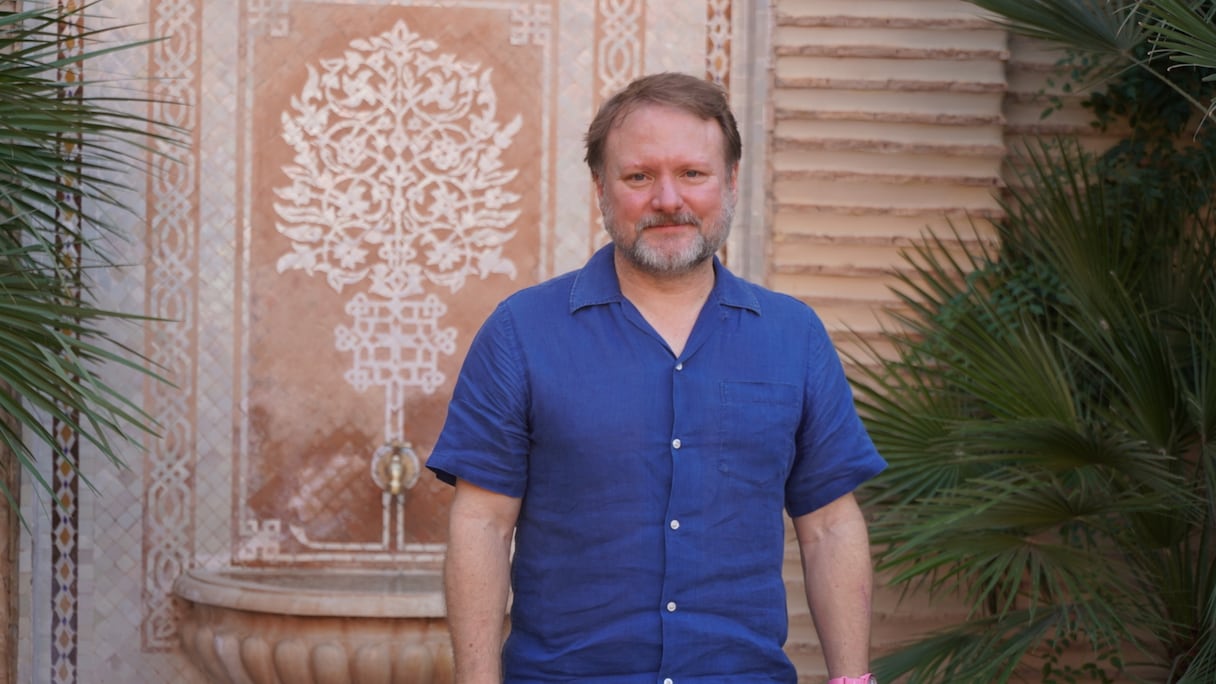
From Star Wars: The Last Jedi to the Knives Out franchise, by way of Looper and Brick, Rian Johnson has explored a diverse range of cinematic worlds. While attending the Marrakech International Film Festival, the American director and screenwriter shares his vision of cinema, the driving forces behind his creative process and the avenues available to a new generation of filmmakers looking to get their work seen. He also offers his thoughts on The Only Living Pickpocket in New York, directed by Noah Segan and starring John Turturro.
Le360: You’ve attended some of the world’s most prestigious film festivals. What, in your view, sets the Marrakech Film Festival apart? And what surprised you most?
Rian Johnson: Well, besides the city itself and the beauty of it, one thing that I love about this festival is that it’s free to the public, that both the talks and the screenings, they don’t charge people to come to see them.
That, to me, is incredible because that also means it’s a festival for the people to come and experience these movies and these conversations with these artists.
And that’s very, very rare in the world of festivals. Usually, you have to buy passes or you have to line up and buy tickets. So that, to me, was pretty extraordinary to hear.
During your session with the audience as part of the Conversations program, which question surprised you the most?
There were really good questions. When I did this conversation, I loved that the audience was mostly students. It felt like there were a lot of young students in the audience, and I’m always curious to see what they ask.
I mean, it didn’t surprise me, but one young woman asked about whether festivals were still a good route for young filmmakers to go through in trying to get their movies out.
And we talked a little bit about how festivals are still one possibility, but there’s also now YouTube, and there are now also ways of getting your movie out online. So it was a really good conversation.
«Story to story, you have to find what that thing is and really stay true to it.»
— Rian Johnson, filmmaker
You explore very different worlds, from Star Wars to murder mysteries. When you move from one world to another, what’s the one thing you’re never willing to compromise on?
Well, the common thread is you figure out what it is that you care about in the story, what moves you about it and what it’s really about.
And in that way, the genre may change, but it’s a little bit like changing clothes. The person underneath is the stuff that you really care about in telling the story.
«Crime is exciting. Crime is kind of like thrilling, and it gives you an automatic conflict, and it gives you characters who are on the edge of society, who want things»
— Rian Johnson, filmmaker
And that’s what you always have to focus on. Story to story, you have to find what that thing is and really stay true to it. As long as you don’t compromise that, that’s the essence of it.
Where does your fascination with crime stories and mysteries come from?
I don’t know. I hope I’m not a secret criminal! I just grew up reading too much crime fiction.
But also, crime is exciting. Crime is kind of like thrilling, and it gives you an automatic conflict, and it gives you characters who are on the edge of society, who want things.
I don’t know. Not in real life, but in movies, I love crime.
Do you ever worry that surprising audiences has become something they’ve come to expect from you?
Oh, I don’t really know what expectations are. For me, at least, I don’t think I have a personal style or something I do over and over. To me, I just kind of approach each movie and try and make it the best I can.
So that’s the nice thing about that. I feel like people aren’t really thinking of me like, “I expect this or that from one of my movies.” They’re just, I hope, going in wanting a good time.
The Only Living Pickpocket in New York, which screened at the Marrakech International Film Festival, has received overwhelmingly positive reviews, particularly for John Turturro’s performance. Some critics, however, feel that the final act becomes too conventional. What do you make of that?
I don’t know. I feel like everyone’s always going to have opinions. Me personally, I love the final act.
I think Noah did a great job with it. It weaves together all the things, and there are plot things that have to come together, but I think it does it quite elegantly.
I can say this because it’s not my film: I disagree with that criticism.