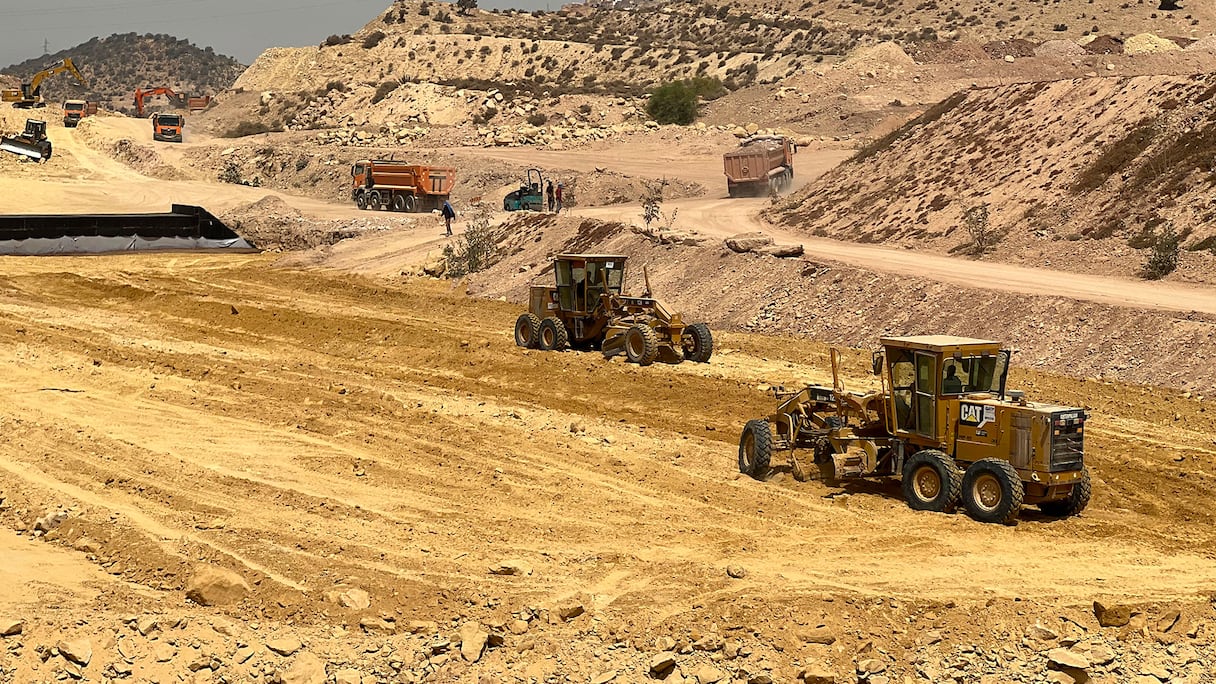
Heavy machinery is now operating at full capacity on the construction site. Following earthworks, hydraulic infrastructure, and initial civil engineering, the third section of the bypass is steadily taking shape. Once completed, the road is expected to ease traffic congestion, improve mobility, and support Grand Agadir’s urban and economic development.
The 5.2-kilometer section will connect several of the city’s main roads and complete the first two sections already open to traffic, which notably provide access to Agadir Al Massira Airport. The project is one of the flagship components of Agadir’s 2020-2024 Urban Development Program, launched before King Mohammed VI at Al Amal Square on February 4, 2020.
The project is financed through a partnership involving the Ministry of the Interior, the Ministry of Equipment and Water, the Ministry of Industry and Trade, the Souss-Massa Regional Council, and the Municipality of Agadir. The third and fourth sections represent a combined investment of MAD 650 million, covering construction works, technical studies, supervision services, land acquisition, and related operations.
“This project is part of Agadir’s Urban Development Program, which includes several major projects aimed at strengthening the city’s infrastructure and that of the surrounding region,” said Mohammed El Aouni, provincial director of the Ministry of Equipment and Water in Agadir-Ida-Ou-Tanane.
“It builds on ongoing efforts to modernize the road network and improve mobility across Grand Agadir,” he added.
According to El Aouni, the works have now exceeded 30% completion, with an investment of nearly MAD 180 million. The project has mobilized significant human and technical resources, including more than 1.4 million cubic meters of excavation and embankment works, nearly 1,000 linear meters of hydraulic structures, and around 1.2 million kilograms of steel for reinforced concrete structures.
The project also includes the construction of an overpass at the Abaraz roundabout in the Hay Mohammadi district, which is expected to become a key traffic junction within the metropolitan area.
“This third section provides continuity with the first two stretches already open to traffic, which currently connect Agadir Al Massira Airport to Grand Agadir’s road network,” El Aouni said. “The fourth section is also planned, and construction will begin shortly.”
Beyond expanding the road network, the new infrastructure is expected to address traffic congestion affecting the metropolitan area, particularly in the city center. It will allow heavy goods vehicles to bypass densely urbanized districts, easing congestion and improving traffic flow.
“This infrastructure will transform mobility across Grand Agadir, which includes Agadir, Dcheira El Jihadia, Inezgane, Aït Melloul, Lqliâa, and Drarga,” El Aouni said.
“Heavy trucks will be able to use this route without passing through the city center, while light vehicles will benefit from smoother access to northern municipalities, including Anza, Aourir, Taghazout, Aghroud, Imsouane, and Essaouira.”
The project is also generating significant economic activity. Companies involved in the construction have created jobs for local workers, while residents continue to closely monitor the progress of the works.
For Abderrahim Boutkhriz, a resident of Hay Mohammadi, the bypass will play a major role in the area’s development.
“We are pleased to see the project moving forward. It will open up access to several districts of Agadir as well as neighboring municipalities, particularly Drarga and Aït Melloul,” he said.
“It will also strengthen the connection between Agadir and Taghazout, two major tourist destinations that welcome growing numbers of Moroccan and international visitors every year.”
Local civil society organizations share the same view. “Civil society stakeholders welcome the efforts made by all the project’s partners, as well as the close supervision provided by Souss-Massa Regional Governor Saïd Amzazi,” Boutkhriz added.
Through the construction of the new bypass, Agadir is continuing to modernize its infrastructure to strengthen its attractiveness, improve residents’ quality of life, and prepare for major international events, including the 2030 FIFA World Cup.