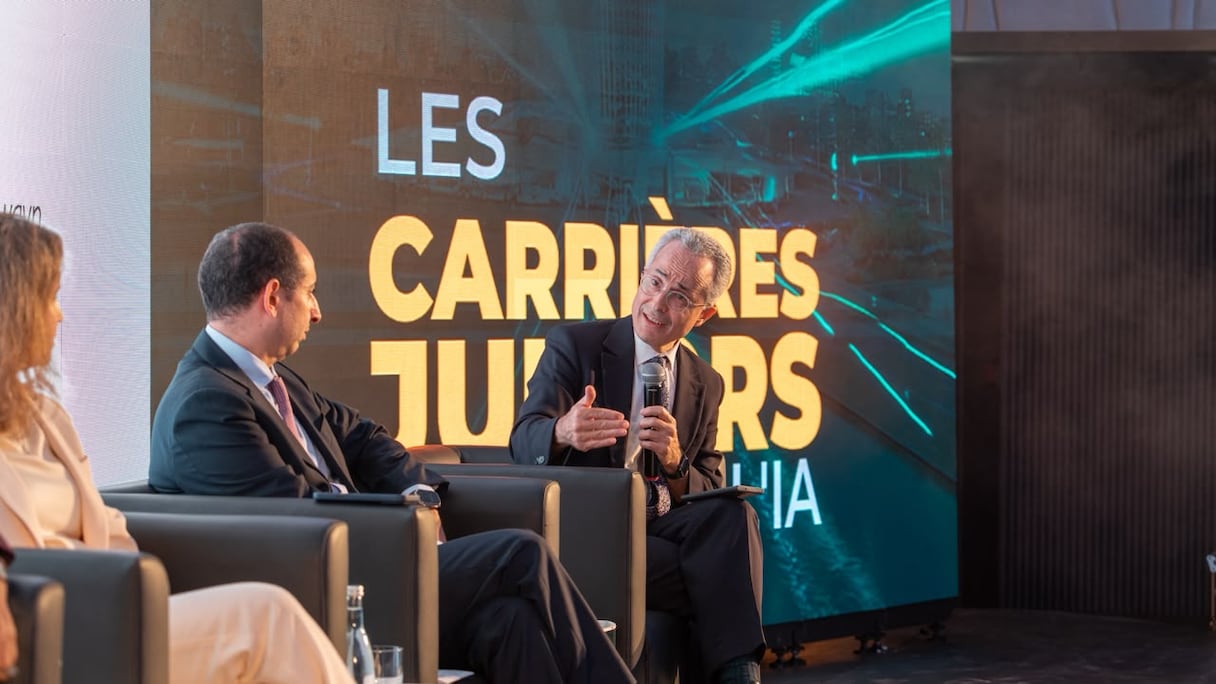
Participants at Al Akhawayn University’s Intelligence Forum delivered what they described as an encouraging message: unlike in countries where artificial intelligence has been adopted more rapidly by businesses, AI has not yet reduced employment opportunities for young graduates in Morocco. Instead, it is primarily changing the tasks assigned to new recruits.
The event, held on July 14 at Mohammed VI Tower in Rabat, brought together Higher Education Minister Azzedine El Midaoui, CGEM President Mehdi Tazi, business executives and academics to discuss how employers, universities and policymakers can work together to prepare young talent for an AI-driven economy.
Speakers noted that this window of opportunity may narrow as Moroccan companies accelerate AI adoption to improve their competitiveness. Their vision is that graduates equipped with strong human, relational and AI-enhanced skills will generate greater added value, supporting economic growth and job creation. Strengthening collaboration between universities and businesses was therefore identified as a key priority.
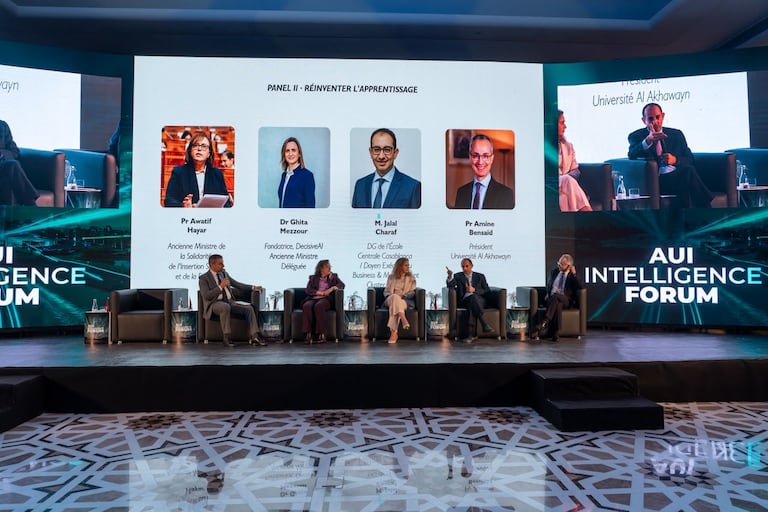
The forum featured Azzedine El Midaoui, Minister of Higher Education, Scientific Research and Innovation; Mehdi Tazi, President of the CGEM; Mohamed Horani, Founder and CEO of HPS; Wafaa Asri, Secretary General of the Department of Vocational Training; Awatef Hayar, professor and former minister; Ghita Mezzour, Founder and CEO of DecisiveAI and former Minister Delegate for Digital Transition; Jalal Charaf, Director General of Centrale Casablanca and Executive Dean at Mohammed VI Polytechnic University; and Amine Bensaid, President of Al Akhawayn University.
AI is changing work, not replacing workers
“As a business leader, I do not yet see AI replacing people, neither in my companies nor in those of my colleagues,” Mehdi Tazi said, adding that more than 90% of jobs are not directly affected today.
Wafaa Asri echoed that assessment, citing international studies by the OECD and the World Economic Forum showing that AI primarily transforms specific tasks within occupations, particularly those assigned to entry-level employees, rather than eliminating entire professions.
The transformation is already underway, however.
“AI is irreversible,” said Mohamed Horani, explaining that HPS has integrated the technology into both its internal operations and its products. Companies are adopting AI to remain competitive and increasingly expect graduates to arrive with AI skills. Capgemini, he noted, now classifies candidates according to three levels of AI proficiency: “AI Aware, AI Ready, AI Native,” with the ability to critically engage with AI becoming a hiring criterion.
According to participants, Morocco currently enjoys an important advantage: time.
That advantage could diminish as companies accelerate AI adoption. In economies where AI has been implemented more rapidly, the labor market integration of recent graduates has worsened. International studies cited during the forum indicate that between 33% and 48% of recent U.S. graduates remain unemployed, even as 53% of companies report difficulty finding AI-related skills.
Read also : Morocco breaks into the global Top 20 for AI-ready outsourcing
With AI adoption still at an intermediate stage, an average period of 33 months before graduates secure their first job, and one in four young graduates unemployed, Morocco still has the opportunity to shape its own trajectory.
“Both scenarios can coexist. Everything will depend on the choices we make today,” Wafaa Asri said.
Amine Bensaid explained that the university chose to act rather than wait for the impact of AI to unfold.
“We were not prepared to simply wait and observe what would happen. We decided to act,” he said, adding that “this is the right moment, and it is certainly not too late” for employers, universities and public decision-makers to work together.
Higher Education Minister Azzedine El Midaoui called on universities to become “creators of wealth.”
Rather than focusing solely on protecting existing jobs, participants envisioned a generation of graduates whose capabilities are enhanced by AI.
“We are not talking about replacement; we are talking about becoming better versions of ourselves with AI,” Mehdi Tazi said.
Awatef Hayar highlighted AI’s potential to promote inclusion, saying the technology could enable rural craftswomen to access international markets in their own language.
Jalal Charaf added that Mohammed VI Polytechnic University is now training graduates capable of orchestrating AI agents that significantly expand their productivity.
Four ways to make AI a driver of employability
Throughout the discussions, participants identified four priorities for integrating AI into higher education and the labor market.
The first is skills development. Speakers advocated equipping students with critical thinking, adaptability, interpersonal intelligence and the ability to work with AI agents, while integrating AI across all academic disciplines.
Minister El Midaoui noted that Morocco already offers more than 80 engineering and master’s programs specializing in artificial intelligence.
“Our role is to educate well-rounded minds capable of adapting to every situation,” he said.
The second priority is making companies genuine learning environments. Participants called for stronger co-design of academic programs between universities and employers, greater expansion of work-study schemes and the development of in-house academies.
“We no longer look at the answers students give; we look at the questions they ask,” Jalal Charaf said.
Data governance emerged as another strategic priority.
“Data is the fuel of AI,” Mohamed Horani said, calling for an ambitious national strategy to harness data and strengthen Morocco’s digital sovereignty in order to avoid dependence on a single provider.
Read also : Cybersecurity maturity in Morocco rises from 49% to 56% in a year
Finally, speakers emphasized the central role of schools. They stressed the importance of strengthening foundational learning before introducing AI into educational pathways, while encouraging students to develop a critical understanding of digital platforms.
AI was also presented as a potential tool for reducing inequalities, particularly through personalized educational support.
Closing the forum, Amine Bensaid defended an optimistic vision of AI’s role in Morocco’s future.
“There is real hope: AI-enhanced talent can generate added value that becomes a driver of growth and job creation in Morocco. That is precisely the purpose of new forms of collaboration between employers and universities: making AI a catalyst for young people’s employability rather than a threat,” he said.
He concluded by adding, “We have no choice but to build this bridge while walking across it.”
Al Akhawayn University says it is already seeing the first results of this approach. After three years of training its faculty, the university has made AI use mandatory across all its courses. According to the institution, 88% of its graduates receive a job offer before completing their studies, while students enrolled in work-study programs receive three to four times more job offers.
The university also announced that it will soon publish a policy brief containing recommendations from the inaugural Intelligence Forum, which is intended to become a recurring institutional event.
