Morocco’s automotive industry has been a major driver of export growth over the past decade. The country’s total exports more than doubled from MAD 218 billion in 2015 to MAD 470 billion in 2025, an increase of 115.6%, according to the latest annual foreign trade report published by the Foreign Exchange Office.
Over the same period, automotive exports surged 191.3%, reaching MAD 159.2 billion, up from MAD 54.7 billion a decade earlier. The industry generated an additional MAD 104.6 billion in export revenue, accounting for 41.5% of Morocco’s overall export growth during the decade.
That expansion has significantly reshaped the country’s export profile. The automotive sector’s share of total exports rose from 25.1% in 2015 to 33.9% in 2025, a gain of 8.8 percentage points. By the end of August 2026, its share had reached 34.68%, with automotive exports rising 14.5% to MAD 116.14 billion.
Read also : Morocco’s automotive exports reach MAD 93.65 Billion
The industry now leads Morocco’s major export sectors. Phosphates and derivatives ranked second in 2025, generating MAD 99.8 billion, followed by agriculture and food processing at MAD 86.83 billion. The automotive industry’s growing dominance reflects the expansion of a manufacturing base built around vehicle manufacturers, component suppliers and an increasingly diverse range of production activities.
Automotive exports by segment, in MAD million (Source: Office des Changes)
| Segment | 2015 | 2017 | 2019 | 2022 | 2025 |
|---|---|---|---|---|---|
| Vehicle manufacturing | 24,679 | 31,575 | 33,899 | 55,149 | 61,389 |
| Wiring | 23,095 | 26,524 | 34,931 | 38,565 | 60,464 |
| Powertrain | 620 | 1,269 | 2,607 | 9,086 | 12,332 |
| Total automotive | 54,664 | 67,740 | 81,565 | 116,656 | 159,228 |
A look at the past decade shows that automotive exports grew steadily between 2015 and 2019 before falling in 2020. The industry rebounded in 2021 and maintained strong growth in 2022. Expansion accelerated in 2023, when automotive exports jumped 28.3% to MAD 149.7 billion, while Morocco’s overall exports edged up just 0.37%. The sector’s share of national exports consequently leapt from 27.2% in 2022 to 34.8% in 2023, before reaching 35% in 2024.
Growth stalled in 2025, however, with automotive exports slipping 0.2% to MAD 159.2 billion even as Morocco’s total exports rose 3%. The slight decline did little to diminish the industry’s transformation over the decade. Figures through August 2026 point to a recovery, driven particularly by vehicle manufacturing, wiring and exterior components, including bodywork and trim parts.
Africa’s leading vehicle producer
The automotive industry’s growing share of exports has gone hand in hand with a sharp increase in Morocco’s manufacturing capacity. In 2024, Morocco overtook South Africa to become the continent’s largest vehicle producer for the first time, manufacturing nearly 614,000 vehicles against approximately 591,000 in South Africa, according to Fitch Solutions.
The shift reflects an industrial strategy pursued over more than 15 years. Morocco’s automotive ecosystem centres on two major manufacturers: Renault, with operations in Casablanca and Tangier, and Stellantis, based in Kenitra. Around them, a network of specialized suppliers produces wiring systems, mechanical components, engines and interior equipment.
Expansion plans by both manufacturers, alongside projects linked to vehicle electrification, offer further scope for growth. Morocco now has installed capacity to produce around one million vehicles annually, supported by an industrial base spanning vehicle assembly, mechanical components, wiring and interior systems.
South Africa’s automotive industry, by contrast, faces logistics bottlenecks, particularly at ports and in rail freight, as well as growing imports. These pressures weigh on the competitiveness of its manufacturing sector, while Morocco continues to expand production capacity and deepen its integration into international supply chains.
Morocco’s lead is also evident in vehicle exports. In 2025, the Kingdom exported 454,443 vehicles, compared with South Africa’s 414,271. The two countries remain Africa’s leading vehicle exporters, accounting for 52.31% and 47.69%, respectively, of their combined export volumes.
Morocco exports 90.53% of the vehicles it produces, compared with 67.02% for South Africa. The difference highlights the Moroccan industry’s strong export orientation, particularly towards Europe, which accounts for around 80% of the country’s vehicle shipments.
Exports reach more than 70 countries
Moroccan-made vehicles are sold in more than 70 countries. Models produced locally include the Dacia Sandero and Logan, Renault Kardian and Peugeot 208, as well as the Citroën Ami and Opel Rocks-e small electric vehicles. This diverse product range is supported by an industrial network combining vehicle manufacturing with component production.
Read also : Automotive industry: ‘Made in Europe’ opens a new strategic chapter in Morocco-EU talks
Proximity to the European Union is a major advantage. Morocco’s free trade agreements with numerous partners and its logistics infrastructure also make the country attractive to carmakers and component suppliers. Together, these factors make it easier to reach international markets and coordinate manufacturing and shipping operations.
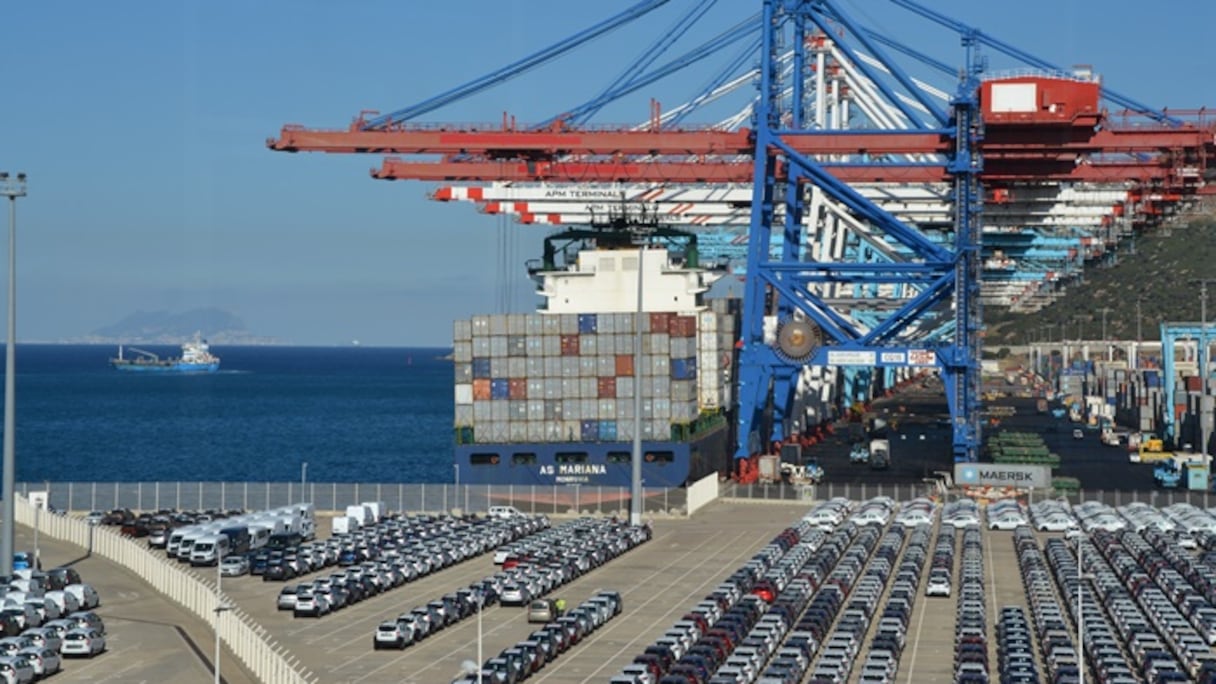
Tanger Med port plays a central role in this network. In 2025, its two vehicle terminals handled 327,569 Renault vehicles and 126,874 Stellantis vehicles, underscoring the port’s importance in moving Moroccan-made cars to international markets.
Morocco’s automotive industry also benefits from investment incentives and a stable industrial environment. Expanding electric vehicle production capacity is another strategic priority as manufacturers accelerate the transition of their model ranges.
Vehicle manufacturing and wiring have been particularly important to the industry’s growth. Between 2015 and 2025, vehicle manufacturing exports rose 148.7% to MAD 61.4 billion, while wiring exports increased 161.8% to MAD 60.5 billion. By the end of August 2026, vehicle manufacturing exports had grown 19% to MAD 44.74 billion, while wiring exports were up 13.9% to MAD 44.77 billion.
Powertrain manufacturing has also become an increasingly significant part of the industry. Exports in this segment rose from MAD 620 million in 2015 to MAD 12.3 billion in 2025, an almost twentyfold increase. Meanwhile, exports of exterior components jumped 43.6% to MAD 3.76 billion in the first eight months of 2026.
Read also : Tangier secures new $66 million investment from China’s Jiangsu Yunyi Electric
France remains Morocco’s largest customer
Europe dominates the destination markets for Moroccan automotive exports. In 2025, France retained its position as the largest market for Moroccan-made passenger cars, with exports worth MAD 16.54 billion, accounting for 28% of the total.
Moroccan passenger car exports by destination, in MAD million (Source: Office des Changes)
| Country | 2023 | 2024 | 2025 | Share |
|---|---|---|---|---|
| France | 20,537 | 19,058 | 16,543 | 28% |
| Italy | 10,172 | 12,668 | 8,574 | 14.5% |
| Spain | 7,110 | 6,818 | 6,785 | 11.5% |
| Germany | 3,929 | 6,068 | 5,233 | 8.9% |
| Turkey | 5,505 | 3,554 | 3,732 | 6.3% |
| Other countries | 17,524 | 19,832 | 18,247 | 30.9% |
| Total | 64,777 | 67,998 | 59,113 | 100% |
Italy ranked second with 14.5% of exports, followed by Spain at 11.5%. Germany took fourth place with 8.9%, while Turkey rounded out the top five with 6.3%.
These five markets illustrate the importance of European demand for Moroccan-made passenger cars. Geographic proximity, established logistics networks and the integration of carmakers and component suppliers into international value chains all help sustain these trade flows.
The growth of automotive exports is helping Morocco broaden its overseas markets while increasing manufacturing’s contribution to foreign trade. With installed capacity of around one million vehicles and a 34.68% share of national exports as of August 2026, the automotive industry has become a cornerstone of the Kingdom’s external trade.
