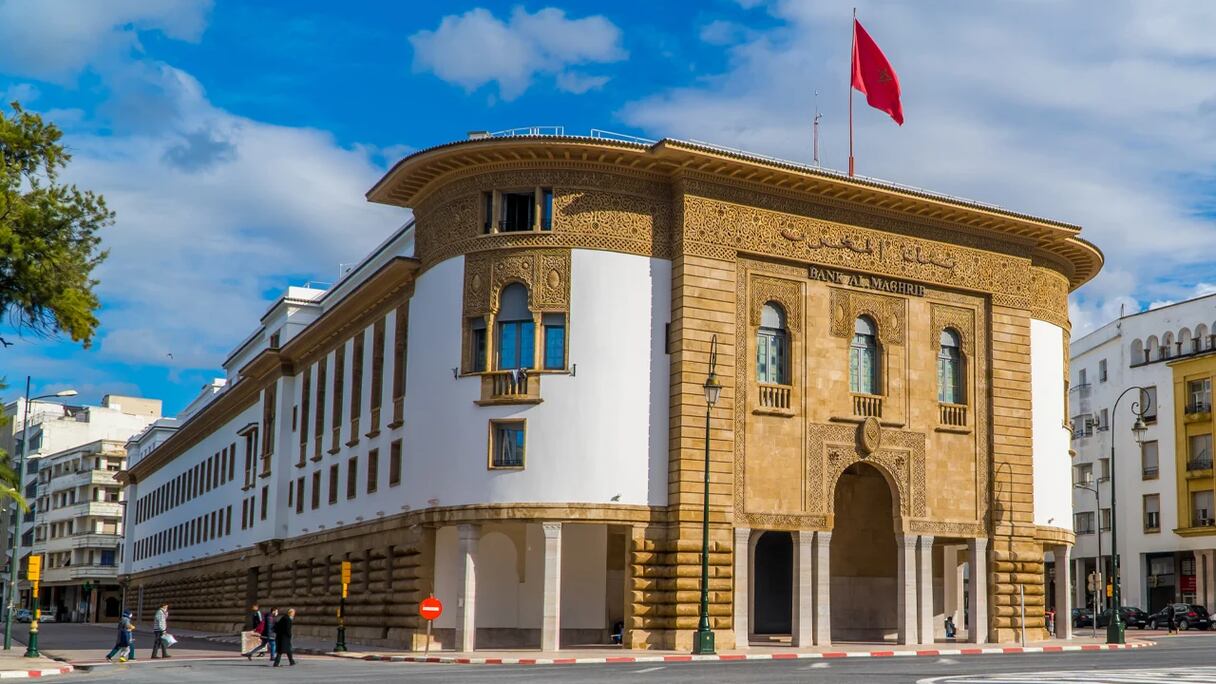
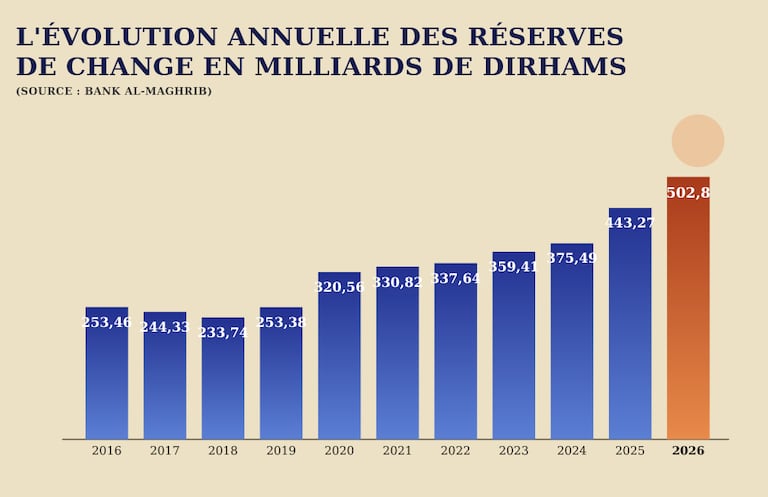
Morocco’s official foreign exchange reserves are expected to continue rising despite a projected widening of the trade deficit. According to the latest forecasts from Bank Al-Maghrib (BAM), reserves are expected to reach MAD 502.8 billion by the end of 2026, equivalent to more than $55.65 billion, before climbing to MAD 515.3 billion, or more than $57 billion, at the end of 2027. That level would cover five and a half months of imports of goods and services. As of the end of July 2026, official reserve assets stood at MAD 497.98 billion, up 22.7% year on year, according to BAM.
The increase comes as Morocco’s external trade remains under pressure, with the current account deficit expected to widen in 2026. It is projected to rise from 2.4% of GDP in 2025 to 4.6% this year before narrowing to 3% in 2027, according to the central bank. The deterioration is partly due to higher petroleum product prices and the rising cost of some inputs, as well as continued investment spending that is driving up imports of capital goods.
Services help cushion the trade deficit
The energy import bill is expected to rise 28.4% in 2026 to MAD 138.1 billion before falling back to MAD 116 billion in 2027, according to the same forecasts. Imports of raw products are expected to increase by 53.4% this year, followed by an 8.3% rise in 2027.
Data available through the end of July 2026 already show the pressure on external trade. Morocco’s trade deficit widened to MAD 244.69 billion, up 26.5% year on year, as imports grew twice as fast as exports. The import coverage ratio consequently fell to 55%, from 58.8% at the end of July 2025.
Morocco’s goods imports exceeded MAD 544 billion, up nearly 16%. Imports of finished capital goods rose 20.8% to MAD 133.20 billion, while the energy bill increased 29.1% to MAD 81.20 billion. Imports of raw products rose 52.2% to MAD 36.94 billion.
Imports of capital goods are expected to remain high throughout the year. Bank Al-Maghrib forecasts growth of 15.6% in 2026 and 8.8% in 2027, bringing the total to MAD 250.7 billion.
Merchandise exports are also increasing, but at a slower pace. They stood at MAD 299.35 billion at the end of July 2026, up 8.4%.
Read also : New land tax rates swell municipal coffers, bills climb for some owners
The automotive industry remains Morocco’s leading export sector, generating MAD 107.15 billion, up 14.9%, driven by vehicle assembly and wiring. Aerospace exports also rose 19.7% to MAD 20.57 billion.
Phosphates and derivatives, meanwhile, were a weak point during the first seven months of the year. Exports fell 7.8% to MAD 50.95 billion, mainly due to a decline in natural and chemical fertilizers.
Figures from the Office des Changes show that services exports are playing an important role in balancing Morocco’s external trade. They reached MAD 193.38 billion at the end of July, up 13.1%, compared with MAD 97.90 billion in services imports, which rose 12.9%. The resulting services surplus stood at MAD 95.48 billion, up from MAD 84.34 billion a year earlier.
Tourism and remittances provide support
Travel revenues, the largest component of the services surplus, reached MAD 79.01 billion, up 13.4%. With travel spending at MAD 19.92 billion, the travel balance posted a surplus of MAD 59.09 billion, up 15.7%.
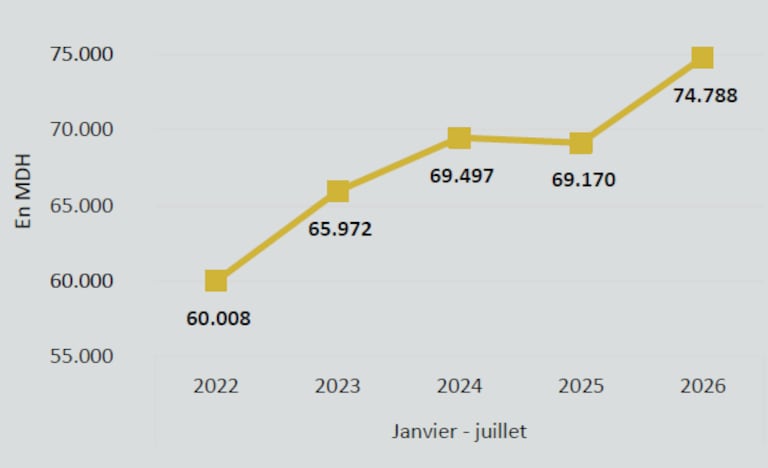
Remittances from Moroccans living abroad are another major source of foreign currency. These transfers reached MAD 74.79 billion by the end of July 2026, up 8.1%.
Foreign direct investment (FDI) revenues also increased, rising 6.3% to MAD 39.11 billion, while outflows fell 47% to MAD 9.64 billion. Net FDI therefore reached MAD 29.47 billion, compared with MAD 18.59 billion at the end of July 2025.
Moroccan direct investment abroad also increased. Inflows reached MAD 10.16 billion, up 22.2%, while outflows rose 53.7% to MAD 17.03 billion. The net flow stood at MAD 6.87 billion.
For the full year 2026, Bank Al-Maghrib also expects FDI inflows to reach an annual flow equivalent to 3.5% of GDP. These inflows will be supplemented by the government’s planned external financing.
Bank Al-Maghrib’s projections therefore rely on several sources of foreign currency. The widening current account deficit, driven in part by the energy bill and investment-related imports, is expected to be offset by services revenues, remittances from Moroccans living abroad, FDI and external financing.
Read also : Bank Al-Maghrib seen holding the line at 2.25%
Exports are also expected to provide additional support, notably as the automotive sector recovers after remaining almost unchanged in 2025. Automotive exports are projected to reach MAD 202.2 billion in 2027.
BAM also expects tourism revenues to continue growing, reaching MAD 160 billion in 2027, while remittances from Moroccans living abroad are projected to consolidate at MAD 136.3 billion that year.
The increase in foreign exchange reserves therefore reflects a mixed external picture: the merchandise trade deficit is widening, but services surpluses, remittances, net FDI flows and external financing are helping sustain foreign currency inflows.
Bank Al-Maghrib’s projections indicate that, despite a temporary deterioration in the current account, Morocco’s foreign exchange reserves should continue to rise over the next two years.