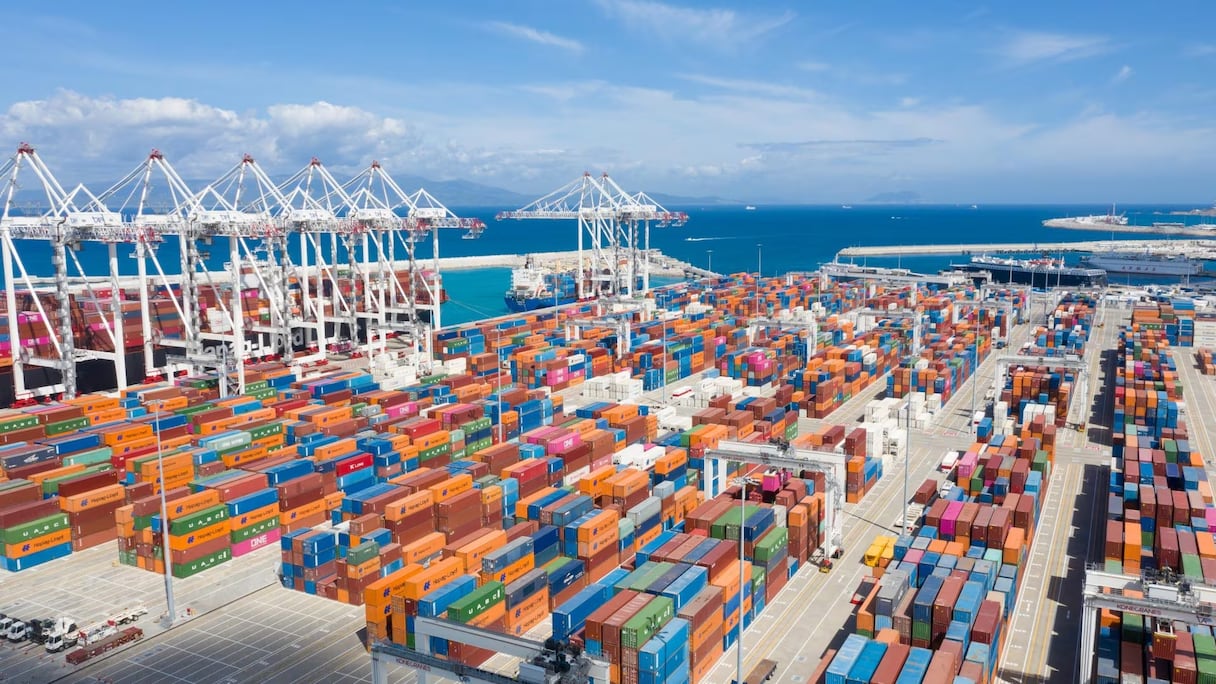
Morocco’s trade deficit widened significantly in the first half of the year, reaching 198.38 billion dirhams at the end of June 2026, compared with 160.58 billion dirhams a year earlier, an increase of 23.5%, according to the latest data from the Office des Changes on foreign trade.
The increase was driven by imports growing much faster than exports, against a backdrop of stronger domestic demand, a recovery in investment, and a higher energy bill. Imports reached 458.77 billion dirhams at the end of June, up 15.3%, while exports stood at 260.39 billion dirhams, an increase of 9.7%.
The gap between the two rates of growth pushed the export-to-import coverage ratio down by 2.8 percentage points to 56.8%, from 59.6% a year earlier. This is its lowest level since 2018. However, the indicator reflects a more nuanced reality: the widening deficit is not only the result of weak exports. It also reflects a Moroccan economy whose import needs are expanding, not only for consumer goods but also for capital goods.
Imports of finished capital goods rose by 21.2% to 112.34 billion dirhams in the first six months of the year. The sharp increase largely reflects stronger economic activity and investment. Purchases of utility vehicles rose by 73.7%, while imports of aircraft parts and other air vehicles increased by 29.7%. Aircraft and other air or space vehicles recorded an even sharper increase of 136.26% year on year.
Read also : Moroccan textile industry faces warning of economic and social crisis by 2050
This acceleration should therefore be interpreted with caution, as the trade deficit cannot be assessed independently of the type of imports behind it, a Moroccan industrialist told Le360. An imported machine or utility vehicle increases the trade deficit when it is purchased, but it can also help expand the country’s production, transport or export capacity, he explained.
However, he added that Morocco will eventually need to place greater emphasis on local production of finished capital goods, particularly as demand in this area is expected to continue growing with the development of major projects in infrastructure, industry and other key sectors.
The impact of higher oil prices
Office des Changes data also show that the energy bill is weighing heavily on the trade balance. Imports of energy and lubricants rose by 28.9% to 68.58 billion dirhams at the end of June, mainly due to higher purchases of gasoil and fuel oil.
The increase comes against a particularly volatile international backdrop, including the conflict in the Middle East, which caused major disruptions in energy markets in 2026 and led to several periods of sharp increases in oil prices. Brent crude exceeded $100 a barrel in July after already recording a significant increase in the spring.
For Morocco, where energy dependence remains high, these pressures have a direct impact on the energy bill. Higher oil and fuel prices increase the cost of gasoil and fuel oil imports.
The energy component also highlights the different factors driving the deficit. Unlike capital goods, whose imports can help strengthen the country’s productive capacity, imported energy mainly meets the economy’s current needs. Higher oil prices therefore represent an external shock that directly worsens the trade balance without, on its own, creating new productive capacity, the industrialist said.
Imports of finished consumer goods are also on the rise, exceeding 111 billion dirhams, up 14.2%. They were driven in particular by passenger vehicle purchases, which increased by 18.1%, parts and components for passenger vehicles, up 26.4%, and medicines and other pharmaceutical products, up 15.4%.
The trend points to relatively strong domestic demand. However, it also shows that a significant share of this demand is being met by foreign suppliers. In other words, growth in consumption and investment is not fully translating into demand for domestic production.
The 37.7% increase in imports of raw products, particularly crude and unrefined sulphur, adds further pressure. It also shows that Morocco’s own productive system remains dependent on certain imported raw materials.
Read also : Morocco’s automotive exports reach MAD 93.65 Billion
Automotive and aerospace sectors support exports
Despite the rise in imports, exports also recorded significant growth. The automotive sector remained the main driver, with exports reaching 93.65 billion dirhams, up 17.4%. Growth was recorded across the construction, wiring, and vehicle exterior segments.
The aerospace sector also performed strongly, with exports reaching 17.32 billion dirhams in the first half of the year, up 19.3%, driven by assembly and the Electrical Wiring Interconnection System (EWIS) segment.
These results confirm the growing importance of Morocco’s industrial ecosystems, which have been developed over the past several years. They also show that efforts to diversify the export base are producing tangible results, with industrial sectors recording growth rates above that of overall exports. However, this momentum remains insufficient to offset the faster increase in imports, particularly as exports remain concentrated in a limited number of sectors.
Agriculture and agri-food exports rose by 5.7% to 52.38 billion dirhams, driven in particular by the food industry. Phosphates and derivatives, however, declined by 2.3% to 45.42 billion dirhams. Sales of phosphates and natural and chemical fertilisers fell, while phosphoric acid exports increased. The trend limits the contribution of a sector that has historically been an important source of Morocco’s export revenues.
Textiles and leather also remained on a downward trend, falling by 6.5% to 21.6 billion dirhams at the end of June, with declines in sales of finished garments, knitwear and footwear. Electronics and electrical products also fell by 4.4% to 6.62 billion dirhams, including a 12.4% decline in electronic components.
The contrast is therefore clear between relatively newer industrial sectors that are strongly integrated into global value chains, such as automotive and aerospace, and sectors that are more exposed to international cost competition.
The challenge is to turn imports into an export driver
The decline in the coverage ratio to 56.8% highlights the gap between the pace of import and export growth. However, the imbalance should be viewed in the context of the structure of imports, as the sharp increase in capital goods also reflects a period of investment and efforts to strengthen productive capacity, the industrialist said.
By the end of June 2026, Morocco’s imports had therefore grown much faster than its exports. Automotive and aerospace exports are expanding, but their performance has not offset the increase in energy, capital goods, consumer goods and raw material imports.
The key challenge for Morocco now will be to turn the increase in imports, particularly those linked to investment, into additional productive and export capacity, he concluded.
