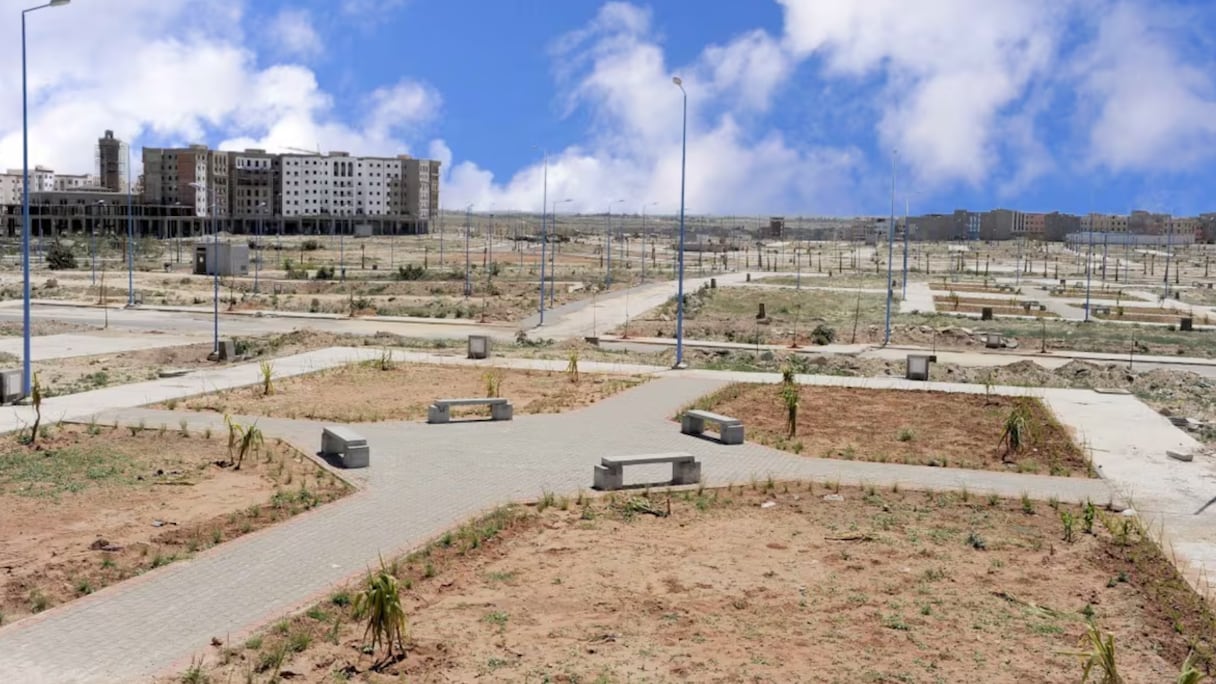
The reform of the undeveloped land tax (TNB) is starting to generate substantial revenues for municipalities. During the first seven months of 2026, the tax brought in 2.81 billion dirhams, 48.9% more than a year earlier. With this amount already collected, TNB revenues have surpassed the full-year forecast of 2.55 billion dirhams, reaching 110% of the 2026 target.
The sharp increase in revenue by the end of July 2026 offers an early indication of the reform’s financial impact. The increase coincides with the rollout, since January 2026, of the new calculation method introduced by a law adopted in 2025 in municipalities that have already switched to the new system.
For local authorities, TNB is therefore becoming a rapidly growing source of revenue. For owners of undeveloped land, however, the change can mean a significantly higher tax bill depending on the location of the property and, above all, the level of infrastructure serving it.
That is the main change introduced by the reform. The tax amount no longer depends solely on the administrative classification of an area. It is now more closely tied to the infrastructure and services available around the land, including roads, drinking water, electricity, sewage systems, public lighting and various public services.
Read also : Tax clock ticks to October 1 for companies and professionals
The logic is straightforward: the better equipped the area, the higher the applicable rate. Conversely, land in poorly serviced areas can qualify for a significantly lower rate.
Before the reform, rates were based mainly on the theoretical zoning set out in urban planning documents, depending on whether the land was located in an area designated for apartment buildings, villas or individual homes.
In Casablanca, for example, the former rates reached 20 dirhams per square meter in apartment-building zones and 12 dirhams per square meter in villa and individual-housing areas. More broadly, rates in apartment-building zones ranged from 4 to 20 dirhams per square meter, compared with 2 to 12 dirhams for villa, individual-housing and other areas.
The system could, however, lead to situations that were difficult for taxpayers to understand. Two plots with the same administrative classification could have very different levels of infrastructure. This gap between a plot’s theoretical classification and its actual situation is what Law No. 14-25 of June 12, 2025, seeks to address.
How much can a landowner pay?
A circular issued by the Interior Ministry on August 5, 2025, sets out the new rules for applying the tax. Land is now classified according to its actual level of infrastructure and the services available in the surrounding area.
Three categories have been established. In well-serviced areas, the rate ranges from 15 to 30 dirhams per square meter. In moderately serviced areas, it ranges from 5 to 15 dirhams. In poorly serviced areas, it can fall to between 0.5 and 2 dirhams per square meter.
The difference can therefore be substantial. For a 1,000-square-meter plot, a rate of 10 dirhams per square meter means an annual tax of 10,000 dirhams. If the same plot is classified as being in a well-serviced area with a rate of 25 dirhams per square meter, the annual bill rises to 25,000 dirhams. On a one-hectare plot, the tax can reach 300,000 dirhams a year in the best-serviced areas.
For landowners, the level of infrastructure has therefore become a key factor in determining the tax bill. For municipalities, the new rate structure could, in turn, strengthen revenues from land located in urban areas with better infrastructure.
Read also : Morocco’s tax authority simplifies transport tax incentives with new guide
The increase in revenue does not mean that the new system is being applied everywhere. The reform provides for a gradual rollout. Each municipality must first map its public infrastructure and classify its various areas. The decision by the municipal council president must then be approved by the governor or wali before the municipal council adopts the tax order setting the rates. The new rates only take effect on January 1 of the year following approval of the order.
As a result, in 2026, some landowners may still be subject to the old system, while others are already covered by the new rate structure. Cities such as Casablanca and Marrakech, for example, have announced new rates in line with Law No. 14-25 starting January 1, 2026.
To speed up the transition, Interior Minister Abdelouafi Laftit sent a circular to governors and walis on October 6, 2025, calling for the rapid implementation of the new system.
Who has to pay the tax?
The TNB applies to undeveloped urban land located within the boundaries of urban municipalities and designated centers covered by an urban planning document. It also applies to certain plots associated with buildings when their area exceeds five times the surface area occupied by existing structures.
The tax is payable by the landowner or, if the owner is unknown, by the person in possession of the land. However, certain situations qualify for an exemption. These include undeveloped land used for professional or agricultural activities, which is exempt up to five times the area actually being used.
Some land is also exempt from TNB. This includes property belonging to the state, local authorities and public Habous, as well as certain Guich and collective lands and various public bodies and institutions.
Read also : Can tax reform reduce the competitive advantage of Morocco’s informal sector?
Temporary exemptions are also provided for in several situations. They include land located in areas without water or electricity networks, land subject to a construction ban, and land covered by a subdivision or building permit.
For development or construction projects, the exemption period depends on the size of the land: three years for plots of up to 30 hectares, five years for plots between 30 and 100 hectares, and seven years for plots larger than 100 hectares.
The tax is calculated based on the land’s area and is due for the full year according to the property’s status on January 1. A change occurring during the year only affects the tax from the following year onward.
Payment must be made before March 1. Failure to file or late filing carries a 15% penalty, plus an additional 0.50% for each month of delay.
A reform that remains difficult to implement
The first months of the reform’s implementation have shown that applying the new system remains complex. To address this, a circular issued on March 5, 2026, introduced stricter rules for applying the tax after several irregularities were identified.
The circular notes in particular that not all undeveloped land is automatically subject to TNB. Only certain types of areas can be taxed, including urban areas, designated centers, certain tourist and expansion areas adjacent to cities, and land located within completed development zones.
However, many municipalities do not have the maps needed for a legal classification and are therefore unable to carry out the required assessment. They lack both the budget for geographic information systems and the qualified staff needed to use them.
Another difficulty is that the committees responsible for reviewing certain exemption applications operate with limited resources, which can lengthen the processing time.
The TNB reform is also a concern for property developers, who sometimes hold large land reserves for future projects. They argue that, in its current form, the system does not distinguish between land held for speculative purposes and land kept as part of a land bank for a property development or subdivision project.
Some projects can be delayed because of financing arrangements, but also because of administrative procedures or difficulties connecting sites to water and electricity networks, they point out.
To address this issue, developers are proposing that the tax primarily target land resold as is for speculative purposes, while land reserves intended for development projects would benefit from more flexible exemption conditions.
They are also calling for delays caused by government agencies or water and electricity utilities to be excluded from the tax calculation.
With 2.81 billion dirhams collected in seven months, the reform is already making a significant contribution to municipal finances. The next question is how its gradual implementation and new rates will affect undeveloped landowners from one municipality to another.
