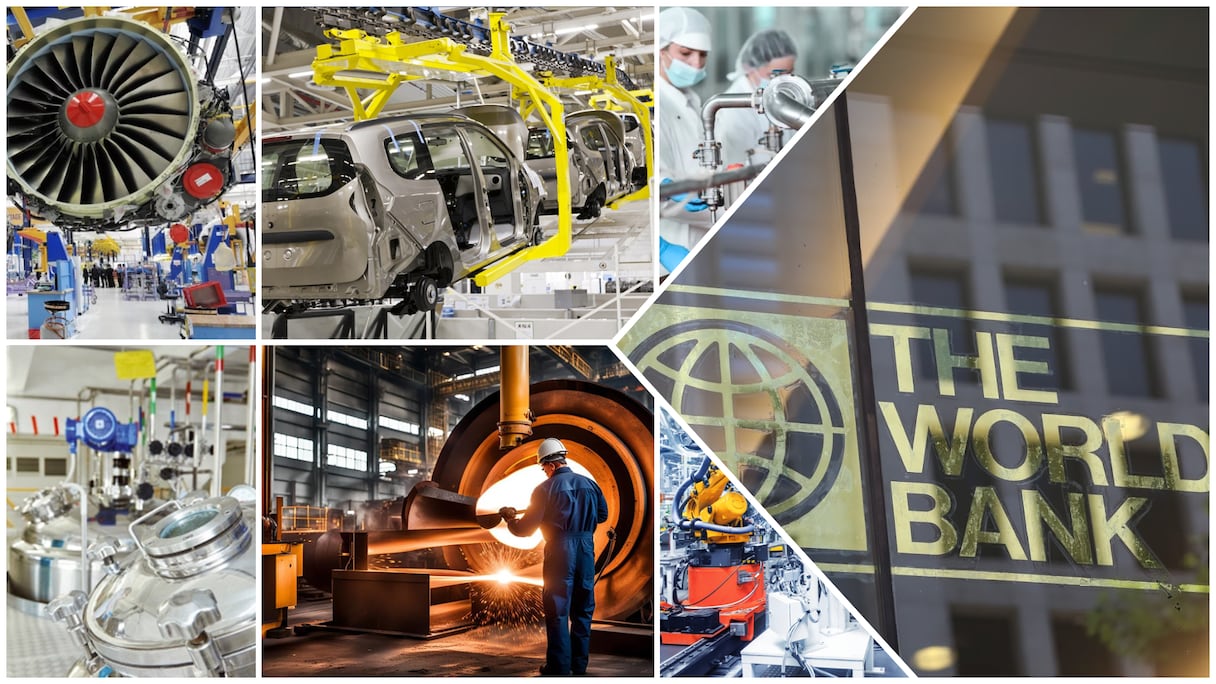
Morocco is among the few African economies to have moved into sophisticated industrial segments while remaining part of one of the continent’s least integrated regional blocs, according to the World Bank’s latest report, Integrating Africa: From Threads to Hubs.
The report examines regional and global value chains across Africa and places Morocco at the intersection of two contrasting realities: a comparatively advanced industrial hub and the Arab Maghreb Union (AMU), which remains one of the weakest links in Africa’s regional integration.
At the continental level, the report shows that intra-African trade remains limited. African countries direct only 20% of their total exports to other countries on the continent, compared with more than 50% within the Association of Southeast Asian Nations (ASEAN) and the European Union (EU).
Against this backdrop, Morocco occupies a distinctive position, according to the report, which assesses the country through several indicators, including participation in value chains, its network of trade agreements, energy governance and trade facilitation.
The report’s authors note that upstream participation in global value chains—the ability of a country to import intermediate inputs for local processing or assembly—remains limited across Africa. Only four countries exceed the threshold of 10% of gross exports under this measure: Kenya, Morocco, South Africa and Tunisia.
In Morocco’s case, this integration is concentrated in automotive and aerospace components, supported by export processing zones and networks of international buyers.
Industrial rise
Between 2015 and 2019, Morocco generated an average of $496 million in regional value chain exports, more than Tunisia ($459 million), Egypt ($445 million), Angola ($311 million) and Algeria ($282 million), according to the report.
In processed chemicals—one of the continent’s most active regional sectors, accounting for $2.7 billion in trade flows related to plastics, fertilizers and chemical exports—Morocco is cited alongside Egypt and South Africa as one of the three main drivers of this activity.
Read also : World Bank says Morocco records strongest economic growth in a decade
The report also highlights Morocco’s industrial rise, describing its strategy as a “great leap” driven mainly by three factors: public-private collaboration, geographical proximity to Europe and infrastructure alignment.
This combination has given Morocco a revealed comparative advantage in medium-complexity sectors, including chemicals, electronics and automotive components.
Morocco has also made inroads into aerospace components and automotive wiring, benefiting from its proximity to European markets and supplier networks.
The report’s authors stress that Morocco’s advanced industrial profile contrasts sharply with the weak regional integration of the bloc to which it belongs, noting that “the AMU remains the least integrated Regional Economic Community” on the continent, with intra-regional trade accounting for less than 5%.
They attribute this situation to political fragmentation, persistent regional tensions and the lack of institutional coordination mechanisms, which they describe as long-standing obstacles to economic integration in North Africa.
Yet, the authors note, the region has the necessary assets to achieve greater integration, including a common language, currency convertibility and the geographical proximity of its member countries.
Their conclusion is that political economy matters more than geography in determining the course of regional integration.
In its mapping of comparative advantages across regional blocs, the World Bank report notes that the AMU stands out for its specialization in heavy manufacturing and chemicals. The Southern African Development Community (SADC), meanwhile, dominates in extractive and light industries, while the East African Community (EAC) and the Economic Community of West African States (ECOWAS) show moderate specialization in agro-processing and textiles.
An extensive trade agreement network
The report also highlights Morocco’s extensive network of preferential trade agreements, not only across Africa but globally. Morocco ranks among the leading countries, alongside the United Kingdom and behind Egypt.
The report also identifies Morocco and South Africa as “anchor suppliers” in Africa’s carbon markets and green standards.
One of the report’s key conclusions is that energy is the sector where the gap between technical capacity and actual integration is most apparent in North Africa.
The region has sophisticated electricity networks and advanced operational practices, but intra-African electricity trade remains minimal due to political fragmentation and differences in regulatory frameworks.
Read also : Only 19% of Moroccan women are in the labor force, World Bank says
According to the report’s authors, this shows that the main obstacle to African energy integration is not production potential but the institutional, regulatory and political conditions needed to turn existing infrastructure into a functioning regional market.
Overall, Integrating Africa: From Threads to Hubs highlights a broader paradox identified by the World Bank across the continent: African economies are capable of moving up the industrial sophistication ladder and building extensive networks of trade agreements, yet their immediate regional integration remains weakened primarily by political and institutional obstacles rather than a lack of economic or technical capacity.
