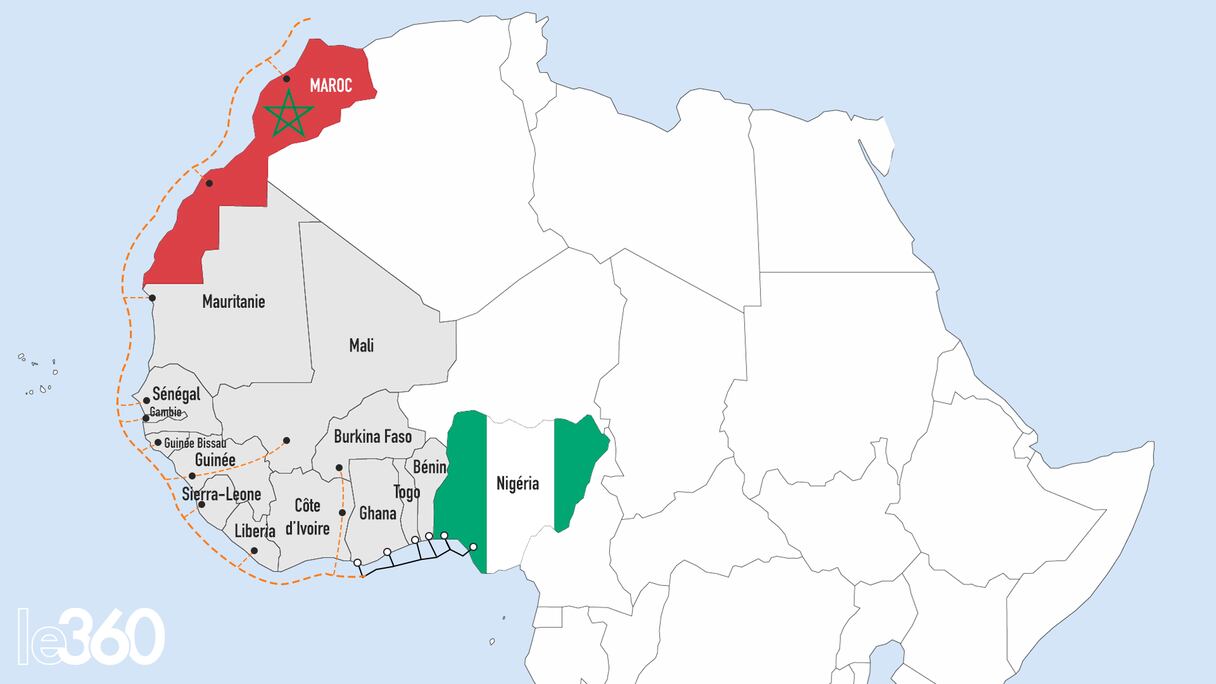
According to Bloomberg, Moroccan Ambassador to the United States Youssef Amrani said Rabat is in discussions with both institutions to help finance the proposed $26 billion pipeline, although he declined to provide details of the talks.
A spokesperson for the US Export-Import Bank (US Exim Bank) confirmed to Bloomberg that preliminary discussions have taken place regarding the project.
The financing push comes just days after heads of state from the Economic Community of West African States (ECOWAS) signed the Intergovernmental Agreement (IGA) for the African Atlantic Gas Pipeline during the bloc’s summit in Freetown, Sierra Leone. The agreement establishes the legal framework for one of Africa’s largest energy infrastructure projects and paves the way for the next phases of financing and implementation.
Read also : ECOWAS member states endorse Nigeria-Morocco African Atlantic Gas Pipeline
First proposed in 2016 by King Mohammed VI and former Nigerian President, the late Muhammadu Buhari, the nearly 6,800-kilometer pipeline is expected to transport natural gas from Nigeria along the Atlantic coast through 13 West African countries before reaching Morocco. From there, it will connect to the Maghreb-Europe Gas Pipeline, providing access to European markets while also supplying participating African countries.
Speaking to Bloomberg, Amrani described the AAGP as “one of the most ambitious infrastructure projects under development today in Africa.” He also said that recent geopolitical tensions affecting global energy markets—including disruptions linked to the conflict involving Iran—have reinforced the strategic importance of developing alternative supply routes between Africa and Europe.
Read also : African Atlantic Gas Pipeline: A decade later, Morocco’s vision has West Africa on board
The latest financing discussions build on a series of recent advances for the project.
In addition to the ECOWAS agreement, Morocco’s National Office of Hydrocarbons and Mines (ONHYM) and the Nigerian National Petroleum Company Limited (NNPC Ltd.) have announced that the main engineering, environmental, and technical studies have been completed, while participating countries have progressively endorsed the initiative through bilateral and regional agreements.
The pipeline is expected to have a transport capacity of 30 billion cubic meters of natural gas per year, of which up to 15 billion cubic meters could be exported to Morocco and Europe, with the remainder destined to supply regional markets.
It aims to establish an integrated regional natural gas market across West Africa and support electricity generation, industrialization, and the development of the continent’s natural resources. The commissioning of the first pipeline segments is expected at the beginning of the next decade.
