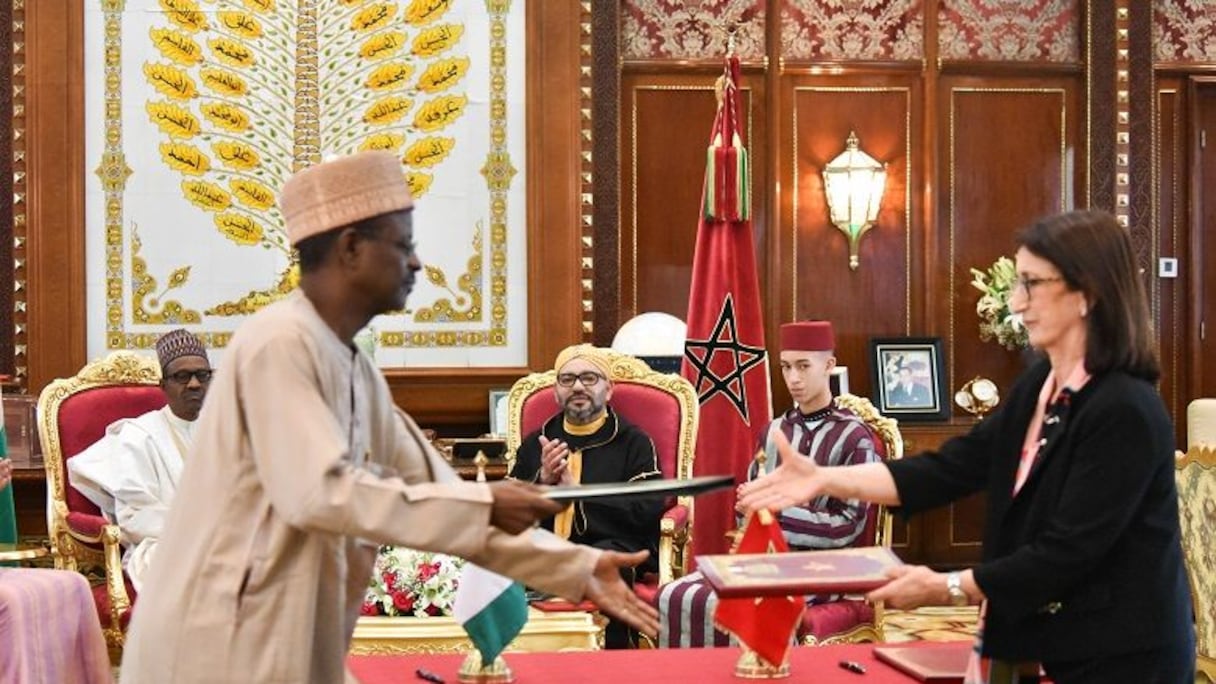
By signing the Intergovernmental Agreement on Sunday, July 19, 2026, in Freetown, ECOWAS and Morocco transformed a royal and presidential vision into a binding regional legal framework. With technical studies completed, governance bodies set to be established in Casablanca and Abuja, and exports to Europe on the horizon, the $25 billion project is reshaping the continent’s geopolitical landscape.
The Atlantic Africa Gas Pipeline is not a short-term response to global energy crises. Its roots lie in a carefully structured geopolitical ambition conceived at the highest levels of government. It was in 2016, during King Mohammed VI’s visit to Nigeria, that the Sovereign and the late former Nigerian president Muhammadu Buhari laid the foundations for this monumental undertaking. That pioneering impetus has found seamless political continuity in the renewed commitment of President Bola Ahmed Tinubu, demonstrating the institutional durability of a transcontinental partnership.
From the outset, the project has been led by an executive partnership between Morocco’s National Office of Hydrocarbons and Mines (ONHYM) and the Nigerian National Petroleum Company Limited (NNPC Ltd.). The relationship between the two institutions extends far beyond the scope of a conventional commercial agreement. It embodies an exemplary model of South-South cooperation founded on trust, clarity and rigour.
This exceptional partnership has a cross-cutting dimension, bringing together energy security, economic development and geopolitical stability. Subject to the King’s close and constant oversight, the pipeline stands as a central pillar of the royal vision for a sovereign, integrated Africa in full command of its resources. The project’s gradual materialisation demonstrates that the original political will has now evolved into the effective and irreversible commitment of all the nations concerned.
The lessons of Freetown
The signing of the Intergovernmental Agreement (IGA) during the summit of the heads of state and government of the Economic Community of West African States (ECOWAS) represents a major institutional breakthrough. By incorporating the project into ECOWAS’s internal decision-making processes, this step formalises the collective adherence of member states to the pipeline’s legal and regulatory framework, granting it absolute legal security.
Read also : ECOWAS member states endorse Nigeria-Morocco African Atlantic Gas Pipeline
Although the Kingdom of Morocco is not a member of ECOWAS, its active and decisive presence in Freetown as a co-promoter illustrates its ability to mobilize continental energies beyond institutional divisions. The Freetown sequence therefore marks the full appropriation of the project by West Africa as a whole, transforming what began as a Moroccan-Nigerian initiative into a major regional undertaking.
From a technical and operational standpoint, the agreement comes at a pivotal moment. ONHYM and NNPC Ltd. have officially confirmed that the principal front-end engineering design, environmental-impact and technical-feasibility studies have now been fully completed. The project therefore possesses all the scientific and economic guarantees required to move beyond the preparatory-study phase and gradually enter operational development on the ground.
The road map to implementation
The Freetown event constitutes the first stage in a meticulously sequenced diplomatic and industrial agenda. The road map for the months and years ahead is structured around decisive milestones that will mark the definitive transition from legal framework to physical implementation.
This coming fall, the Kingdom of Morocco will host an official signing ceremony of historic significance. The event will bring together King Mohammed VI, Nigerian President Bola Ahmed Tinubu and the president of the Islamic Republic of Mauritania. It will provide for the joint signing of the agreement by Morocco and Mauritania, two states that are not members of ECOWAS but are indispensable to the geographical continuity of the route, thereby sealing the alliance among all the countries along the pipeline.
The agreement to be signed in the fall will formally establish the project management company. Headquartered in Casablanca, this project company will be responsible for overseeing all financial, commercial and operational aspects of the undertaking.
At the same time, the pipeline’s regulatory and governance authority, known as the Pipeline Higher Authority, will establish its headquarters in Abuja, Nigeria, where it will monitor compliance with interstate commitments and ensure the security of the network.
Once the project company and governance authority are operational, the promoters will proceed with structuring the financial consortium, mobilizing international and institutional investors and preparing the Final Investment Decision (FID). The successful completion of these financial arrangements will open the way to the heavy-construction phase. Current timetables envisage the commissioning of the first regional sections at the beginning of the next decade, marking the effective start of natural-gas flows.
Estimated at approximately $25 billion, the Atlantic Africa Gas Pipeline stands as the largest energy infrastructure project in the continent’s history. Extending for nearly 6,800 kilometres, the route will cross 13 countries along Africa’s Atlantic seaboard, interconnecting their national networks before reaching northern Morocco and linking directly to the Maghreb-Europe Gas Pipeline (GME).
A corridor of shared prosperity
The infrastructure will have an annual transport capacity of 30 billion cubic meters of natural gas, allocated in a balanced manner to meet both continental and international needs.
Approximately 15 billion cubic meters a year will be reserved for the West African domestic market. This resource will make it possible to create an integrated regional natural gas market, provide clean and affordable fuel for electricity generation, bring an end to the region’s energy deficit, stimulate its industrial base and process the continent’s mineral and natural resources locally.
Up to 15 billion cubic meters a year will be destined for the Moroccan market and for export to Europe. At a time when the global geopolitical environment is defined by the search for secure supplies, the pipeline offers Europe a stable, safe and sustainable alternative source of energy.
Beyond its industrial and energy dimensions, the Atlantic Africa Gas Pipeline is fully aligned with the Atlantic Initiative launched by King Mohammed VI. This strategic vision seeks to end the isolation of the Sahel states and structure Africa’s Atlantic seaboard as a space of peace, reinforced cooperation and co-development.
The pipeline must not be regarded merely as a conduit for hydrocarbons but as a genuine corridor of socioeconomic integration. By connecting economies, harmonising industrial standards and fostering the creation of thousands of skilled jobs along its route, it lays the foundations for shared growth.
It gives West Africa the means to assert its energy sovereignty while becoming an indispensable player in global trade between Africa, Europe and the Americas. It will demonstrate that the African continent is now capable of designing, uniting around and financing world-class cross-border infrastructure, thereby affirming its position as a driving force of global growth for decades to come.
