Meeting in Freetown, Sierra Leone, on the sidelines of the bloc’s 69th Ordinary Session, the ECOWAS heads of state and government signed an intergovernmental agreement approving and establishing the framework for the construction of the Atlantic Africa Gas Pipeline (AAGP), linking Nigeria and Morocco.
The agreement carries major strategic significance for the countries involved in the project, including ECOWAS member states, Mauritania, Morocco and European countries. It reflects the bloc’s formal commitment to a project expected to generate significant economic momentum for the populations of the region.
The intergovernmental agreements resolve all outstanding sensitive issues, including sovereignty over cross-border sections of the pipeline, revenue-sharing arrangements and environmental responsibilities. In practical terms, they establish the governance framework for the pipeline among ECOWAS member states.
Read also : ECOWAS member states endorse Nigeria-Morocco African Atlantic Gas Pipeline
By signing the agreements, the region’s leaders have removed the final obstacle to the construction of this strategic energy infrastructure.
The institutional framework for the pipeline will be finalized through the subsequent joint signature of Morocco and Mauritania—two countries that are not ECOWAS members—in the presence of the Nigerian president.
Following this decision, two entities will be established: a Project Company, headquartered in Casablanca, responsible for financial structuring through a combination of equity and debt financing as well as operational management; and the Pipeline Higher Authority, whose headquarters are planned for Abuja, Nigeria.
Once these two entities are established, the focus will shift to mobilizing investors and preparing the Final Investment Decision, with the technical, environmental and engineering studies already completed.
The project is estimated to cost $25 billion, making it one of the most ambitious infrastructure projects on the African continent. The use of a special-purpose company is expected to facilitate fundraising through sovereign loans, bond issuances and public-private partnerships. Several partners are expected to contribute to the project’s financing, including the United Arab Emirates, the Islamic Development Bank and the OPEC Fund for International Development.
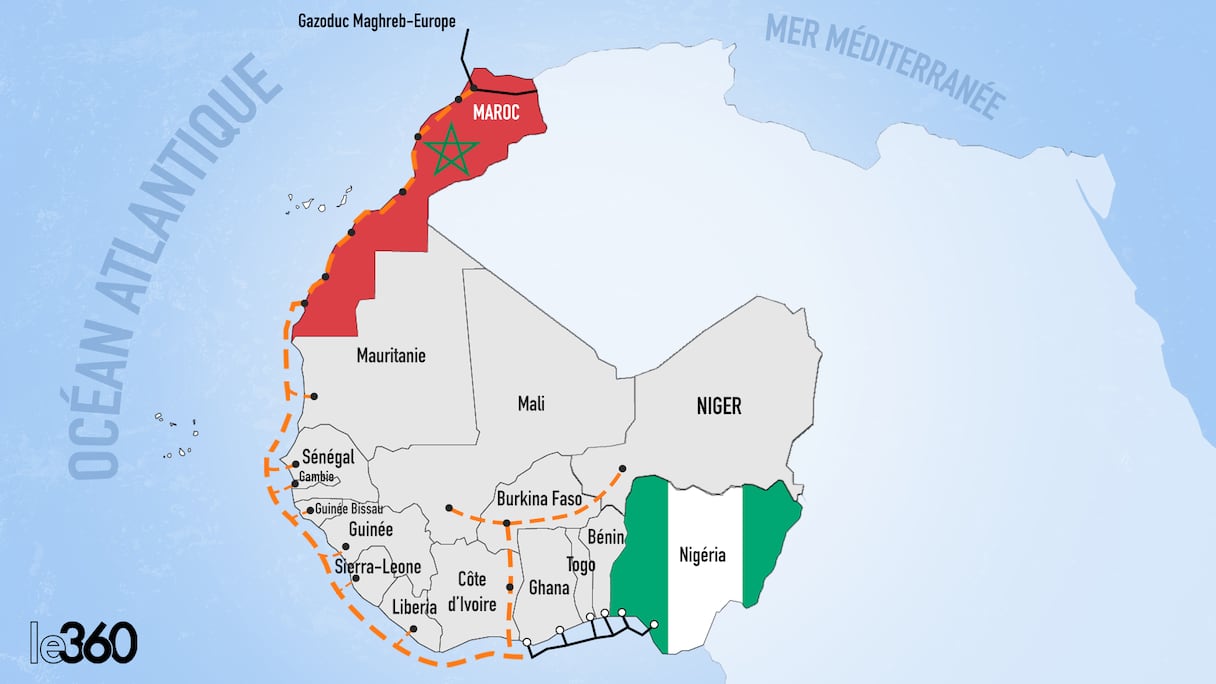
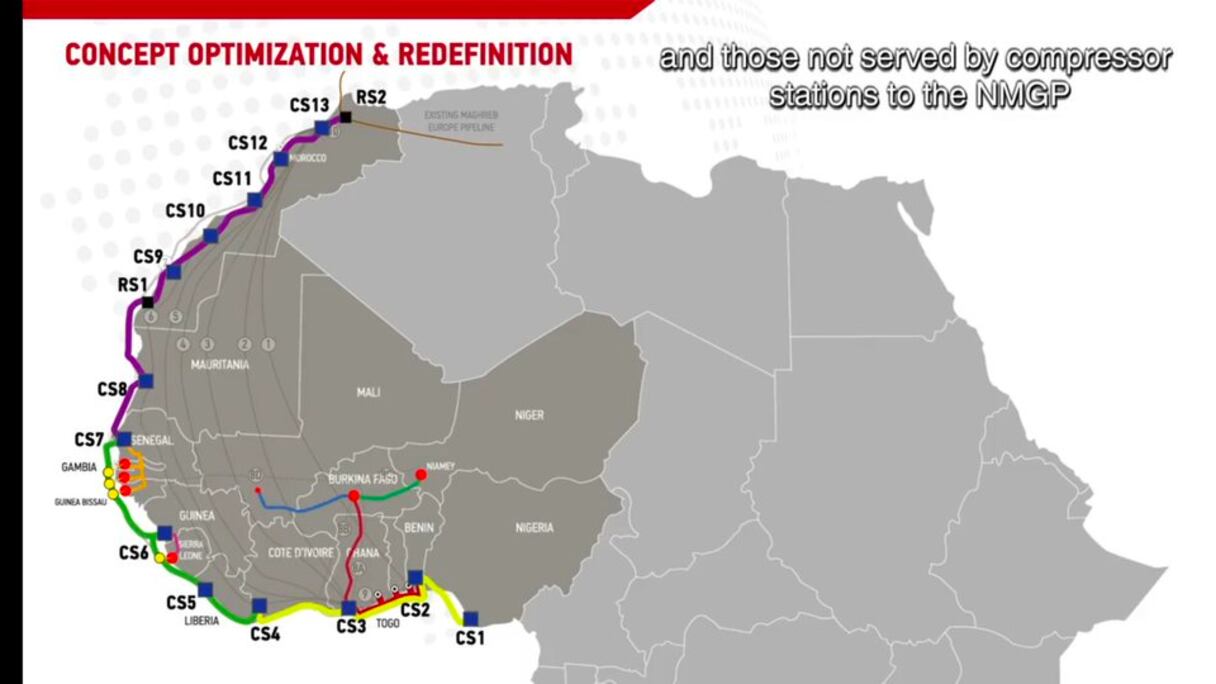
The Atlantic Africa Gas Pipeline will cross 13 countries and extend approximately 6,900 kilometers. Morocco will host the longest national section, stretching 2,220 kilometers, including 1,830 kilometers onshore between Dakhla and Ouazzane and 390 kilometers offshore between Lagouira and Dakhla.
To maximize the project’s impact across participating countries, the pipeline route provides for progressive interconnections between national networks. The first segments will link Morocco to the gas fields of Mauritania and Senegal. Another section will connect Ghana and Côte d’Ivoire, while a final segment will link Ghana to Nigeria’s gas fields. By developing the infrastructure in autonomous sections, the project’s promoters envisage a phased commissioning, with the first gas deliveries from the initial phases expected in 2031.
Construction is expected to begin in 2028, with first gas deliveries scheduled for 2031. The pipeline will have a target annual transport capacity of 31 billion cubic meters of natural gas. Half of that volume will be exported to Morocco and Europe, while the remainder will supply regional markets to support electricity generation and industrialization.
Once completed, the pipeline is expected to strengthen the region’s energy security while serving as a key driver of sovereignty, industrial development and shared prosperity.
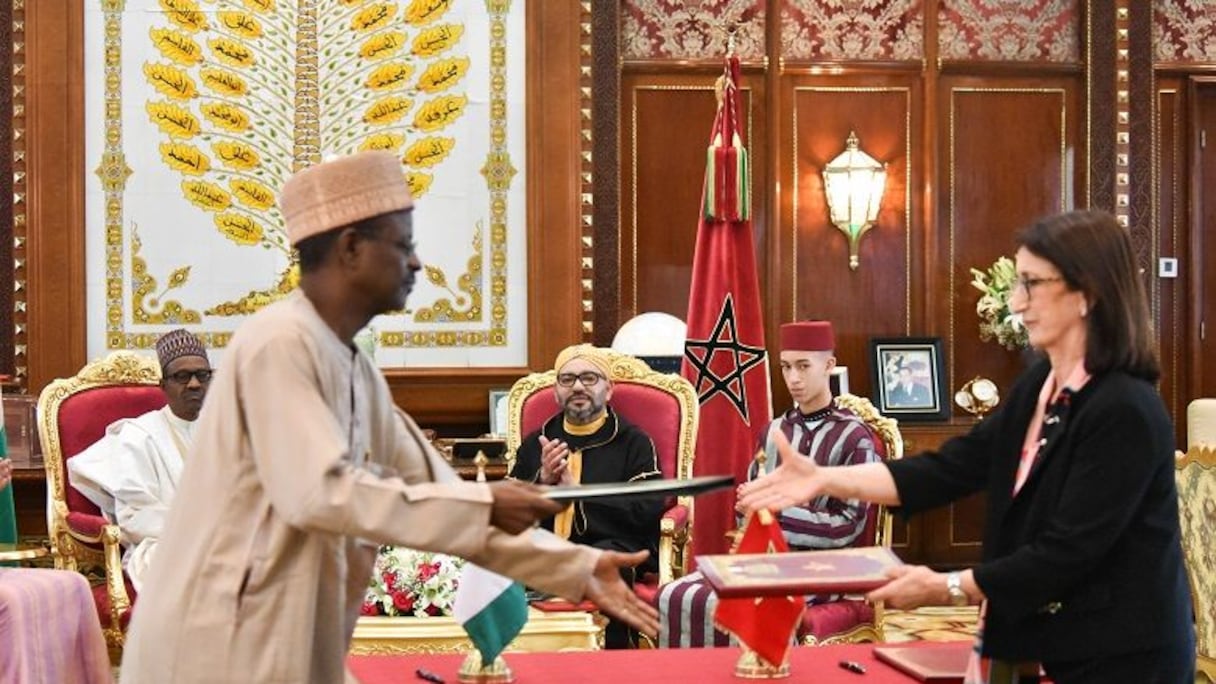

Cérémonie de signature, devant le roi Mohammed VI et l'ancien président nigérian Muhammadu Buhari, de la déclaration conjointe entre le Maroc et le Nigéria sur le Gazoduc Africain Atlantique, le 10 mai 2018 à Rabat. DR
According to a joint statement issued by Morocco’s National Office of Hydrocarbons and Mines (ONHYM) and the Nigerian National Petroleum Company (NNPC), the pipeline “aims to connect West Africa’s gas resources to the region’s principal consumption centers while strengthening the integration of African energy markets and creating a new development corridor linking West Africa, the Sahel states, the Kingdom of Morocco and Europe.”
With estimated reserves of 209 trillion cubic feet, Nigeria possesses Africa’s largest natural gas reserves and the world’s seventh largest. However, these resources remain significantly underexploited, as successive governments have historically prioritized oil production over gas development.
The geopolitical upheaval in global gas markets triggered by the Russia-Ukraine war has nevertheless prompted Europe to seek alternative sources of supply, and Nigeria intends to capitalize on the opportunity. For Africa’s most populous nation, which currently exports its gas primarily as liquefied natural gas (LNG), the pipeline will provide an efficient, secure and more commercially attractive route for transporting substantial volumes of natural gas.
Beyond Nigeria, Côte d’Ivoire has emerged as a gas producer through its Baleine and Calao fields. In Senegal, the Sangomar and Yakaar-Téranga fields, with estimated recoverable reserves of 70 billion and 1.4 trillion cubic meters, respectively, could also contribute to supplying the Atlantic Africa Gas Pipeline. The same applies to the Grand Tortue Ahmeyim field, located on the Senegal-Mauritania maritime border and brought into production in 2025. Its reserves are estimated at 1.4 trillion cubic meters, of which 560 billion cubic meters are considered recoverable.
The pipeline project was first proposed by King Mohammed VI during a landmark visit to Abuja in 2016. Since then, teams from ONHYM and the Nigerian National Petroleum Company have worked continuously toward the realization of this major strategic project.
