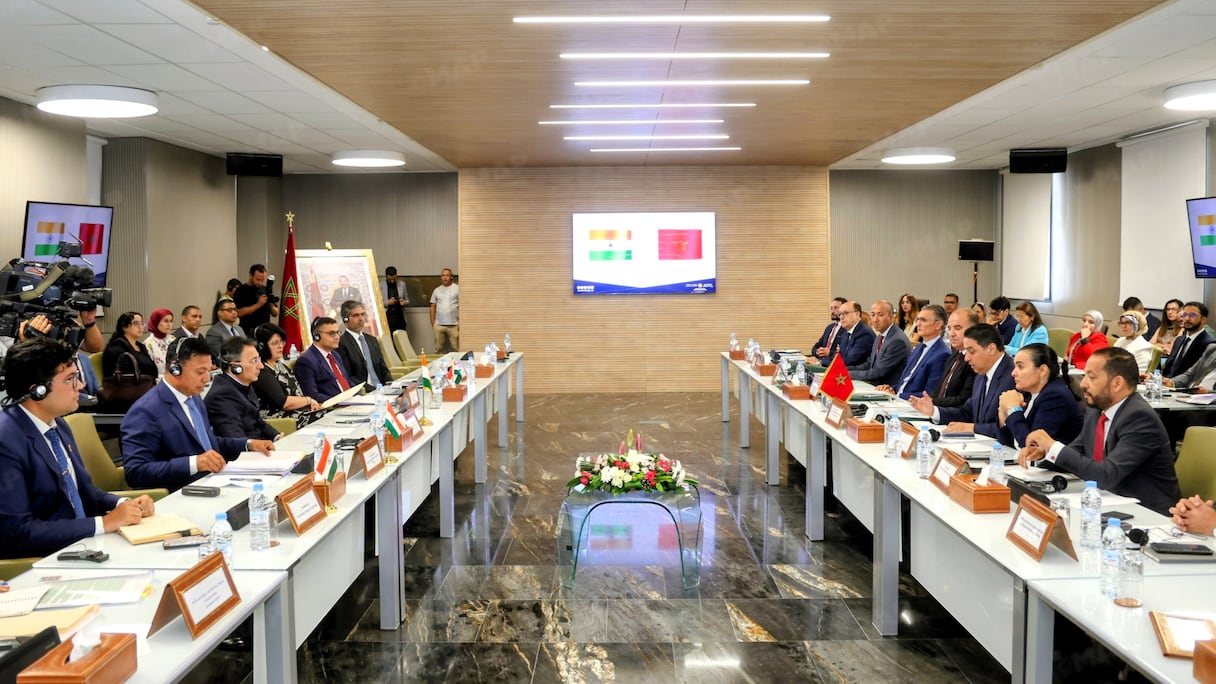
The 7th session of the Morocco-India Joint Commission convened on Monday in Rabat, with both nations expressing a mutual desire to enhance economic and trade cooperation and explore new partnership avenues, particularly in trade, investment, and industry.
During the session, Secretary of State for Foreign Trade, Omar Hejira, stated that the meeting marked a significant step in strengthening the friendship and cooperation between the two countries, aiming to elevate their ties to broader and more ambitious levels.
Hejira emphasized that “The holding of this session aligns with the High Royal Directives calling for the consolidation of the Kingdom’s strategic partnerships and the diversification of their prospects, particularly with the Asian continent.”
He noted that Morocco-India relations, established in 1993, are founded on strong ties of friendship, mutual respect, and shared perspectives on various international issues.
According to Hejira, the relationship between the two countries has gained considerable momentum since King Mohammed VI’s visit to India in 2015, reflecting a shared commitment to developing a multidimensional strategic partnership.
He reiterated Morocco’s eagerness to further strengthen its relations with India and to forge new areas of cooperation and partnership in pursuit of common interests.
Hejira also highlighted Morocco’s strategic advantages, including its favorable geographic position, well-developed infrastructure, and extensive network of free trade agreements with several global markets. These attributes, he noted, position Morocco as an ideal platform for Indian companies seeking access to African and European markets.
For his part, India’s Minister of State for Commerce and Industry and Electronics and Information Technology, Jitin Prasada, affirmed India’s commitment to further strengthening its partnership with Morocco.
He reported that bilateral trade reached approximately $4 billion in 2025-2026, comprising nearly $1.6 billion in Indian exports to Morocco and around $2.89 billion in Moroccan exports to India.
Prasada urged both countries to aim for a doubling of bilateral trade over the next five years, while simultaneously working to diversify its structure, eliminate non-tariff barriers, and facilitate access to their respective markets.
He also advocated for the establishment of a joint working group dedicated to bilateral trade, enhanced exchanges between companies from both nations, and an assessment of the feasibility of concluding a preferential trade agreement.
The Indian minister further identified several sectors with the potential to boost investment and industrial cooperation between the two countries, including automotive, electrical industries, and renewable energy.
He called for stronger partnerships in the fertilizer sector, increased joint investment, and greater participation by Indian companies in Moroccan infrastructure projects spanning roads, railways, energy, water, and digital connectivity.
Prasada also emphasized the importance of greater private sector involvement, particularly through stronger business partnerships, investment, and joint ventures. He extended an invitation to a high-level Moroccan delegation to attend the Partnership Summit 2026, scheduled for November 12 and 13 in Visakhapatnam, India.