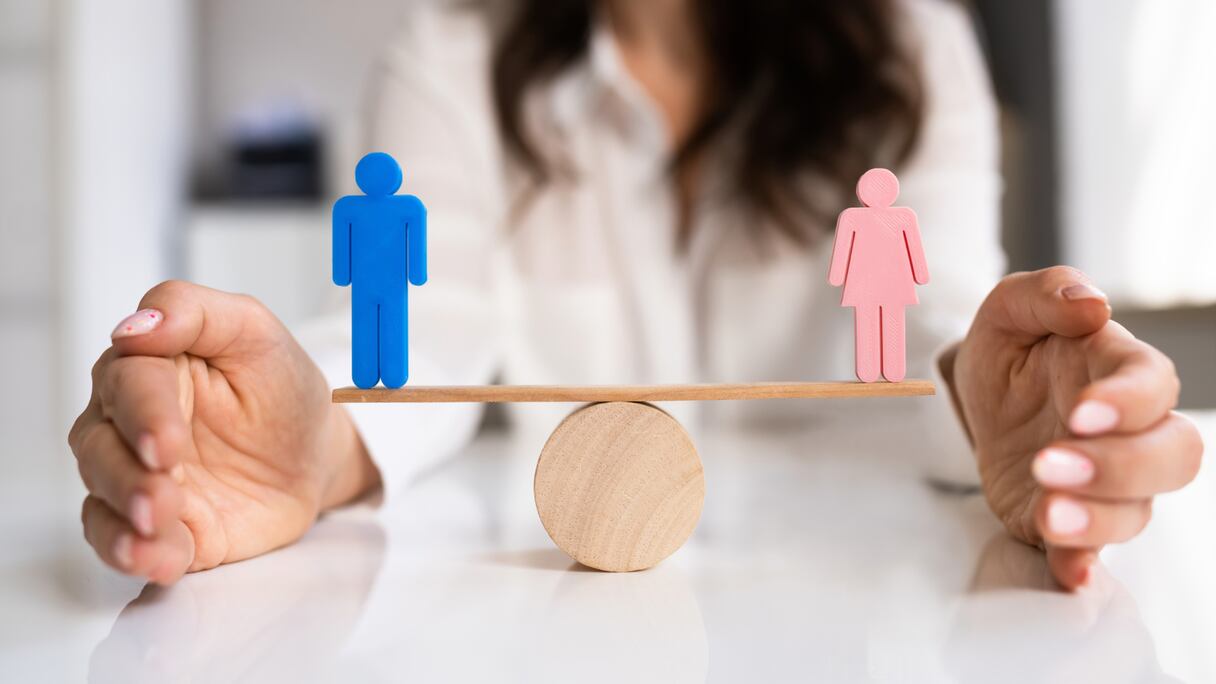
Morocco has fallen two places in the global ranking of gender equality, according to the 2026 Global Gender Gap Report published by the World Economic Forum (WEF).
The Kingdom now ranks 139th out of 145 countries covered by the report, compared with 137th in the previous edition, representing a two-place drop in one year.
This decline comes even though Morocco’s overall gender parity score has barely changed, rising from 0.628 in 2025 to 0.632 in 2026 on a scale from 0 to 1.
This apparent paradox reflects the difficulty Morocco faces in keeping pace with other economies assessed by the index, which are closing their gender gaps at a faster rate.
The ranking breaks down each country’s performance across four areas, namely economic participation and opportunities, educational attainment, health and survival and political empowerment, where Morocco’s performance remains highly uneven.
In economic participation and opportunities, Morocco ranks 141st out of 145 countries. The female labor force participation rate stands at just 19.80%, compared with 69.60% for men, a gap of 49.80 percentage points that places the Kingdom 143rd worldwide on this indicator.
Women’s estimated annual income stands at $3,330, compared with $14,900 for men, also placing Morocco 143rd on this criterion.
A very low literacy rate
On educational attainment, Morocco ranks 118th. The Global Gender Gap Report notes that the Kingdom has reached almost complete parity in primary, secondary and tertiary enrollment, with Morocco ranking first worldwide on each of these indicators.
Literacy, however, remains the weakest point in this sub-index, with Morocco ranking 123rd. The gap between women, at 64.35%, and men, at 82.44%, remains one of the widest recorded by the index.
For the health and survival sub-index, Morocco ranks 133rd, notably affected by healthy life expectancy, where it ranks 138th. Healthy life expectancy stands at 61.84 years for women compared with 62.82 years for men.
In political empowerment, Morocco ranks 90th, with women occupying 24.30% of parliamentary seats, placing the country 81st on this indicator, and 26.32% of ministerial positions, placing it 57th.
In the Middle East and North Africa (MENA) region, Morocco ranks 12th, ahead only of Algeria, which ranks 141st globally, and Iran, which ranks 144th. In Africa, Morocco has surpassed only four countries, namely Mali, Algeria, the Democratic Republic of Congo and Chad.
Across the continent, the WEF report highlights Namibia’s exceptional position, with the country ranking fourth worldwide and recording the best performance in Africa.
The most striking difference between Morocco and sub-Saharan Africa concerns the economic participation and opportunities sub-index.
The region has closed 70.6% of its gender gap in this area, ranking fourth worldwide, compared with only 42.4% for Morocco.
The situation is reversed in educational attainment, where sub-Saharan Africa has closed 89.5% of its gap, its weakest regional sub-index, compared with 95.8% for Morocco.
Beyond the scores, the report provides a series of legal and contextual indicators for each economy. For Morocco, it classifies the inheritance rights of widows and daughters as unequal, while the right to divorce is also classified as unequal. Access to movable and immovable assets, by contrast, is classified as nearly equal.
The WEF report also notes that Moroccan women obtained the right to vote in 1959 and that Morocco applies electoral-list quotas in favor of women at the national level, a mechanism that the report lists as active.
The global top five
In health, the report records a maternal mortality rate of 70 deaths per 100,000 live births, a fertility rate of 2.21 births per woman and an early marriage rate of 8.80%. Skilled health personnel attend 86.60% of live births.
On the labor market, only 12.30% of the Moroccan companies covered by the report have a woman as their majority owner, while 5.44% are headed by a woman serving as chief executive. Paid parental leave also remains highly unequal, with 98 days granted to mothers compared with three days for fathers.
At the global level, the top three positions have remained unchanged for a third consecutive year. Iceland retains first place with a score of 0.930 and is the only economy in the index to have closed more than 90% of its gender gap. It has held the top position for 17 consecutive years and has appeared in the top 10 for 20 consecutive editions.
Finland, with a score of 0.872, and Norway, with 0.857, complete the top three, ranking second and third respectively. They are followed by Namibia, with 0.845 in fourth place and the United Kingdom, with 0.842 in fifth. Namibia is also the highest-ranked sub-Saharan African economy in the report.
