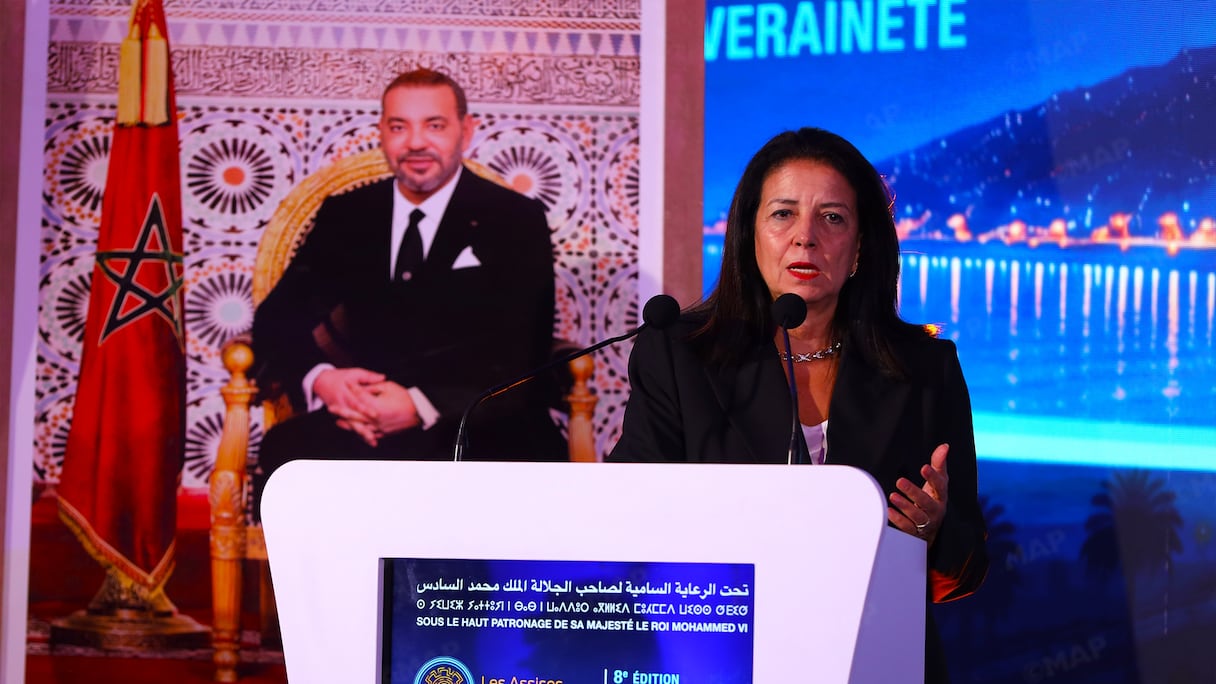
Morocco is seeking to strengthen its digital sovereignty and accelerate its technological development by gaining control over infrastructure, data, computing capacity and technology models, Minister Delegate for Digital Transition and Administrative Reform Amal El Fallah Seghrouchni said on Thursday in Tangier.
Speaking at the eighth edition of the annual conference of the Association of Information Systems Users in Morocco (AUSIM), held under the High Patronage of King Mohammed VI, El Fallah Seghrouchni delivered a keynote address titled “AI Made in Morocco, the Race to Achieve Sovereignty.” She stressed the need to speed up the country’s digital transformation.
The minister described digital sovereignty as an “invisible sovereignty,” calling it a strategic issue for Morocco’s development.
She explained that digital technology now underpins progress across all sectors because of its cross-cutting role. Control over digital systems, infrastructure and the different layers of technology has become essential to building a digital state and supporting the country’s economic and social development, she said.
El Fallah Seghrouchni also outlined the ministry’s progress in digital development and its priorities for artificial intelligence (AI). Morocco is working toward AI that is “frugal, inclusive and responsible,” developed in Morocco for domestic use while remaining open to international cooperation.
This ambition is part of the Morocco AI 2030 roadmap, which aims to contribute MAD 100 billion to gross domestic product (GDP) by 2030. The strategy is built around an ecosystem combining sovereign infrastructure, national computing capacity, data, public platforms, a legal framework, innovation, talent and international cooperation, the minister said.
She also stressed the need to move quickly as AI investment becomes increasingly concentrated and countries compete to control computing power and technological capabilities. For Morocco and Africa, acting swiftly could help them benefit from the “leapfrog effect,” allowing them to bypass certain stages of development. Achieving this will depend on four essential factors, she said — energy, computing capacity, data and talent.
Looking ahead, El Fallah Seghrouchni identified five priority areas. These include bringing sovereign computing capacity into operation and making it accessible to researchers and startups; completing the legal and institutional framework, particularly for AI; developing models in Arabic, Moroccan Darija and Amazigh before expanding to African languages; training and certifying talent on a large scale; and gradually moving public services from digital systems toward agentic AI.
The minister said the “AI Made in Morocco” initiative reflected the Kingdom’s determination to “design, not just use” technology, while choosing not to wait for others to take the lead.
In a statement to the press, AUSIM President Mohamed Saad explained that Tangier was chosen to host this edition to support the transition of AI from experimentation to practical implementation and industrial-scale deployment.
With its port and industrial infrastructure, location between two seas and two continents, and openness to different cultures, Tangier provides a particularly relevant setting for discussing this next phase of AI, he said.
Saad described the city as a “turning point between two worlds,” reflecting Morocco’s ambition to establish itself as a major AI hub in Africa.
Looking back at the evolution of the AUSIM conference, Saad noted that previous editions had addressed a range of digital topics, including data, blockchain, machine learning and digital transformation.
AI has taken center stage this year, he said, as companies seek ways to integrate the technology, test its applications and use it to support development and growth. The event brings together business leaders to share their experiences and present concrete examples of AI being integrated into company operations.
Held under the theme “AIMPOWERING: Through Innovation, Intelligence and Sovereignty,” the three-day event provides a forum for discussion and exchange among professionals responsible for deploying, operating and making decisions about technology.
Plenary sessions, keynote addresses, thematic workshops and experience-sharing sessions will examine several key issues, including AI, value creation, data governance and technological sovereignty.
