
The 2025 Financial Stability Report, presented jointly by Bank Al-Maghrib, the Insurance and Social Welfare Supervisory Authority (ACAPS), and the Moroccan Capital Market Authority (AMMC), examines pensions as a structural rather than a short-term issue. While improvements recorded during the year have provided several schemes with some breathing room, they have not fundamentally changed the timeline of their actuarial imbalances. The financial picture, however, cannot be separated from two other factors: extending coverage to workers who remain outside the system and the level of protection provided to pensioners.
The report’s first key finding is that contributions paid by 5.1 million workers rose by 9.3% to 73 billion dirhams, while benefits paid to 1.5 million pensioners increased by 5.8% to 75.3 billion dirhams. The overall ratio of contributors to pensioners therefore stood at around 3.4. This indicator does not, however, constitute a uniform actuarial ratio, as it combines schemes with different demographic structures, benefit rules, and levels of maturity.
The faster growth in contributions nevertheless reduced the combined technical deficit from 4.4 billion dirhams in 2024 to 2.3 billion dirhams in 2025. The overall balance remained positive at nearly 9.5 billion dirhams. The gap between the two balances reflects the decisive role played by investment income: the system is still paying out more in benefits than it receives in contributions, but returns on reserves currently offset this shortfall.
Pension coverage remains an unfinished part of social protection
Saâd Taoujni, a consultant specializing in health and social protection policy, management, and law, advocates for an actuarial assessment to be directly linked to the scope of social protection reform. He notes that the reform “notably provided for the extension of pension coverage to nearly five million new beneficiaries,” referring to undeclared workers.
Taoujni highlights that the financing plan presented to Parliament by Mohamed Benchaâboun allocated an annual sum of 16 billion dirhams over five years, totaling 80 billion dirhams, to support the expansion of the pension scheme. However, Taoujni points out that this component, along with unemployment insurance, was ultimately never implemented.
He adds that only compulsory health insurance and direct social assistance have been rolled out. Yet, challenges persist in healthcare provision, the functioning of the Unified Social Register, and beneficiary targeting. This situation reframes the debate: the reform must not only rebalance existing funds but also broaden the contribution base without creating new, inadequately financed rights.
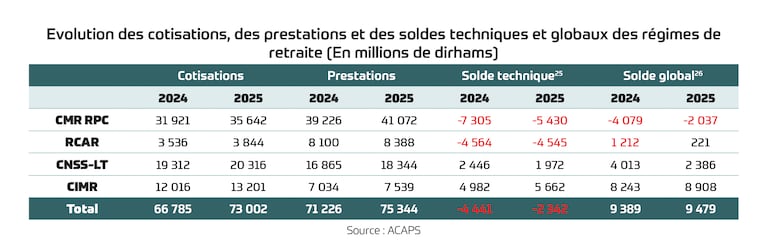
Table: Contributions, benefits and balances of the pension schemes in 2024 and 2025
CMR gains time without pushing back the deadline
The most visible improvement concerns the CMR’s civil pension scheme. Contributions increased by 11.7%, from 31.9 billion to 35.6 billion dirhams, driven by the second phase of the salary increase agreed under the social dialogue process, which took effect in July 2025. Benefits grew more slowly, by 4.7%, reaching 41.1 billion dirhams.
This difference reduced the scheme’s technical deficit from 7.3 billion to 5.4 billion dirhams. With a financial balance of 3.6 billion dirhams, the overall deficit was cut in half, falling from 4.1 billion to 2 billion dirhams. While this is a substantial improvement over one year, it remains insufficient to restore lasting balance, as benefits still exceed contributions by more than 5 billion dirhams.
According to the report, the additional flows generated by salary increases have not significantly extended the viability horizon of the CMR-RPC, which remains estimated at between five and six years. They have, however, reduced the equilibrium contribution rate to 32%, from 35% before the salary increases. The gap with the rate currently in force has therefore narrowed from seven percentage points to four.
The document states that the pricing of benefits introduced following the 2016 parametric reform is now balanced. This improvement, however, is not enough to erase accumulated commitments or the deficits generated by the scheme’s maturity. The forward-looking projection is particularly clear: CMR-RPC reserves are declining rapidly, approaching depletion around 2030, before becoming insufficient to absorb negative balances.
RCAR still has a financial cushion
The RCAR presents a different picture. Contributions rose by 8.7% to 3.8 billion dirhams, driven by salary increases in public institutions and for non-permanent state and local government employees. Benefits reached 8.4 billion dirhams, an increase of 3.6%.
The persistent imbalance between contributions collected and benefits paid maintains the technical deficit at approximately 4.5 billion dirhams. However, financial income, which generated 4.9 billion dirhams, enabled the scheme to achieve an overall surplus of 221 million dirhams, though this is a decrease from 1.2 billion dirhams in 2024. This demonstrates that investment income continues to support the scheme’s balance, even if it doesn’t eliminate the technical deficit.
According to the report, the RCAR maintains a relatively comfortable viability horizon of 29 years. While this period is supported by the size of its accumulated reserves, it should not be mistaken for sustainable balance. The scheme remains structurally underpriced, with its equilibrium contribution rate projected to be 150% of the regulatory rate in 2025.
Once again, salary increases have had a mixed effect. While they immediately boost revenues, they can also lead to higher future benefits and, consequently, increased long-term liabilities. The report therefore notes a deterioration in actuarial indicators despite the improvement in contribution flows.
CNSS safety margin is narrowing
The CNSS’s long-term branch, while technically still in surplus, is on a deteriorating trajectory. Contributions increased by 5.2% to 20.3 billion dirhams, but benefits rose at a faster rate of 8.8% to 18.3 billion dirhams. This disparity reduced the technical balance from 2.4 billion to 2 billion dirhams.
This trend also impacted the overall result, which dropped from 4 billion to 2.4 billion dirhams. Although the branch remains in surplus, the simultaneous erosion of its technical and overall balances indicates a narrowing ability to absorb shocks, even before it enters a deficit.
Forward-looking assessments cited in the report project its viability horizon at 10 years. Its pre-financing ratio stands at only 58%, the lowest among the four schemes studied, while its equilibrium contribution rate is 173% of the regulatory rate. This highlights a significant gap between the financing secured and the actuarial cost of the benefits provided.
The document, therefore, recommends adjustments to three critical variables: the contribution rate, the retirement age, and the mechanism for acquiring pension rights. The combination of these adjustments will determine how the burden is distributed among workers, employers, and future pensioners. The decision will not be solely actuarial; it will also impact labor costs, disposable income, and career lengths.
Viability does not determine pension levels
The trajectory of the CNSS long-term branch raises a question distinct from its solvency: the adequacy of benefits. A scheme can maintain a positive balance while paying pensions insufficient to protect retirees’ incomes; conversely, any unfunded increase in benefits adds to its future liabilities.
According to figures provided to our media outlet by Saâd Taoujni, the average CNSS pension is around 1,800 dirhams, with nearly 70% of retirees receiving less than 2,000 dirhams per month. Survivor pensions are also often very modest, he added. These levels, distinct from viability projections, indicate that the reform will need to balance financial stability with the social adequacy of pensions.
The consultant reported encountering the same concern during several conferences with retirees: individuals who retired 20 or 25 years ago are now living on pensions that have become derisory, while their purchasing power has stagnated. “Beyond the figures, it is the dignity of women and men who devoted their lives to serving the country that is at stake,” he said.
The CIMR is at the opposite end of the spectrum. Its contributions increased by 9.9% to 13.2 billion dirhams, compared with a 7.2% increase in benefits to 7.5 billion dirhams. Its technical surplus therefore rose from 5 billion to 5.7 billion dirhams.
Combined with a financial balance of 4.1 billion dirhams, this result brought the overall surplus to 8.9 billion dirhams, up 8% year on year. The fund also boasts a pre-financing ratio of 113%, the only one above 100% among the four schemes presented.
According to the report, actuarial assessments confirm the CIMR’s viability throughout the projection period. Its reserves are expected to continue rising until the end of the scenario presented in 2083. This trajectory contrasts with the rapid depletion anticipated for the CMR-RPC, the expected reversal of the CNSS in the middle of the next decade, and the more gradual erosion of RCAR reserves.
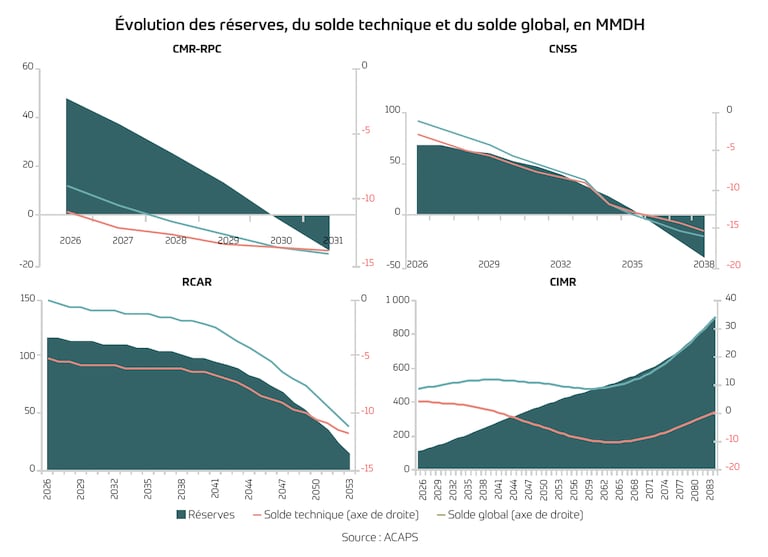
Table: Projected trajectories of reserves and balances
Large reserves, but unevenly available
The schemes’ combined reserves reached 340.8 billion dirhams at the end of 2025, marking a 4.3% year-on-year increase. This growth significantly outpaced the average annual growth of 1.5% observed over the preceding five years. Consequently, the 2025 rebound cannot be extrapolated without considering future financial performance and the escalating withdrawals required for pension payments.
Excluding the 69 billion dirhams deposited with the Deposit and Management Fund on behalf of the CNSS long-term branch, the reserves are allocated as follows: 54.3% in fixed-income securities, 33.9% in equities and shares, and 10.7% in real estate assets. The report’s chart illustrates a shift in this allocation, with fixed-income securities decreasing from 59% in 2021 to 54% in 2025, while equities rose from 31% to 34% and real estate from 7% to 11%.
While this reallocation may bolster long-term returns, it also heightens the reserves’ exposure to fluctuations in equity and property markets. This issue becomes particularly critical for schemes nearing asset depletion, as a shorter time horizon diminishes their capacity to absorb valuation volatility. Although strong financial performance can defer an imbalance, it cannot permanently substitute for contributions aligned with promised benefits.
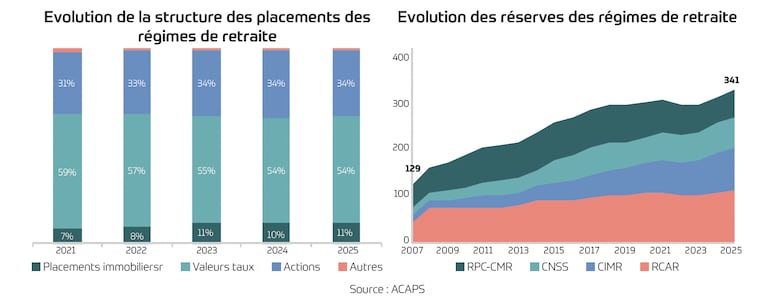
Table: Investment structure and changes in reserves
The pre-financing ratio reveals a hierarchy that does not perfectly correlate with the schemes’ viability horizons. It stands at 88% for the CMR-RPC, 76% for the RCAR, 58% for the CNSS, and 113% for the CIMR. Notably, the CMR-RPC, despite appearing better pre-financed than the RCAR by this indicator, possesses a significantly shorter viability horizon.
This contrast confirms that the volume of reserves alone does not dictate a scheme’s resilience. Factors such as the pace of benefit payments, contribution trends, the maturity of the covered population, and the pricing of benefits determine the speed at which assets are depleted. Therefore, a substantial reserve can be rapidly exhausted if it consistently has to cover a high technical deficit.
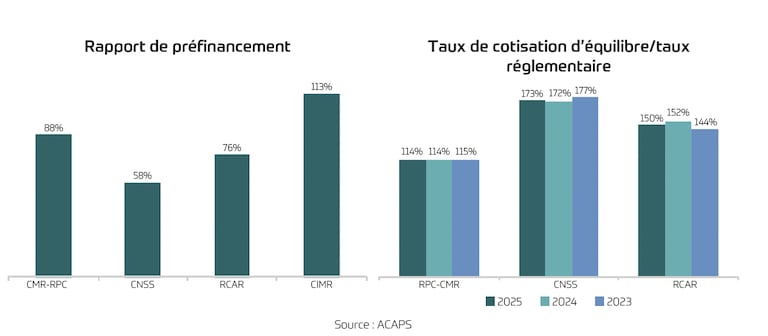
Table: Prefunding and equilibrium contribution rates
Ultimately, the diagnosis presented by the three financial authorities points less to an immediate crisis and more to an uneven distribution of breathing room. The improvement in contributions in 2025 mitigated some deficits, but this was partly driven by salary increases whose impact on the viability horizon remains limited. Concurrently, financial income is maintaining the system in overall surplus without rectifying the underpricing prevalent in several schemes.
The report explicitly warns that delays in the systemic reform of the public sector could diminish operational flexibility and escalate implementation costs. The longer the adjustment is postponed, the more concentrated the necessary changes to contribution rates, retirement ages, or pension right acquisition mechanisms will need to be over a shorter period.
Delays are narrowing the scope for reform
Saâd Taoujni also recalls that the Minister of Economy and Finance announced before Parliament that pension reform would not be undertaken by the current government. This political timeline clashes with the actuarial timeline: with the CMR-RPC’s viability limited to five or six years, every year without a decision reduces the time available to spread the adjustment.
The consultant places this delay within a process spanning more than three decades, during which the World Bank and the International Labour Organization have repeatedly raised the issue of reform. He also links it to royal commitments concerning the social state. The length of the debate has a direct economic consequence: technical deficits continue to consume reserves, while funding for expanded coverage remains to be mobilized.
“Despite the converging opinions of the Economic, Social and Environmental Council, the Court of Auditors, and the main constitutional institutions, why has pension reform still not been launched when the financial stakes are considerable?” Taoujni asks. The question is less about the existence of the diagnosis, which is now widely shared, than about the choice of timing and the distribution of the burden among the state, employers, workers, and pensioners.
The reform process must therefore reconcile three objectives that do not necessarily coincide: preserving the solvency of the schemes, extending pension coverage to currently excluded workers, and improving the protection provided by the lowest pensions. The 340.8 billion dirhams in reserves can cushion imbalances, but they cannot sustainably finance either persistent technical deficits or an expansion of coverage without new resources. The breathing room observed in 2025 is therefore a window for action, not a substitute for reform.
