
In a report published on Monday, August 3, the HCP presented the first findings from its new Labour Force Survey (LFS), which is set to replace the former National Employment Survey (NES). The revised methodology, aligned with international standards adopted at the 19th, 20th and 21st International Conferences of Labour Statisticians of the International Labour Organization (ILO), introduces significant changes to the way unemployment is measured.
A more restrictive definition
The most significant change concerns the definition of employment itself. Under the new methodology, only work performed for pay or profit is classified as employment. This revised definition excludes certain forms of activity that were previously counted.
Another major innovation is the introduction of the strict unemployment rate. This more restrictive indicator counts as unemployed only those who are without work, immediately available to start, and actively seeking employment. It therefore excludes people who are available for work but not actively looking for a job, as well as those who are job hunting but not immediately available to work.
The result is a mechanical reduction in the statistical number of unemployed people—and, consequently, in the unemployment rate.
Read also : Major overhaul planned for Morocco’s High Commission for Planning: What would change
According to the LFS, the strict unemployment rate stood at 9.5% in the second quarter of 2026, down from 10.8% in the first quarter. It reached 11.9% in urban areas, compared with 5.4% in rural areas.
Significant disparities remain by gender and age. Unemployment continues to affect women (14.8%) more than men (8.1%). Young people aged 15 to 24 remain the most exposed, with an unemployment rate of 27.2%, followed by those aged 25 to 34 at 14.5%.
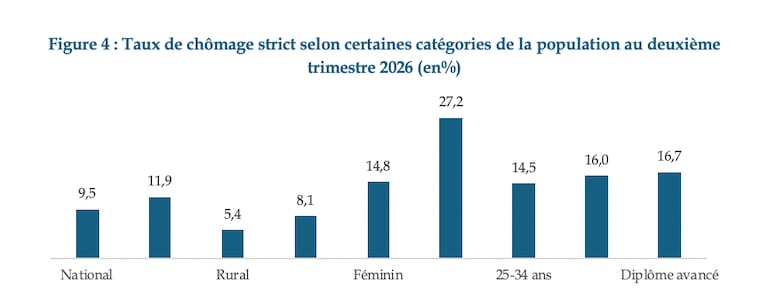
Educational attainment also continues to play a decisive role. The unemployment rate reaches 16.7% among higher education graduates, 16% among holders of intermediate qualifications, and 11.4% among those with basic qualifications, compared with just 3.8% for people with no formal qualifications.
Read also : Over half a million graduates enter Morocco’s labor market each year. Can the economy keep up?
A break in statistical continuity
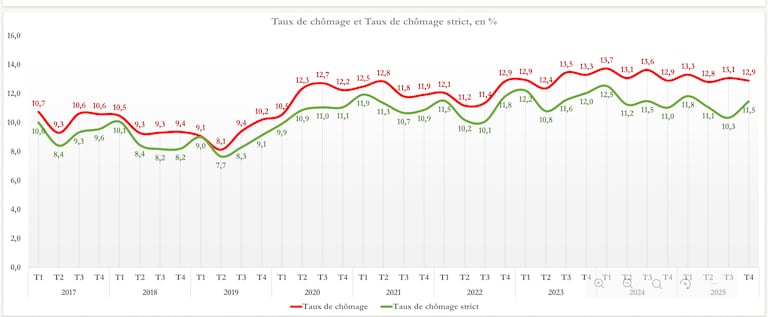
The HCP stresses that the results of the new survey cannot be directly compared with those of the previous one because of the conceptual changes introduced. To provide some continuity, the institution has published provisional backcast series covering the 2017–2025 period using the new methodology.
However, no figures have been released for the first half of 2026 under the previous methodology. That gap limits the ability to assess the labor market’s actual evolution and to measure the impact of recent public policies.
The charts published by the HCP also show that the traditional unemployment rate and the strict unemployment rate can diverge significantly. At certain points, the two indicators converge, but they can also move in opposite directions, with differences reaching as much as three percentage points.
Just months before Morocco’s legislative elections, the sharp decline in the unemployment rate appears to offer a favorable signal for the outgoing government. Yet behind this apparent improvement lies, above all, a methodological sleight of hand that fundamentally changes the way unemployment is calculated without necessarily reflecting a tangible improvement in employment. Changing the thermometer does not necessarily mean the fever has broken.
