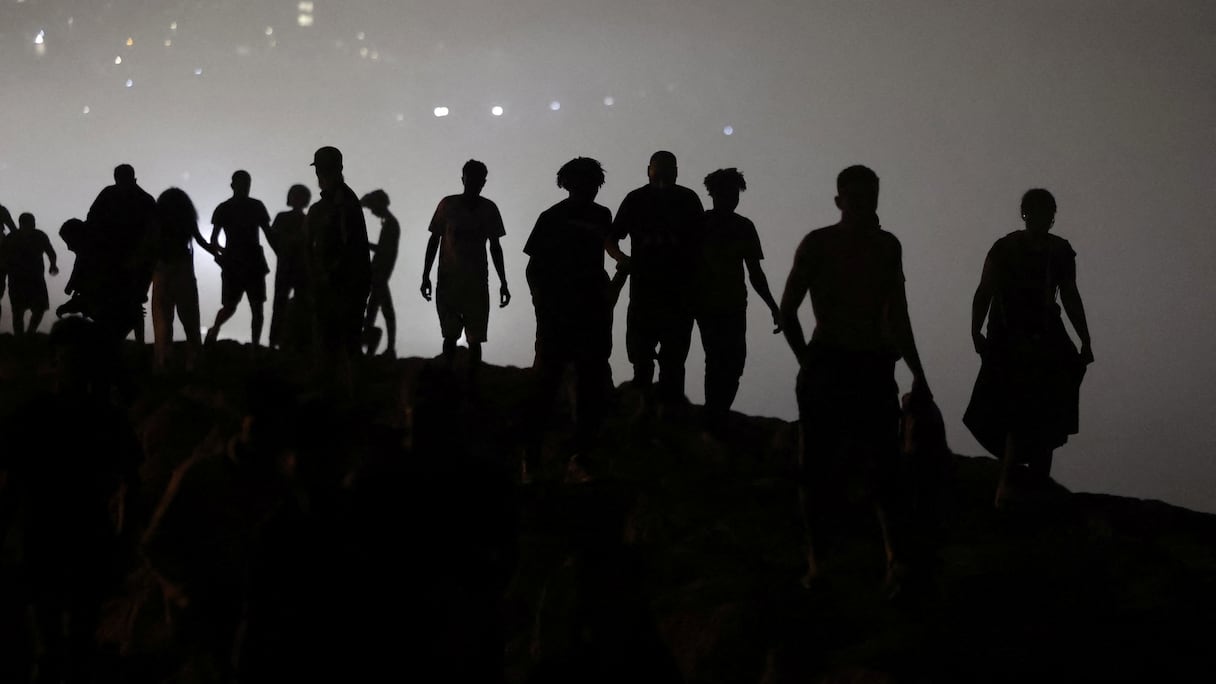
From the outset, the report sets out a clear finding. What happened was not merely a temporary surge in migration pressure, but a genuine warning signal about the state of confidence, employment and the ability of institutions to channel social frustrations toward credible prospects. In other words, Ceuta has revealed tensions that have been building among part of Morocco’s youth.
A human crisis above all
One of the report’s strongest messages is its focus on “human value.” The authors argue that counting flows or debating figures is not enough. Estimates also vary depending on the source: Moroccan authorities put the number of people directed toward Ceuta at around 40,000 and toward Melilla at 1,135, while Spanish estimates put the number of entries at around 50,000 and returns at more than 48,000. The number of deaths also varies between accounts.
For the center, the issue goes beyond these discrepancies. It is about establishing a consolidated account, identifying victims and missing persons, informing families and investigating failures. “Human value must be the starting point and the criterion for judgment,” the report stresses, calling for an approach that moves beyond statistics alone.
Read also : Migration crisis: CNDH reports serious human rights violations
The document also sheds light on the role of social media and disinformation. Messages gave the impression that entering Ceuta would quickly open the way to mainland Spain. But for the authors, the rumor was merely a spark. It does not, on its own, explain the scale of the phenomenon.
Instead, it encountered an already fragile environment marked by unemployment, a lack of clear prospects and a deficit in social mediation. The report also points to a gap between security preparations, which were discussed internally, and public communication, which it considers to have come too late in the face of the rapid spread of digital content.
Another major lesson is the gap between macroeconomic indicators and people’s lived reality. Morocco recorded 4.9% growth in 2025 while keeping inflation under control, and investment also increased significantly. However, this momentum did not translate equally into the daily lives of households.
The report stresses that the employment issue cannot be reduced to the unemployment rate. The labor force participation rate remains low at 41.8%, particularly among women at 17.5%, while labor underutilization remains high, especially among young people. Added to this is the familiar vicious cycle: “no job without experience, no experience without a job.”
Fnideq: A symptom of a territorial imbalance
The situation in the M’diq-Fnideq prefecture illustrates these imbalances. Its unemployment rate stands at 29%, well above the regional average. However, the report stresses that the movement toward Ceuta cannot be reduced to this area alone. Young people from several cities took part in attempts to cross.
Fnideq thus appears as a territory under pressure, where geographical proximity to Europe heightens perceptions of gaps in living standards and services, encouraging rapid reactions to rumors.
In response to these findings, the center is calling for a paradigm shift. The response cannot be limited to adding more public programs. It must be based on a clear framework, time-bound objectives, defined responsibilities, published data and independent evaluation.
The report notably proposes the establishment of a five-year “national mission contract” centered on three priorities: the ability to remain in Morocco in dignified conditions, access to productive employment and stronger confidence in institutions.
Among the concrete measures proposed is the universal provision of a first paid and supervised professional experience, combined with training and skills certification.
A specific territorial plan for the M’diq-Fnideq-Tetouan area is also recommended, linked to opportunities offered by Tanger Med and the region’s productive sectors.
Read also : Ceuta: Algerian network preparing fresh mid-August mobilization, warns Stefano Piazza
Beyond its recommendations, the report puts forward a central thesis. The Ceuta crisis is the product of a convergence of factors: economic and social vulnerabilities, digital rumors, a deficit in social mediation, shortcomings in institutional communication and the geopolitical dimension of the border.
According to its authors, it is a test of Morocco’s ability to turn its achievements — infrastructure, industrialization and stability — into clear and tangible individual paths for its youth.
“The border does not begin at the fence,” the document concludes. It begins when citizens doubt their place in the economy, their voice in institutions and their share of the future. Conversely, making staying in Morocco a rational and dignified choice, and migration a legal and informed decision, requires an inclusive economy and a society capable of fully recognizing the value of its young people.
From this perspective, the Ceuta crisis appears less as an isolated episode than as a moment of truth. A moment that calls for rethinking the relationship between youth and public policy, beyond emergency responses.
