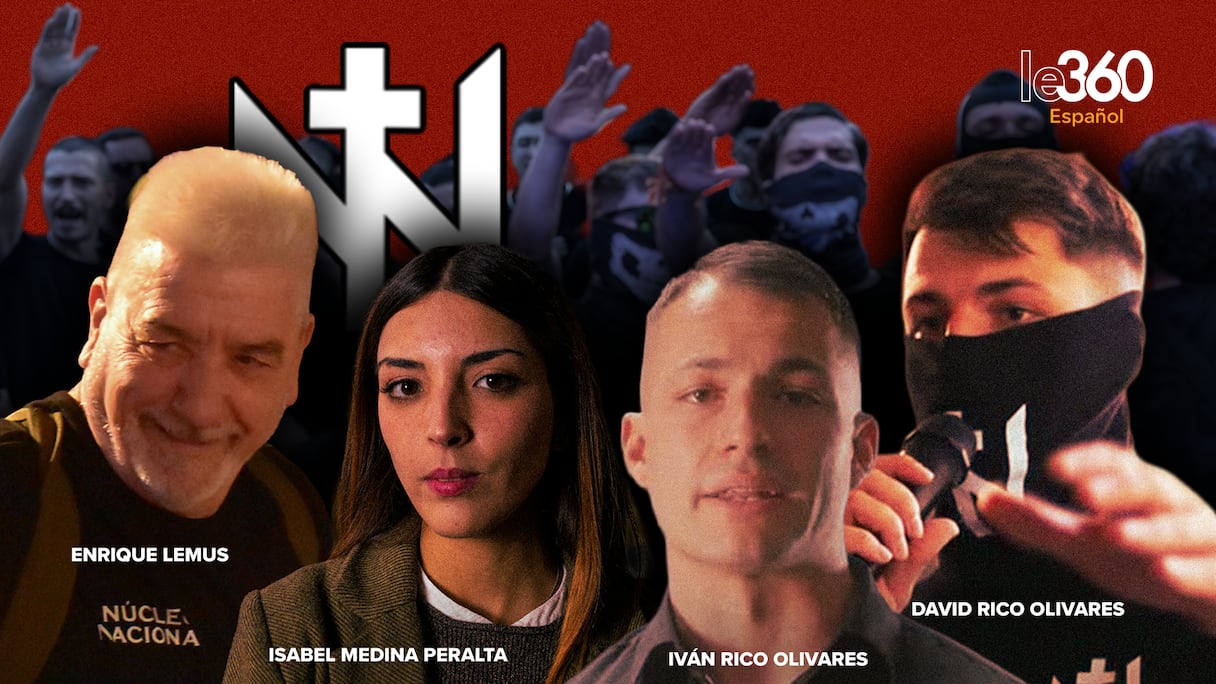
For months, the most recognizable figure of Núcleo Nacional was, paradoxically, a man whose face no one had ever seen. Dressed in black and wearing a balaclava, he appeared in the group’s videos speaking of “race,” the “Reconquista,” “foreign invasion,” and “demographic replacement.” He identified himself simply as Iván.
In July 2026, the masked man chose to reveal his identity. Standing before television cameras was Iván Rico Olivares, an administrative employee, the son of a former People’s Party municipal councilor, and the principal operational leader of an organization that had made anonymity and paramilitary aesthetics two of its defining hallmarks.
The move was carefully calculated. Iván Rico did not remove his mask to moderate his rhetoric but to announce Núcleo Nacional’s transition into a new phase. After the streets, gyms, social media, and anti-immigration rallies, the time had come, in his own words, to use “the regime’s tools” and enter the electoral arena.
Read also : Anti-Moroccan hatred gains alarming ground in Spain
The association will continue to operate under the name Núcleo Nacional, but the political party officially registered to contest elections bears a different name: Noviembre Nacional (“National November”). The name is a direct reference to the November 2023 demonstrations outside the PSOE headquarters on Madrid’s Ferraz Street, where the movement first emerged. The electoral shift therefore reflects no ideological transformation—only a change of strategy. A movement that once promised to fight the system in the streets now intends to use the very institutions it rejects to “blow them up from within,” as its leaders have explained to supporters.
Ferraz: The Far Right’s Incubator
Núcleo Nacional emerged from the protests against Spain’s amnesty law held in the autumn of 2023 outside the Socialist Party (PSOE) headquarters on Ferraz Street in Madrid. Those demonstrations brought together Vox activists, Falangists, neo-Nazis, football ultras, and members of various far-right fringe groups. As the protests gradually lost momentum, the most radical participants maintained the contacts forged during those evenings and began organizing under the name Noviembre Nacional.
In January 2024, the collective became active on Telegram. On April 14, it held its first public presentation at Madrid’s Espacio Ardemans, a venue historically used by La Falange. The date itself—the anniversary of the proclamation of Spain’s Second Republic—was chosen as an act of provocation. During that gathering, the masked leader, later identified as Iván Rico, declared his intention to unite under a single banner “Francoists, Falangists, and National Socialists”—the latter term referring, quite simply, to Nazis.
The new organization thus became a rallying point for former members of Bastión Frontal, Democracia Nacional, Skin Moncloa, Ultras Sur, and activists from Falangist circles. It also occupied part of the political space left vacant by Hogar Social Madrid. Veterans contributed organizational experience, former Bastión Frontal members brought youth and social media expertise, while football ultras injected a culture centered on physical strength and street confrontation.
In August 2024, Núcleo Nacional was officially registered in Spain’s National Register of Associations as a “civic-political” organization, listing an address in Valladolid historically associated with Democracia Nacional. This legal status enabled it to collect membership dues, sell merchandise, rent venues, and organize events, while Spain’s Civil Guard began examining some of its videos and public statements for potential hate crimes.
At the same time, the organization sought to shed the traditional image of skinheads and football hooligans. The old neo-Nazism of shaved heads, fringe bars, and urban subcultures gave way to a more polished aesthetic: black clothing, professionally produced videos, gyms, book clubs, podcasts, Telegram channels, and branded merchandise. The message remained virtually unchanged; only its presentation was modernized.
The Rico Brothers: The Power Behind the Balaclava
Iván Rico Olivares is the political face and chief spokesman of the organization. Throughout nearly the entire first phase of Núcleo Nacional’s existence, he concealed his identity behind a balaclava, cultivating an intimidating image while making public identification more difficult.
This carefully staged anonymity contrasted sharply with his intense online activity. His speeches were distributed through short videos combining epic music, footage of physical training, and scenes of activists marching dressed entirely in black.
His brother, David Rico Olivares, plays a less visible but equally essential role in the movement’s propaganda apparatus. Much of the group’s digital strategy and content distribution is attributed to him. According to police sources cited by El País, the two brothers live in a municipality in the province of Guadalajara, near Madrid.
By publicly removing his balaclava, Iván Rico symbolically marked the transition from militant subculture to electoral politics. It is difficult, after all, to run as a candidate, grant interviews, and campaign while continuing to embody the anonymous masked figure. When asked by a La Sexta journalist how he felt about being described as racist, Rico smiled and replied: “I’m fine with that.” Speaking before supporters, he was even more explicit: “We are racists—or racialists.” The semantic distinction is intended to lend an air of ideological sophistication to a worldview that ranks individuals according to their ethnic origin.
Enrique Lemus: The Veteran Who Knows the Machinery
The third key figure is Enrique Lemus Sánchez. Older than the Rico brothers, Lemus comes from Democracia Nacional, one of the historic parties of Spain’s extra-parliamentary far right.
His role lies less in digital propaganda than in his experience with the inner workings of political organizations. Lemus understands party structures, administrative procedures, the functioning of associations, and the establishment of territorial networks. He serves as the bridge between the old far right of the 1990s and a new generation politically shaped by Telegram, YouTube, and TikTok.
On February 10, 2026, it was Lemus who officially registered Noviembre Nacional in the Ministry of the Interior’s Register of Political Parties. He appears as president of the new nationwide political formation, headquartered at the same Valladolid address as Núcleo Nacional.
Read also : Poll: 77.3% of Spaniards view Morocco as an “enemy country”
In practice, however, Iván Rico remains the movement’s principal public leader, while Lemus contributes the legal and organizational expertise required to transform the group into a political party.
Around them revolves a broader ecosystem of propagandists, including neo-Nazi singer Alberto Pugilato and content creator David Santos, who amplify the group’s events and broaden its reach beyond traditional activist circles.
Isabel Medina Peralta: The Movement’s Most Recognizable Face
While Iván Rico embodies the organization’s operational leadership, Isabel Medina Peralta is by far its best-known public figure.
Peralta first rose to prominence in February 2021 when, at just 18 years old, she delivered an antisemitic speech during a tribute to Spain’s Blue Division at Madrid’s La Almudena cemetery. In that speech, she blamed “the Jew” for a wide range of social problems, instantly becoming one of the leading figures of Spain’s neo-Nazi movement.
After joining La Falange, she helped found Bastión Frontal before traveling to Germany to receive training from the neo-Nazi party Der III. Weg (“The Third Way”), an organization monitored by German authorities for combining political propaganda, physical discipline, and street activism. In 2022, German authorities barred her from entering the country after discovering a Nazi flag in her luggage. The public display of such symbols is prohibited under German law.
Following Bastión Frontal’s collapse, Peralta attempted to establish Sección de Asalto, a small group inspired by several European neo-Nazi organizations. During the 2023 Ferraz protests, she climbed onto a bus shelter and performed the Nazi salute. Even some conservative demonstrators booed her—a scene that exposed the limits of her acceptance even within the broader anti-government protest movement.
In April 2025, Madrid’s Provincial Court sentenced her to one year in prison, imposed a six-month fine, and barred her from holding public office for one year after convicting her of inciting hatred. The charges stemmed from an unauthorized demonstration held outside the Moroccan Embassy in Madrid on May 18, 2021.
During that protest, organized amid the Ceuta migration crisis, Peralta denounced an alleged “racial replacement” and shouted slogans such as “Death to the invader.” The court ruled that her remarks went far beyond expressing an opinion on immigration and amounted to incitement to a “violent struggle” against Moroccans and Muslims.
In July 2026, Madrid’s High Court of Justice upheld her conviction. Peralta responded by tearing up a copy of the ruling before television cameras before once again performing the Nazi salute outside Morocco’s embassy in Madrid.
Her presence within Núcleo Nacional serves a dual purpose. It gives the movement considerable media visibility while connecting it to international neo-Nazi networks. At the same time, it ties the organization directly to an anti-Moroccan discourse that is far from incidental and has instead been one of the defining threads of her political trajectory.
Openly Embracing Nazism
Isabel Medina Peralta openly identifies as a National Socialist. The term might appear to describe some vague blend of nationalism and socialism, but in reality it leaves no room for ambiguity: National Socialism is the full name of Adolf Hitler’s Nazi ideology, founded on racial supremacy, antisemitism, authoritarianism, and the subordination of the individual to a community defined by blood and ancestry.
In Peralta’s case, this is no provocative label casually adopted. Her antisemitic speeches, admiration for Hitler’s Germany, training with Germany’s neo-Nazi party Der III. Weg, and repeated Nazi salutes leave little room for alternative interpretation.
Nor does Núcleo Nacional seek to conceal the fact. At the movement’s launch, Iván Rico explained that he intended to unite “Francoists, Falangists, and National Socialists.” Another activist was even more direct: “Nazis? Fascists? Of course we are!”
That ideology is reflected in a platform that places racial identity at the foundation of the nation. Núcleo Nacional presents the “defense of the race” as the “backbone” of the Spanish people, encourages higher birth rates among Spaniards, and rejects multicultural society. Its leaders also promote the conspiracy theory known as the “Great Replacement,” according to which elites are deliberately encouraging immigration in order to replace Europe’s native populations.
From this follows their proposal for “remigration”—a euphemism extending well beyond the deportation of undocumented migrants. It also targets legally established immigrants and even Spanish citizens of foreign origin whom the movement considers racially incapable of assimilation. For Núcleo Nacional, citizenship depends not only on nationality or birthplace but also on ancestry.
Read also : The PP’s Morocco double game on the road to La Moncloa
Added to this racial doctrine are antisemitism, antifeminism, opposition to LGBT rights, abortion, and euthanasia; Francoist revisionism; and admiration for various European fascist movements.
The organization has modernized its image and is preparing to contest elections, but neither its updated aesthetic nor its new political status alters the substance of its ideology. Beneath the electoral packaging remains a doctrine that its own leaders proudly call by its proper name: National Socialism.
“El Nido”: The Heart of Núcleo Nacional
One of the keys to Núcleo Nacional’s development lies in its determination to build a community extending beyond traditional political activism.
Its Madrid headquarters, located in the Las Tablas district and known as El Nido (“The Nest”), covers approximately 530 square meters. It includes a gym, a library, a lecture hall, a terrace, a bar, and a merchandise store selling T-shirts, bracelets, and other products. According to El País, a portrait of Adolf Hitler hangs prominently in the library.
The gym is far more than an auxiliary facility. Physical conditioning and hand-to-hand combat occupy a central place in the movement’s culture. Its leaders present the disciplined body as a metaphor for the nation they seek to build: strong, homogeneous, masculine, and ready for confrontation.
Isabel Peralta has explained that the objective is to create a community of “supermen” willing to die for their homeland and their comrades. The ideal activist is expected to study, work, train, and subordinate personal life to the needs of the collective.
The movement’s book clubs are intended to lend an intellectual veneer to its ideology. Participants study Falangist, Francoist, and National Socialist texts. Peralta has even encouraged the reading of books burned by Hitler’s regime, arguing that people should understand why they had been banned.
Complementing these activities is a highly effective digital machine. The organization’s videos are professionally produced, featuring tight camera shots, martial music, matching uniforms, training sessions, and short, punchy slogans. The aim is not to persuade through lengthy political manifestos but to cultivate identity, project strength, and foster a sense of belonging.
In November 2025, police intelligence sources estimated Núcleo Nacional’s membership at around 1,500, mostly young people paying monthly dues of €10. That figure, however, has not been independently verified. Beyond membership fees, the organization finances itself through donations, crowdfunding campaigns, and the sale of clothing and accessories. Some of its T-shirts contain coded references to Nazism, white supremacy, and the Holocaust.
The merchandise serves not only to fund the organization but also to allow supporters to display a shared identity without resorting to explicit Nazi symbols that could trigger criminal proceedings or social rejection.
The movement has established branches in Madrid, Valladolid, and Barcelona and announced plans to expand into Asturias, Marbella, and other cities. Nevertheless, a considerable gap remains between its social media following, its claimed membership, and its actual ability to mobilize supporters. Its principal demonstrations generally attract between 150 and 200 participants, although larger turnouts are occasionally achieved through cooperation with other far-right groups.
Morocco as the Designated Enemy
Within this racial worldview, Morocco occupies a unique place. Núcleo Nacional portrays it not merely as the country of origin for part of Spain’s immigrant population but as an adversary deliberately acting against the Spanish people. Rejection of Moroccan immigrants thus merges seamlessly with hostility toward Islam.
The organization has summed up this position in an unequivocal slogan: “Morocco is our enemy.” During the latest migration crisis, Iván Rico declared outside Morocco’s embassy that “Ceuta has been invaded,” portraying the arrival of migrants as “a dress rehearsal by the Moroccan government” ahead of a future operation against Ceuta and Melilla.
Such language is far from innocent. By speaking of an “invasion,” Núcleo Nacional erases any distinction between the Moroccan state, human trafficking networks, and the thousands of young people who attempted to reach Ceuta. All are merged into a single perceived threat. The Moroccan is no longer portrayed as an individual migrant but as the vanguard of a political and demographic project.
This hostility also targets Moroccans legally residing in Spain. Under the movement’s racial conception of nationhood, acquiring Spanish nationality—or even being born in Spain—does not necessarily make someone Spanish. This explains why its slogans combine calls for “deportation” with far more explicit chants such as: “Moors Out of Spain.”
The Ceuta crisis provided the organization with an opportunity to translate those slogans into action. On July 31, Núcleo Nacional gathered outside the Moroccan Embassy in Madrid. Isabel Medina Peralta tore up the judicial ruling confirming her conviction for inciting violence against Moroccans and Muslims—a sentence stemming from a demonstration held at the same location in 2021. She then performed the Nazi salute, prompting someone in the crowd to respond with a “Sieg Heil.” The following day, around ten activists led by Iván Rico traveled to Ceuta to continue their campaign.
The operation ended far from the show of strength they had hoped for. Upon arriving at the port, the activists were confronted by local residents who accused them of exploiting the crisis to spread hatred. Spain’s National Police had to escort them, and they eventually left the city without staging their planned demonstration. One masked activist initially refused to uncover his face for fear of being recognized at his workplace—a revealing contrast between the movement’s aggressive imagery and its members’ willingness to personally bear the consequences.
Isabel Peralta’s presence also demonstrates that this fixation is long-standing. In May 2021, before Núcleo Nacional even existed, she had already exploited an earlier migration crisis in Ceuta by denouncing a “racial replacement without precedent” outside the Moroccan Embassy and shouting “Death to the invader.” Convicted for those remarks, she returned to the same location five years later with the very same message.
In one of her most recent videos, she attempted to deny being Islamophobic through a statement that, in reality, laid bare her underlying worldview: “I’m not Islamophobic. I simply have a problem with Moroccans.”
Morocco is not the movement’s only designated enemy, but it is the one through which Núcleo Nacional fuses all its obsessions into a single figure: race, immigration, Islam, territory, and national decline. Every diplomatic dispute, migration movement, or border incident reinforces the same narrative—that of a Spain betrayed from within and besieged from the south.
This is therefore far more than opposition to immigration. It is a specifically anti-Moroccan discourse, repeated in the organization’s slogans, embodied by its leaders, and now carried from social media into the streets.
The Danger of Normalization
Entering the electoral arena allows Núcleo Nacional to extend its reach beyond street activism and online propaganda. Under the Noviembre Nacional banner, the movement will be able to field candidates, campaign publicly, and cloak a project still rooted in racial supremacy and rejection of democracy with a veneer of institutional legitimacy.
Its chances of securing parliamentary representation remain limited. Yet its influence cannot be measured solely by the number of seats it wins. The group can recruit new activists, attract funding, inject its vocabulary into public debate, and push other ultra-right formations toward even more radical positions. Concepts once confined to neo-Nazi circles—such as “remigration” and “racial replacement”—are already beginning to be presented as legitimate political proposals.
It is precisely in this process of normalization that the real danger lies. Contesting elections does not change the nature of Núcleo Nacional, but it may gradually strip away its image as a fringe extremist group. When racism becomes “racialism,” mass expulsions become “remigration,” and neo-Nazism becomes just another electoral candidacy, only the packaging changes. The project itself remains exactly the same.
