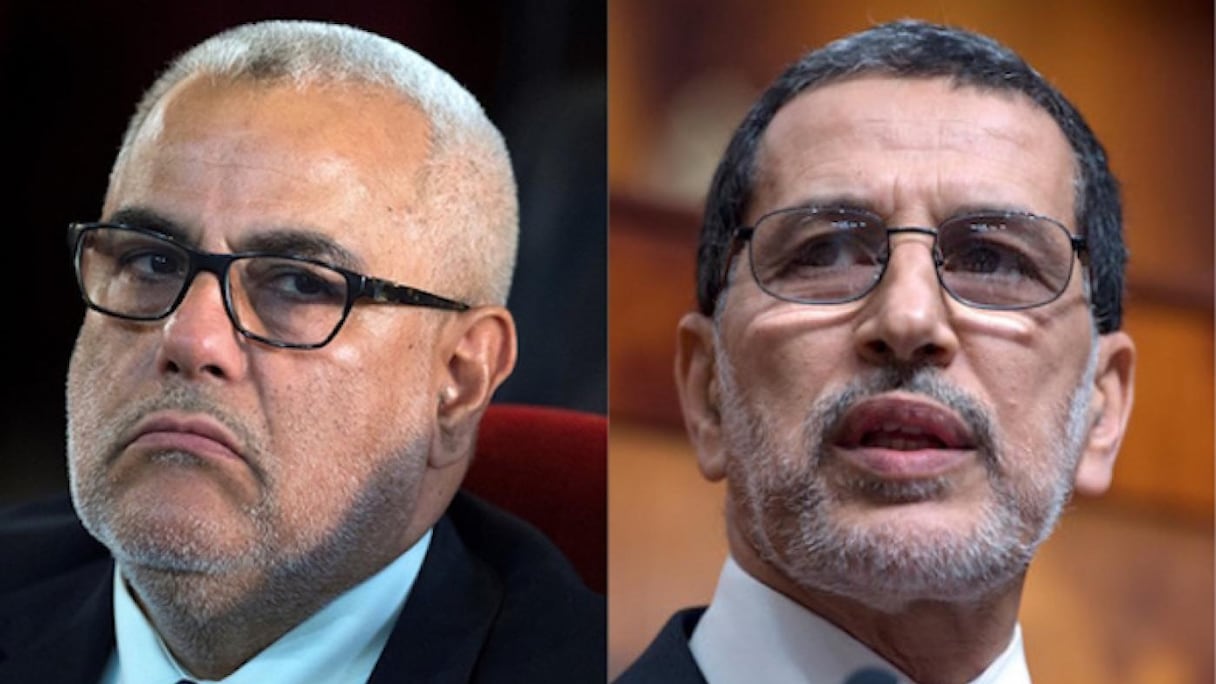
It all began with a single remark. Abdelilah Benkirane made it at a party rally in Nouaceur last weekend, and within hours an old feud inside the Justice and Development Party (PJD) had burst back into the open. In a scathing rebuke, Benkirane told Saâd-Eddine El Othmani to “stay home” and get on with his academic work, accusing him of making too many public appearances and risking, in his words, “sowing confusion” within the party.
The broadside followed another episode a few days earlier. Justice Minister and PAM leader Abdellatif Ouahbi had publicly revived the question of El Othmani’s responsibility for signing the 2020 agreement that accompanied the resumption of relations between Morocco and Israel. Ouahbi had notably questioned why Benkirane had taken no action against his successor when El Othmani, as head of government, had been the one to sign the agreement.
Benkirane’s remarks in Nouaceur came in response. The clip quickly spread across social media, with one line directed at El Othmani dominating the reaction: “Stay home.”
The reaction inside the PJD was swift. Several senior party figures came to El Othmani’s defense, arguing in particular that responsibility for normalization could not simply be laid at the former head of government’s door.
On social media, former Employment Minister Mohamed Yatim questioned the wisdom of dragging the 2020 agreement back into the debate. Khalid Samadi, a former higher education minister, urged that the decision be viewed in its proper context and with all the circumstances surrounding it taken into account. Mohamed Amine Dahaoui, a member of the PJD Youth National Council, argued that disputes of this kind belonged inside the party’s institutions rather than being played out in public.
Then, on Tuesday, Hassan Abbasi, a former adviser and chief of staff to Saâd-Eddine El Othmani, broke his silence with a video responding to Benkirane. He did more than simply defend his former boss. Abbasi went back through several chapters of the PJD’s recent history, challenging Benkirane’s version of events point by point.
Abbasi begins by recalling the years he says he spent working alongside El Othmani. His account reaches back to 2013, when the Istiqlal Party withdrew from the governing coalition, plunging Benkirane’s government into crisis.
According to Abbasi, when negotiations began to bring the RNI into government, Saâd-Eddine El Othmani was expected to relinquish the Foreign Affairs portfolio to Salaheddine Mezouar and take over the Education Ministry instead. Abbasi says El Othmani ultimately gave up that option to help keep the governing coalition intact.
Then came 2017. After Abdelilah Benkirane failed to form a majority following the 2016 legislative elections, Saâd-Eddine El Othmani was tasked with forming a new government. The succession has since been portrayed in some accounts as the moment the relationship between the two men broke down. Abbasi rejects that version. He says El Othmani secured Benkirane’s agreement before accepting the task entrusted to him and before the matter was put to the party’s governing bodies.
Abbasi’s point is clear: El Othmani did not exploit Benkirane’s predicament to take his place.
He then turns to the issue at the heart of the latest war of words between the two men: the 2020 agreement on the resumption of relations between Morocco and Israel.
This time, Abbasi turns Benkirane’s own record against him. After the agreement was announced, the former head of government publicly defended El Othmani and rejected attempts to hold him solely responsible for a decision taken while he was serving as head of government.
On Tuesday, October 6, Benkirane finally returned to the controversy in public.
In a clarification posted on his Facebook page, the PJD secretary-general first argued that the clip from his remarks at the Mediouna rally had been taken out of context. His comments, he said, had come in response to what he described as a “cowardly attack” by Abdellatif Ouahbi.
More importantly, Benkirane reaffirmed his regard for his former political ally, pointing to the decades they had spent working together and saying he continued to hold El Othmani in “the utmost respect and esteem,” despite their differences over how certain situations and positions should be viewed.
On the substance, however, Benkirane did not entirely back down. He maintained that El Othmani would have been better off staying away from certain activities which, he argued, could be seized upon by the party’s opponents and used against it.
Then came the attempt to draw a line under the row. Benkirane said his public call for El Othmani to “stay home” had not been intended to cause offense. “If my remarks may have caused him offense, I want to assure him that this was not intentional, and I ask him to excuse me,” he wrote in substance.
In trying to call El Othmani to order, Benkirane reopened a file he might have preferred to keep closed. The backlash from within his own camp has instead brought his own statements from 2020 back to the surface. Far from putting the controversy to rest, his apology merely shifted the spotlight onto Benkirane himself.
