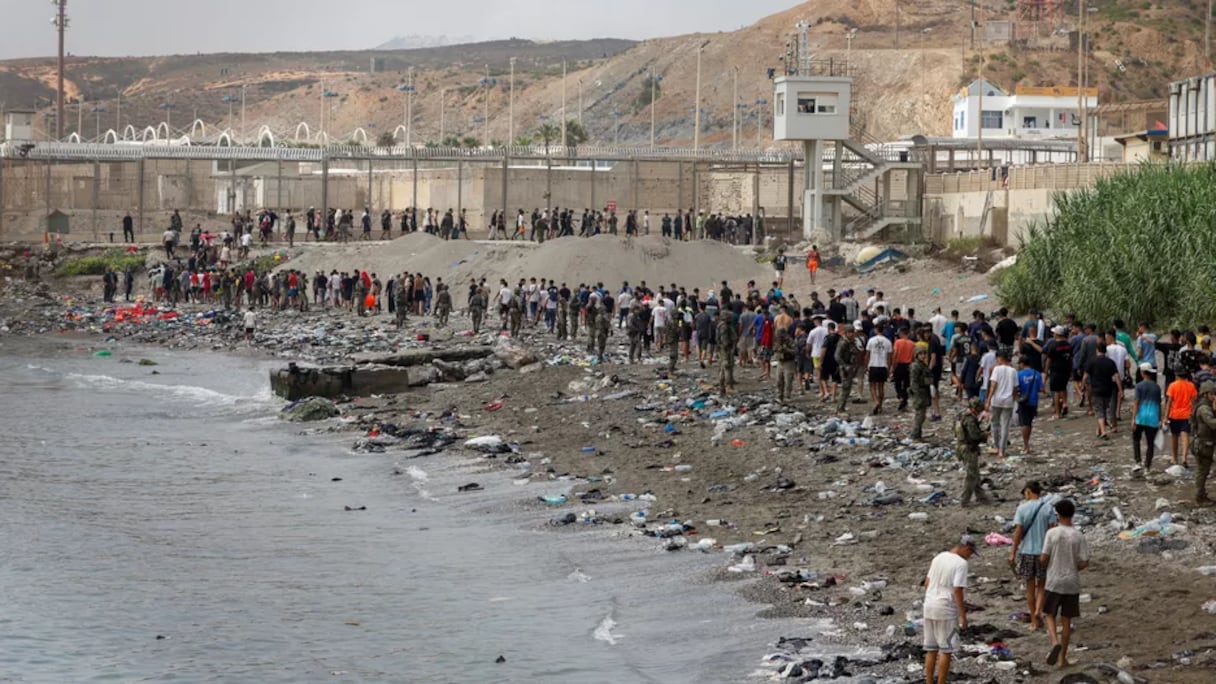
Following an unprecedented wave of migration that saw about 60,000 people attempt to reach the occupied enclave of Ceuta over the course of a few days, according to the Spanish authorities, return operations are continuing at a steady pace. Figures from Spain’s Interior Ministry. show that 25,000 people had already left the enclave by 1 p.m. on Friday. The smooth flow at the crossing points has allowed departures to continue regularly, at a rate of around 150 people per minute.
Speaking from Ceuta on Friday, Spanish Prime Minister Pedro Sánchez highlighted the effectiveness of the partnership with the Kingdom.
“I thank the Moroccan authorities for their willingness to cooperate on the repatriation operations,” he said, adding that he remains in constant contact with Rabat to coordinate efforts on the ground.
The direct coordination aims to quickly ease pressure on Ceuta, where the migrant influx represents nearly 70% of the enclave’s usual population. According to the Spanish police, 41 people died during the sea crossings.
Read also : Fnideq-Ceuta crisis: repatriation of migrants gets underway
Joint analyses conducted by the Moroccan and Spanish authorities point to the central role played by migrant smuggling networks in triggering the mass movement. According to Pedro Sánchez, these criminal networks deliberately exploited and distorted a recent ruling by Spain’s Supreme Court concerning the return of people arriving by sea in order to encourage migrants to rush toward the enclave’s entry points. He said the misleading interpretation spread “like wildfire,” deceiving thousands of people.
Alongside the events in Ceuta, an attempted incursion was also recorded in Melilla, where 130 people, a significant proportion of them minors, managed to enter the enclave, according to comments by government delegate Sabrina Moh reported by El País. Morocco and Spain continue to maintain the highest level of vigilance while strengthening their security and diplomatic coordination to stabilize the area and prevent further waves of migration.