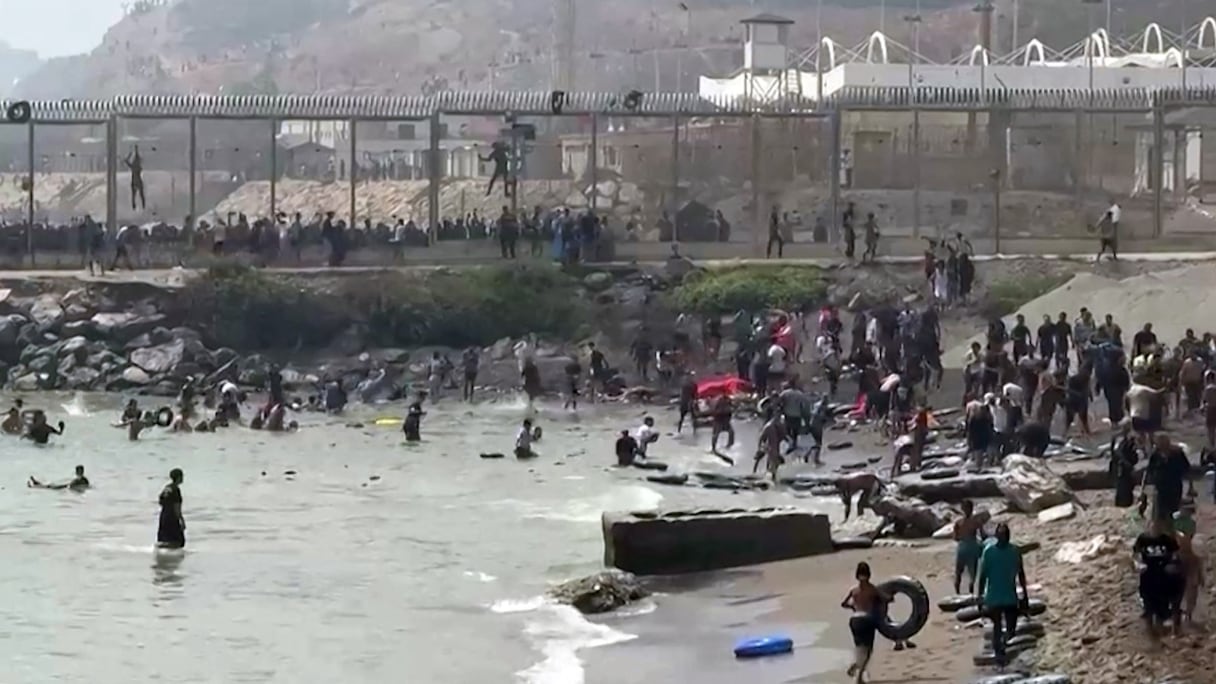
The operation to return migrants who entered Ceuta illegally is underway. It began on Thursday and continued actively on Friday, July 31, 2026, following a swift agreement and close coordination at the highest level between the Moroccan and Spanish authorities.
The measures adopted provide for the systematic return of all those who took part in the crossing, ruling out any possibility of regularization. Judicial proceedings are also being considered.
In response to the seriousness of the events, Spanish officials praised their cooperation with the Kingdom. Spanish Interior Minister Fernando Grande-Marlaska denounced the exploitation of judicial rulings by migrant smuggling networks and highlighted the “exemplary cooperation” between Rabat and Madrid. He expressed his gratitude to the Moroccan security forces for their preventive efforts on the ground, noting that no sea arrivals had been recorded in Ceuta in 2026 before July 15.
Read also : Morocco, Spain agree to repatriate all migrants who reached Ceuta from Fnideq
Spanish Prime Minister Pedro Sánchez also addressed the situation on social media platform X.
“We are mobilizing all the necessary resources, working with the Moroccan and international authorities, and preparing the measures required to restore normality as quickly as possible,” he said.
Tensions that had been building along the Fnideq-Ceuta coastline descended into chaos on Wednesday, July 29, and Thursday, July 30, 2026. Following calls that spread rapidly through social media and word of mouth, thousands of people gathered on the beaches of Fnideq, the closest point to Ceuta.
At least 18 dead in the crossing
Determined and organized in groups, thousands of migrants seeking to leave crossed into the sea in an attempt to reach Ceuta by swimming around the breakwater. On the ground, security forces were confronted with intense violence and an almost unmanageable security situation.
According to profiles of the migrants recorded at the scene, 60% were Algerian nationals who had been waiting for an opportunity to exploit a security breach. Around 35% were Moroccan nationals, mainly young people reportedly encouraged by rumors that they would not face immediate return, while the remaining 5% were from sub-Saharan Africa.
The attempted sea crossing proved particularly tragic because of the strong currents and turbulent waters along the breakwater. According to the provisional toll announced by the Spanish government, at least 18 people were confirmed dead, with their bodies recovered in Ceuta, around 20 others remain missing, and several people were seriously injured.
The sudden rush was triggered by human trafficking networks exploiting a legal ruling. On July 8, 2026, the Fifth Section of the Administrative Litigation Chamber of Spain’s Supreme Court issued a decision, following an appeal by an Algerian national, prohibiting immediate pushbacks (devoluciones en caliente) for migrants arriving by sea.
The court required the authorities to open an individual administrative identification procedure before expelling any migrant arriving by sea. Widely circulated from July 10 onward, the ruling was subsequently distorted on social media and mistakenly perceived as a guarantee against immediate deportation and as an opportunity to access Spain’s ongoing regularization procedures.
While Rabat and Madrid jointly managed the immediate security and humanitarian response, the events once again brought into focus the underlying issue: the status of the occupied cities of Ceuta and Melilla.
