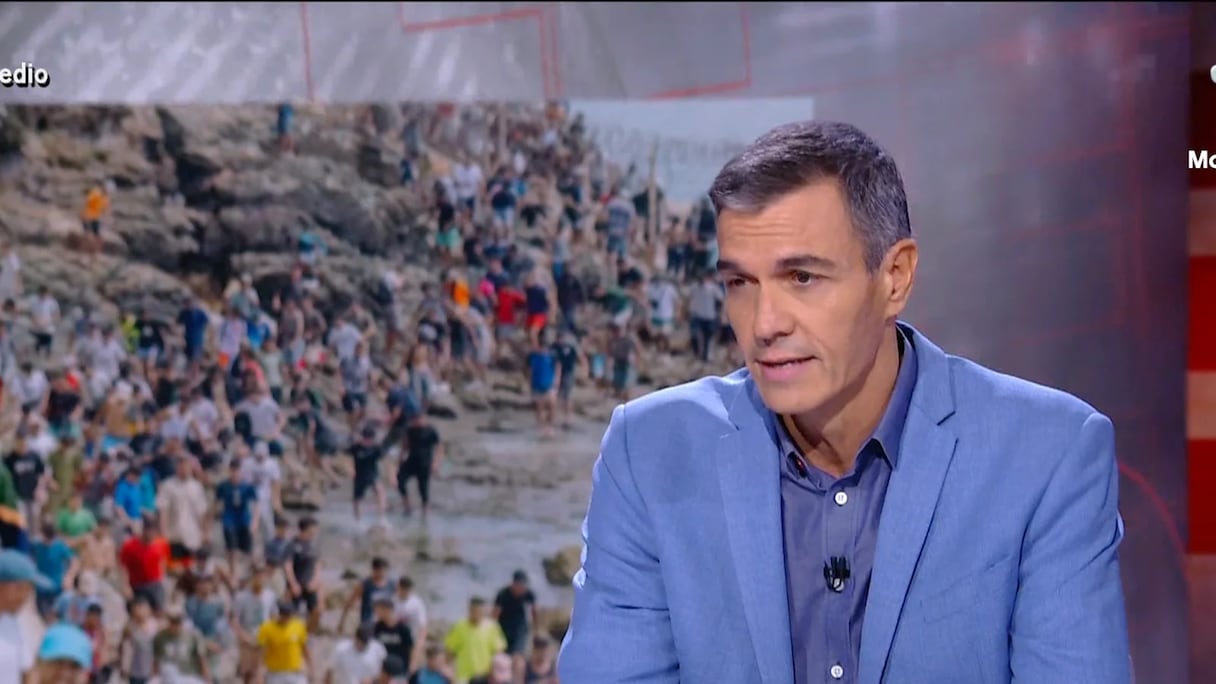
Amid continued domestic controversy and recurring tensions surrounding the Ceuta crisis, Spanish Prime Minister Pedro Sánchez offered another clarification Monday, September 14, during his appearance on “El Intermedio,” broadcast on private channel La Sexta. Reaffirming bilateral cooperation with Morocco, demanding factual evidence and categorically rejecting conspiracy theories, the Spanish prime minister is maintaining a line of institutional firmness and diplomatic realism.
Pedro Sánchez clearly reaffirmed the guiding principle of his foreign policy, stressing the need to “maintain good relations with Morocco” while calling for “patience in order to reach a comprehensive settlement to the migration crisis in Ceuta.”
Against this backdrop, the Spanish prime minister dismissed accusations from the right wing opposition, particularly Vox and the People’s Party, that Madrid had supposedly submitted to Rabat. He rejected “the possibility of blackmail by Morocco” and denied “any link between the mass arrival of migrants in Ceuta and espionage using Pegasus.”
Insisting on the rigor that must guide public action, Sánchez highlighted “the absence of evidence implicating Morocco in the events in Ceuta,” stressing that “there is currently no evidence establishing such responsibility.” To support his objective based approach in the face of political controversy, he said that “relations between countries, and particularly with neighbors, must be based on respect and facts, not on wild speculation or contempt.”
Read also : 86% of Spaniards say good relations with Morocco are important, CIS poll finds
He also reiterated the position he had expressed in previous appearances, stressing that his government would take no action without tangible evidence. “I have never said that we would not take firm action against Morocco if it is proven that it was behind what happened on July 30 and 31, (...) but as of today, there is no information that solidly establishes Morocco’s responsibility for this wave that we faced.”
Satire of conspiracy theories
Pedro Sánchez’s media appearance was also marked by a sharp criticism of disinformation and fictional scenarios promoted by some political actors to destabilize the government as well as relations between Morocco and Spain. The prime minister lashed out at false information circulating about him, comparing it to stories worthy of streaming platforms. “These false stories circulating about the mobile phone or other issues, well, maybe they are great for a Netflix series, but reality must be built on facts, not false information.”
In the same vein, he rejected the interpretation that WhatsApp messages from the National Intelligence Center (CNI) to the chief of staff of the government delegate in Ceuta “constituted a warning announcing what was actually going to happen.”
This appearance on “El Intermedio” directly follows the positions defended by the Spanish prime minister. At the end of August, during his appearance on Cadena SER’s “Hoy por Hoy,” Sánchez had already highlighted the effectiveness of operational coordination on the ground between Morocco and Spain.
Referring to the action taken by the Moroccan authorities in response to the influx of people in Fnideq, he said: “My experience with the Ceuta crisis is one of coordination and instant, immediate cooperation on the part of the Moroccan authorities. They remained in constant contact on July 30 and 31. On July 31, we began to see an operational deployment by the Moroccan authorities precisely in the Fnideq area to deal with the influx of people attempting to enter the autonomous city of Ceuta illegally.”
He also stressed the complete absence of incriminating evidence against Morocco. “There is no information from the State security forces and corps, nor from the National Intelligence Center [CNI], nor from any intelligence center with which the Spanish government normally cooperates, that would cast doubt on the participation, in any way, of the Moroccan authorities.” In response to criticism from part of the opposition seeking to turn Morocco into a preferred target for xenophobic or political rhetoric, Sánchez has consistently stressed the strategic importance of this partnership.
Read also : Spain to open Ceuta files with Morocco already in the dock
During his address to Congress on September 9, the prime minister had already set the course for his administration, refusing to give in to the escalation demanded by some political figures. “Today, we have heard many political leaders calling for our relations with our neighbor to be torn apart. Their only proposal is escalation. I cannot go down that path, I must not do so and I will not do so,” he said.
By consistently contrasting institutional transparency, illustrated by the declassification of CNI and security force documents, with unfounded political accusations, Pedro Sánchez is reaffirming a clear choice: refusing to sacrifice good neighborly relations to the demands of domestic political battles while maintaining an absolute commitment to truth and facts.
