The Popular Party (PP) has chosen to take a harder line against Morocco. After spending several days directing its attacks at Pedro Sánchez’s government, Spain’s main opposition party is now directly blaming Rabat for the events that took place in Ceuta on July 30 and for the situation that continues to unfold in the occupied city.
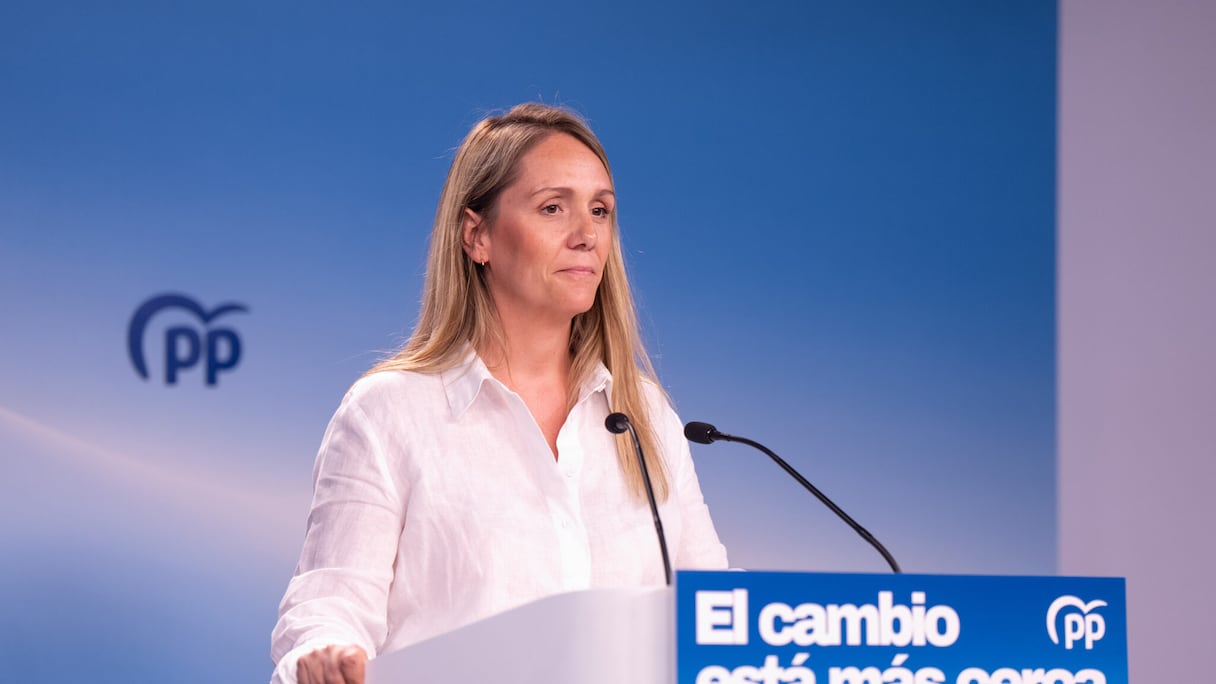
The accusation was made by Alma Ezcurra, one of the PP’s senior national figures, during a visit to Ceuta. The party’s deputy secretary for Sectoral Coordination said, in comments reported Wednesday by El Mundo, that Morocco had played a role, “by action or omission,” in the mass and irregular arrival of migrants.
“Morocco is responsible for what happened and what is still happening in Ceuta,” Ezcurra said, adding that this assessment was now shared by “the Spanish people, Europeans and the whole world.”
To support her accusation, she used a striking but difficult-to-substantiate analogy. “The Spanish people are not naive. When 70,000 people cross a border illegally and violently at the blow of a whistle, and the next day 60,000 leave the way they came at the blow of another whistle, someone must be giving the signal,” she said.
Read also : Ceuta: Spanish Gov’t says it’s working with Morocco to reunite 1,527 minors with their families
The whistle analogy allows the PP to suggest that the operation was orchestrated from Morocco without providing evidence of such coordination. It also turns the return of tens of thousands of people into an argument against Rabat, even though the same figure could instead point to the intervention of Moroccan authorities to contain the situation and facilitate the returns.
An accusation the PP had avoided until now
The statement marks a clear shift from the position adopted by the party during the first days of the crisis. Just a week earlier, PP Secretary-General Miguel Tellado had described Pedro Sánchez as the “main person responsible” for the mass arrivals in Ceuta, without directly blaming Morocco.
Two days earlier, Alberto Núñez Feijóo himself had limited his demands to greater “reciprocity, transparency and good faith” in relations between Madrid and Rabat. That cautious approach appeared consistent with the conservative leader’s stated intention to make Morocco his first international destination if he were to enter the Moncloa Palace.
Ezcurra has now abandoned that restraint. The shift gives the PP a ready-made line of attack against the PSOE, which it accuses of establishing an opaque and unbalanced relationship with Rabat. But it also draws the conservatives into a race with Vox to see who can adopt the most hostile rhetoric toward Morocco.
The PP official went so far as to declare that “Spain cannot hand over the key to its border to Rabat,” promising that a government led by her party would put an end to the situation. The statement is meant to sound firm, but it overlooks a fundamental reality. Cooperation with Morocco is not a special favor granted to Pedro Sánchez. It is a structural necessity for any Spanish government, including a potential administration led by Feijóo.
Spain can demand greater transparency or challenge certain aspects of bilateral cooperation. It cannot, however, claim that it can manage migration movements around a border that Morocco has never recognized and that separates its own territory from Ceuta, a city under Spanish administration that Rabat considers occupied.
Ceuta and Melilla turned into weapons against the PSOE
Ezcurra also seized on recent remarks by Moroccan Justice Minister Abdellatif Ouahbi to challenge the Spanish government. The Moroccan official had reiterated that Rabat continues to claim Ceuta and Melilla, a longstanding position of the Kingdom that is by no means new diplomatically.
“Is this the loyal cooperation that the government maintains with the Kingdom of Morocco?” the conservative official asked, before demanding that the government clarify whether it intended to open a “diplomatic conflict” with Rabat.
The argument nevertheless contains a contradiction. The PP is demanding that the Spanish government guarantee Morocco’s cooperation on migration while appearing to call for a diplomatic crisis because Rabat continues to uphold a position it has maintained for decades. Cooperation does not mean that the two countries have resolved all their disputes, nor that Morocco has abandoned its territorial claims.
It is equally inconsistent to accuse the Kingdom of disengaging from border management when Moroccan security forces have absorbed much of the pressure on the ground, intervened to prevent further departures and continue to deploy significant human and material resources in response to calls circulating on social media.
Morocco has also reinforced its security measures ahead of Aug. 15, the date set by several calls for new attempts to force entry, and has warned that the law will be enforced to the fullest extent. Rabat has also asked Spain to unblock the procedures required for the immediate return of unaccompanied Moroccan minors. These are difficult to reconcile with the image of a country that has deliberately abandoned its responsibilities.
A strategy that could backfire on Feijóo
The PP’s offensive may bring immediate political benefits in Spain. It allows the party to target Sánchez, challenge the PSOE’s foreign policy and prevent Vox from monopolizing the most aggressive rhetoric toward Morocco. In the medium term, however, the consequences could prove far less beneficial for the conservatives.
Feijóo says he wants to rebuild relations with Morocco on the basis of trust, seriousness and mutual respect. Such a relationship will be difficult to build on unsubstantiated accusations, threats of a rupture and a rhetorical competition with Vox.
Read also : Ceuta and Melilla remain on the table, Ouahbi says, as Morocco rules out escalation
Morocco is doing its part to monitor access points and is shouldering pressure that it cannot sustain indefinitely on its own. Spain, for its part, must meet its own obligations when people reach territory under its administration by applying the identification, protection, asylum or residency procedures provided for under its legislation.
The PP is fully entitled to hold Sánchez accountable for his handling of the crisis and demand explanations. But turning Morocco into a weapon in Spain’s political battle will not resolve the situation in Ceuta, nor will it strengthen bilateral cooperation. Above all, this strategy will not help Feijóo build the stable and calm relationship he would need from his first day in office if he were ever to govern Spain.
