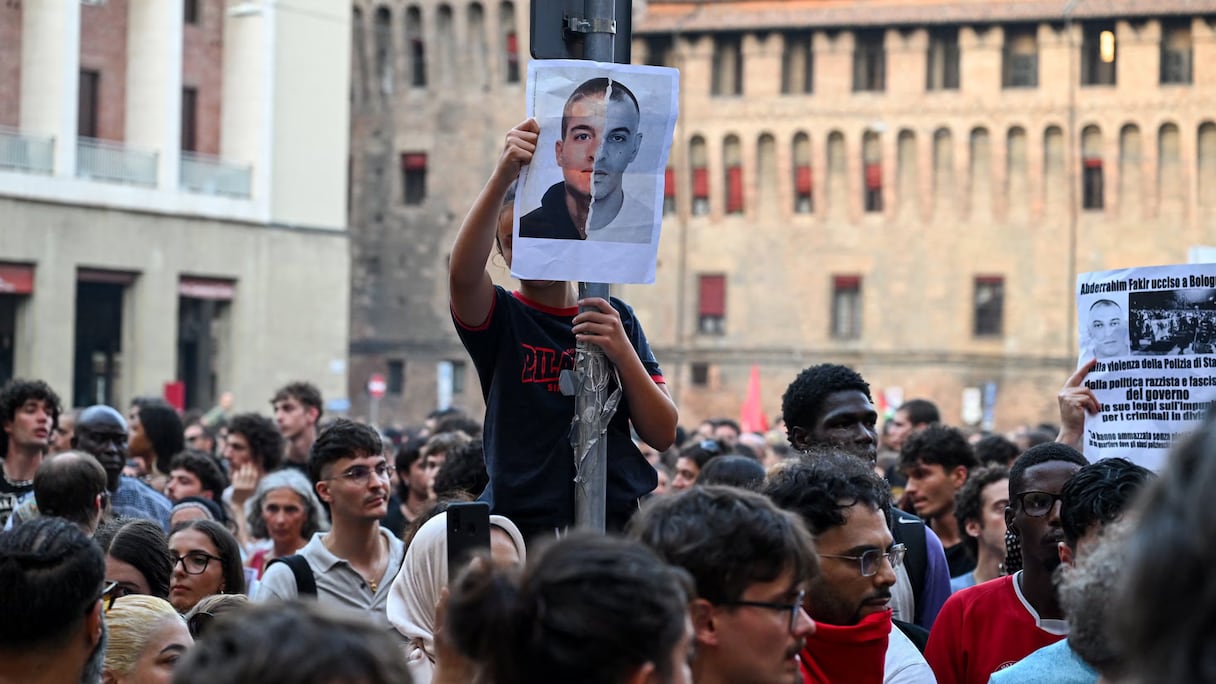
No usable fingerprints were recovered from the handcuffs used during Abderrahim Fakir’s arrest. Forensic examinations carried out by Rome’s scientific police on the restraint device used by the two officers who intervened on Via Svevo in Bologna’s Pilastro district on July 19 found only small biological and hair traces, as well as a stain of an as-yet unidentified substance that could be blood or rust.
The initial findings concern equipment seized on the day of the incident as part of an investigation ordered by the Bologna prosecutor’s office. The examination of the handcuffs was intended to determine whether they were indeed the device used in an attempt to restrain Abderrahim Fakir and whether they had functioned properly.
Read also : Two officers in Abderrahim Fakir case set to resume patrol duties amid questions over their reassignment
The absence of usable fingerprints has now shifted the focus toward a mechanical analysis of the device. No fingerprints, including those belonging to anyone other than the two officers, were found on the handcuffs.
“This is a particularly unusual result, but one that could also prove significant,” Fabio Anselmo, the lawyer representing Fakir’s family, said of the initial findings.
“At the root of this, there was a violent compression that lasted too long. Otherwise, what would be the relevance of examining the handcuffs to determine whether they were the ones examined and whether they functioned properly?” he asked.
Meanwhile, Rome’s forensic police also carried out biological and hair analyses on another piece of evidence seized by investigators: a white, size L T-shirt. Several profiles, including some likely to be blood, were isolated and will undergo further analysis to determine their origin.
The final supplementary examinations linked to the autopsy are also set to resume in an effort to establish the precise circumstances and causes of the 42-year-old Moroccan man’s death. Experts appointed by the prosecutor’s office and the parties involved are due to meet in Padua on Wednesday to examine Fakir’s heart, which was removed in its entirety during the autopsy.
Read also : Abderrahim Fakir Case: autopsy reveals “Hemorrhagic infiltrations on the back” as investigation continues
The examination is intended to determine whether the organ shows signs of toxicity, compression or any previously undetected heart conditions. Other investigations are also ongoing, including an analysis of the victim’s phone using data already extracted by the mobile squad, a 3D reconstruction of Via Svevo and an examination of footage from an officer’s body camera.
Abderrahim Fakir, a 42-year-old Moroccan who arrived in Italy at the age of five, died on July 19 after being pinned to the ground by two police officers during his arrest in Bologna. Initial autopsy findings pointed to blood in his lungs and extensive hemorrhagic infiltration caused by compression to his back, findings that Fabio Anselmo described as “violent mechanical asphyxia caused by dorsal compression.”
Read also : Abderrahim Fakir case: Family’s lawyer seeks removal of Bologna police from investigation
The analysis of the victim’s phone has since yielded initial findings for Bologna’s criminal investigation unit, while further autopsy analyses are due to resume at the end of the month. Thirty-six days after his death, Fakir’s body remains in Italy as his family continues to call for its repatriation.