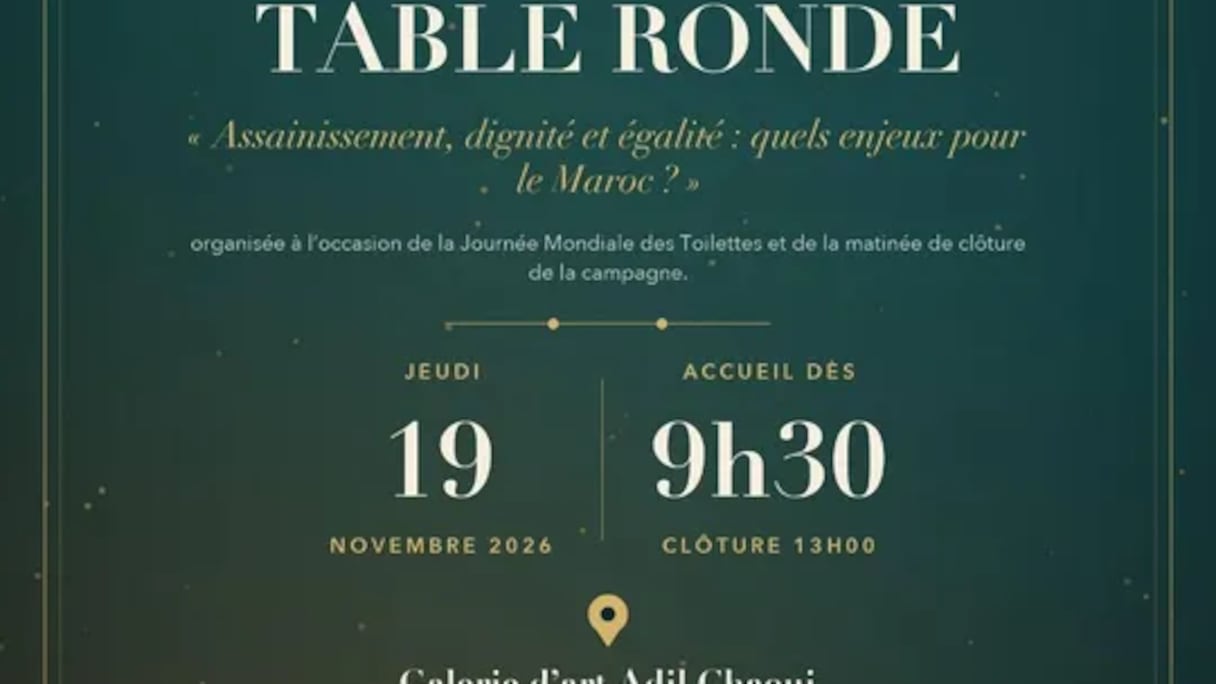
Environment Women Association (EWA) will hold a roundtable on public sanitation and its links to dignity and equality on Thursday, November 19, at 09:30 at Galerie d’Art Adil Chaoui in Salé.
Held under the theme “Sanitation, dignity and equality: What is at stake for Morocco?”, the meeting will bring together diplomatic representatives, public figures, experts and civil society actors to discuss access to clean, safe and accessible sanitation facilities, as well as its implications for public health, education, gender equality and human dignity.
The event will also mark the conclusion of EWA’s awareness campaign, “100 Days, 100 Messages, One Fight: Dignity,” launched on August 11, 2026.
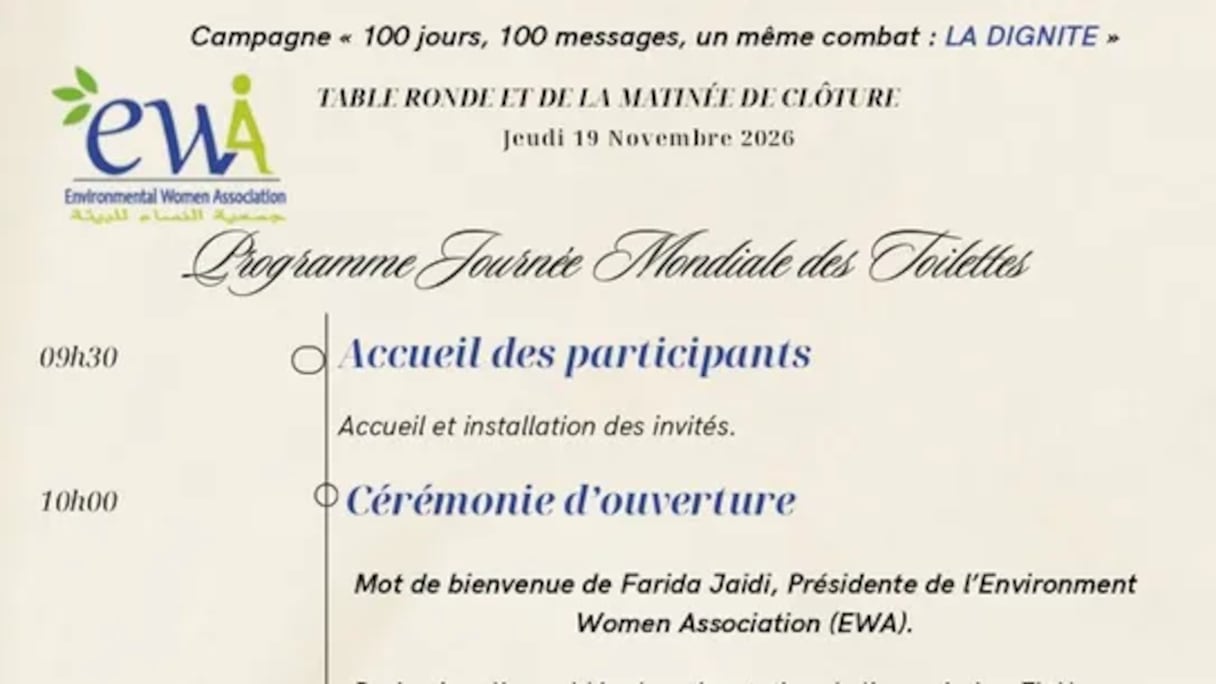
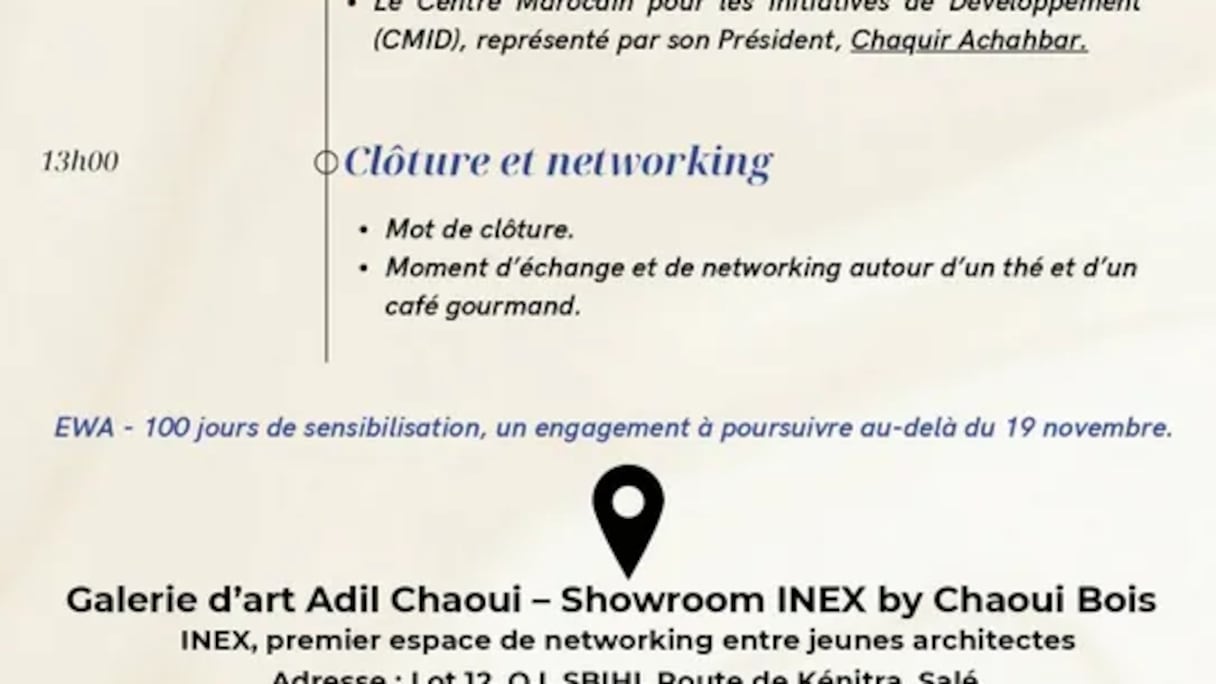
Program of the roundtable on public sanitation, dignity and equality, organized by Environment Women Association (EWA) on Thursday, November 19, at Galerie d’Art Adil Chaoui in Salé.
In its press release, the association said the campaign sought to draw attention to the importance of decent public toilets, arguing that access to such facilities “is neither a luxury nor a secondary issue.” It affects basic needs, including health, hygiene, safety, privacy and dignity, the association said.
EWA also pointed to the particular consequences of inadequate sanitation for women and girls, children, older people and people with disabilities. The absence of suitable facilities, or their poor condition, can restrict mobility, complicate access to schools and affect working conditions and participation in public life.
The roundtable comes as the association calls for a national effort to improve public sanitation infrastructure. Its proposal is to create, rehabilitate or upgrade 100,000 public toilet facilities by 2030, an objective it says should be assessed and translated into concrete measures rather than treated as an already approved government program.
The proposed target would cover more than stadiums and tourist areas, extending to markets, public gardens, railway stations, transport hubs, leisure areas and neighborhoods, including in areas that remain poorly served.
Read also : Public toilets remain scarce, poorly maintained as calls for action grow
To support such an initiative, EWA says a national assessment would first be needed to identify existing facilities, their condition, accessibility and maintenance needs, as well as areas lacking adequate infrastructure. It also calls for minimum standards covering access to water, hygiene, lighting, safety, privacy and accessibility for people with disabilities.
The association stressed that building facilities is not enough without ensuring their continued maintenance and proper management. “A toilet that is built but then left abandoned does not sustainably meet citizens’ needs,” it said in its statement.
EWA also called for coordination between public authorities, local governments, businesses, facility managers, civil society organizations and citizens, while stressing that shared responsibility should not dilute the obligations of each actor.
For Farida Jaïdi, president of Environment Women Association, access to decent sanitation is a “human right and a fundamental requirement for respecting human dignity.” The association said its role is to raise awareness, advocate for change and encourage the stakeholders responsible for public infrastructure to take action.
The roundtable coincides with World Toilet Day, observed on November 19. The 2026 United Nations theme for the day is “Sanitation and gender equality,” according to EWA’s statement.
