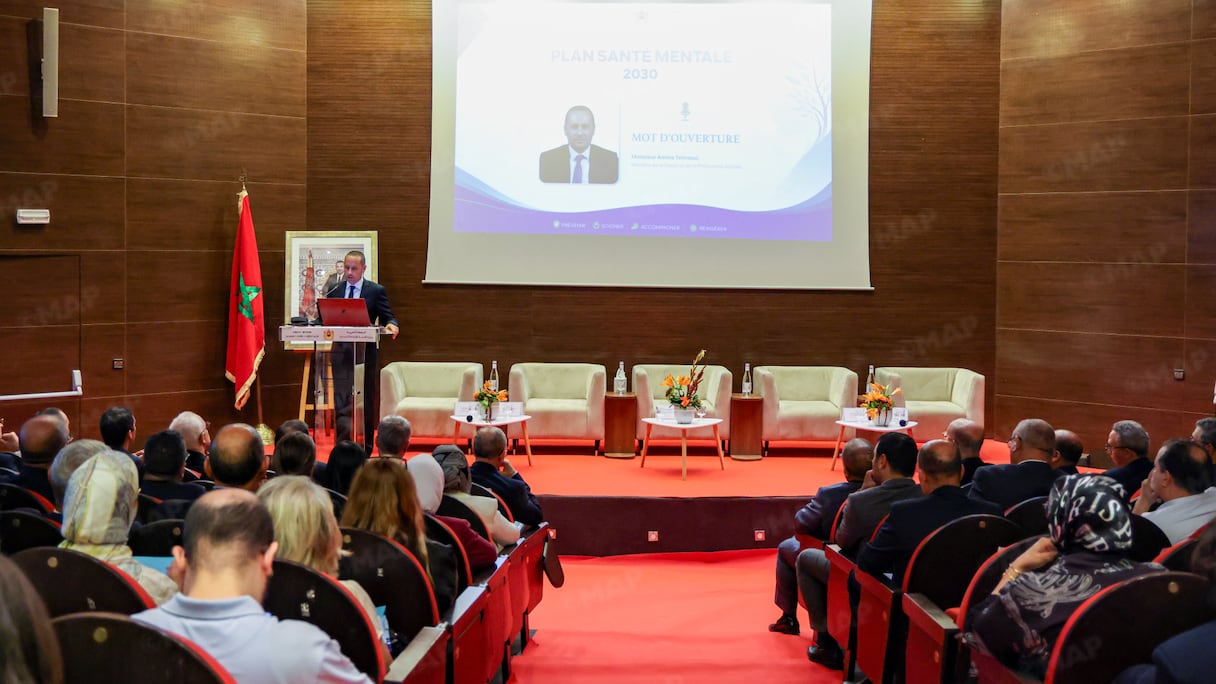
The Ministry of Health and Social Protection launched the Mental Health Plan 2030 in Rabat on Thursday, August 3, setting out a national framework to expand access to mental health services, improve the quality of care and strengthen support in the sector.
Unveiled at a meeting chaired by Minister of Health and Social Protection Amine Tehraoui, the plan marks a new stage in Morocco’s public health policy. It aims to promote mental health, prevent mental disorders, and support rehabilitation and social reintegration.
By 2030, the plan seeks to significantly expand mental health care capacity. The number of beds is expected to rise from 2,466 to around 4,728, while psychiatric hospitals will increase from 10 to 17. The number of intermediate care facilities is also set to grow from four to 24, with the aim of extending mental health services to all regions of the Kingdom.
Tehraoui said investment in mental health was also an investment in human capital, social cohesion, and the dignity of every individual. Mental health, he said, can no longer be considered a secondary issue and must instead be treated as one of the essential conditions for the success of social and development projects.
The strategy is built around several major changes, including early intervention and prevention throughout life, while taking into account challenges linked to vulnerability and support for ageing.
It also seeks to place mental health at the center of the national health system, allowing people to access care close to where they live and within the shortest possible time, the minister said.
Developed through broad consultation, the plan adopts a territorial and cross-sector approach aligned with other public policies, Tehraoui added.
The year 2026 will see the launch of structural reforms, while implementation will gradually expand across all territories in the following years. By 2030, authorities aim to assess the changes that have effectively been made in citizens’ lives.
Abderrazak Ouanas, delegate president of the Lalla Oumkeltoum Foundation for Mental Health, praised the High Royal Solicitude extended to people in vulnerable mental health situations.
He said the Foundation’s presidency by Princess Lalla Oumkeltoum reflected an enlightened Royal vision that places mental health among the national priorities of the health sector.
Ouanas said the plan’s implementation would require the mobilisation and combined efforts of all relevant stakeholders, describing mental health as an essential factor in public health and social cohesion.
He reaffirmed the Foundation’s commitment to the national effort and its determination to make its full institutional contribution to the plan, which, he said, opens a new era for the promotion of mental health in line with the High Royal Solicitude.
Awatef Belakhel of the World Health Organization’s office in Morocco said the plan reflects a human-centered vision focused on strengthening human rights, tackling social stigma and ensuring appropriate support and care.
Mental health, she said, is a fundamental right, an essential condition for individual and collective development, and an indispensable pillar of universal health coverage.
Fadoua Rahhaoui, from the Ministry of Health and Social Protection’s Non-Communicable Diseases Division, outlined the plan’s main strategic priorities and the projects expected to deliver results in the short and medium term.
These include the construction and upgrading of mental health infrastructure, stronger initial and continuing training, the development of new skills, and the modernization of the legislative framework.
A major part of the plan focuses on human resources. It aims to increase the number of psychologists in the public sector from 32 to 786, raise annual psychiatrist training capacity from 36 to 124, and increase the annual training capacity for nurses specializing in mental health from 490 to 750.
The plan also provides for the introduction of a legal framework governing the psychology profession.
Nearly 4 billion dirhams will be allocated to implementing the Mental Health Plan 2030 and supporting its various measures and actions.
The plan also aims to bring services closer to citizens by strengthening the role of primary health care and intermediate facilities, improving coordination with hospital and specialized services and developing a territorial organization adapted to the needs of the population.
The Mental Health Plan 2030 was developed by the Ministry of Health and Social Protection through an approach involving 13 ministerial departments and other relevant stakeholders, with support from the WHO. It is built around three strategic pillars and four framework conditions, covering 86 actions and measures.