The figures were presented by Fatiha Smihrou of the Directorate of Epidemiology and Disease Control (DELM) during a webinar held on Wednesday, October 7, where health officials outlined the surveillance and response measures in place.
Smihrou first outlined the reasons for heightened vigilance. Diphtheria is a highly contagious bacterial toxic infection, with a basic reproduction number (R0) of 6 to 7. It is caused mainly by Corynebacterium diphtheriae, but can also be caused by other corynebacteria. Its case fatality rate ranges from 5% to 10%.
The disease is subject to mandatory reporting, along with other vaccine-preventable diseases.
Vaccination had kept diphtheria under control for decades. Smihrou said outbreaks have nevertheless become more frequent in recent years, a trend she described as a “probable consequence of vaccine hesitancy.” Cases have also been reported in Mauritania, Senegal and Mali.
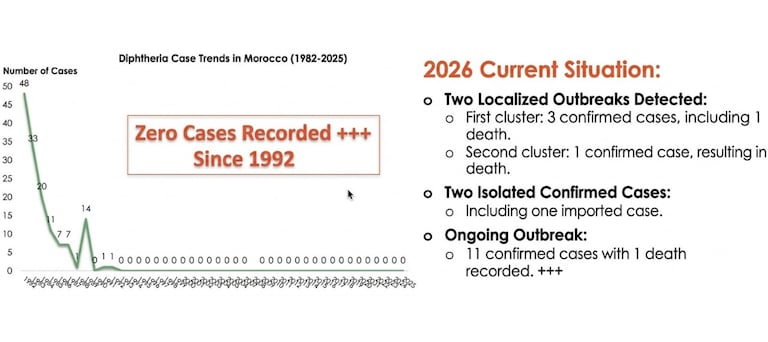
Several episodes have occurred in Morocco since the beginning of 2026. Two outbreaks were initially detected. The first involved three confirmed cases, including one death. The second involved one confirmed case, which also resulted in death.
Two sporadic confirmed cases were subsequently reported, including one imported case.
The current outbreak, which began several weeks ago, had reached 11 confirmed cases, including one death, as of Wednesday.
A procedure manual developed following the February alert has standardized surveillance and response activities.
At this stage, surveillance has six objectives: detecting suspected cases early and confirming them quickly; documenting toxin production and antibiotic resistance; identifying transmission trends, high-risk areas and populations; monitoring the evolution of the outbreak; and assessing the effectiveness of response measures.
Read also : Have your children missed a vaccine dose? Health Ministry urges parents to check
Identifying and managing suspected cases
A suspected case involves an upper respiratory tract infection such as pharyngitis, nasopharyngitis, tonsillitis or laryngitis accompanied by an adherent pseudomembrane, a thick grayish coating that does not detach. An ear, nose and throat infection compatible with diphtheria and accompanied by a marked deterioration in general condition or signs of complications is also sufficient to qualify as a suspected case.
A probable case is a suspected case epidemiologically linked to a confirmed case. It can also refer to a suspected case in which direct examination reveals a Gram-positive bacillus.
A confirmed case is established by laboratory testing through PCR or culture. Deaths are counted only among confirmed cases when they result from a diphtheria complication and are not attributable to another cause.
When a suspected case is identified, clinicians must isolate the patient and have them wear a surgical mask without creating panic. The case must then be reported immediately to the local health authority, namely the provincial surveillance units.
A local rapid response team then takes over. It validates the case to prevent false reports from placing additional pressure on the system during the winter season. The case is subsequently reported to the national epidemiological surveillance service, which assigns it a tracking code. This code allows the patient to be monitored throughout the different stages of care.
At the current stage of the outbreak, hospitalization is systematic for every validated suspected case. The patient is isolated and tested, with the sample sent to the laboratory through coordination with the central service. An investigation is also conducted around the case, Smihrou said.
Treatment and response begin before laboratory results are available. The laboratory immediately informs regional and provincial teams, including of preliminary results, so they can anticipate the necessary response.
The data are then centralized on a national platform. Their analysis is used to monitor the outbreak, identify populations at risk and guide decisions.
How are close contacts managed?
Mouad Merabet of the DELM, who coordinates the National Public Health Emergency Operations Center, presented the measures for managing contacts. He described contact management as one of the main pillars of the response at this stage of the outbreak.
Merabet said every response strategy begins with identifying the epidemiological chain, which has three links: the reservoir and pathogen, the modes of transmission, and the susceptible host. Treating patients acts on the first link, while contact management acts on the third.
Anyone who has had close exposure to a case during the contagious period is considered a contact. Merabet said theoretical thresholds for distance and duration were not useful enough for field operations.
Read also : Diphtheria: symptoms, risks, treatment and what to know
Contacts may include family members, co-workers, classmates, visitors to a patient or fellow travelers. Healthcare workers who provided care without following infection prevention and control measures are also considered contacts.
Contagiousness begins when symptoms appear and can sometimes start slightly earlier. Without antibiotics, it can last from two to six weeks. With effective antibiotics, carriage becomes negligible after 48 hours, according to the World Health Organization. US Centers for Disease Control and Prevention recommendations extend this period to four days. Asymptomatic carriers can also transmit the disease.
“The respiratory form is currently circulating in the country”
Merabet noted that these considerations apply mainly to areas with high endemicity, which is not the case in Morocco. He added that the respiratory form of diphtheria is currently circulating in the country.
Once a contact has been identified, health teams must determine whether the person is already sick. A symptomatic contact becomes a suspected case. Contacts are then classified into three risk levels.
High-risk exposure includes direct contact with respiratory secretions, face-to-face exposure or prolonged close contact. It also includes healthcare workers who were not adequately protected. Vaccination status does not exclude someone from this category.
Moderate risk covers close contact without direct exposure, such as in a classroom or shared office. It also includes healthcare workers who were protected but repeatedly exposed over several days.
Low risk refers to brief, occasional contact, such as passing someone in a corridor or being in the same building.
Four measures are used for contacts: chemoprophylaxis, which involves giving medication to prevent an infectious disease from developing in a healthy person who has been exposed to the risk of infection; vaccination to strengthen protection against the toxin; surveillance to detect the disease early in people at risk; and exclusion or restrictions to limit contact during the period in which a person may develop the disease.
Chemoprophylaxis is systematic for high-risk contacts. Its use for moderate-risk contacts depends on the circumstances. It is not prescribed for low-risk contacts to avoid excessive use of antibiotics that remain effective.
Merabet said antibiotic resistance data show that the current strain is resistant to ampicillin and penicillin G.
Vaccination is strongly recommended for everyone, including low-risk contacts, according to the current schedule.
High-risk contacts are excluded until the maximum incubation period has passed. For moderate-risk contacts, the decision also depends on the circumstances. Merabet said that at the current stage, “we can go further with restrictive measures to contain the current outbreaks.”
The response strategy is scaled according to the epidemiological situation. For isolated cases, potentially accompanied by secondary cases, contact management is comprehensive. The same applies to small outbreaks.
In large outbreaks, authorities must prioritize. Once community transmission occurs, the entire population becomes a contact population. The response then shifts from an individual approach to one that is “much more population-based,” Merabet explained.
Vaccination: who gets which vaccine
Mohamed Benazzouz, a public health physician and head of the National Immunization Program (PNI) and the Child Health Protection Department at the Ministry of Health and Social Protection, presented the vaccination response.
The response focuses on contacts. Three vaccines in the national program contain a diphtheria component: the pentavalent vaccine, which protects against diphtheria, tetanus, pertussis, hepatitis B and Hib; the DTC vaccine, which protects against diphtheria, tetanus and pertussis; and the Td vaccine, which protects against tetanus and diphtheria.
Three rules govern the response. The first lowers the protection threshold following a dose of diphtheria-containing vaccine from 10 years to five years during an outbreak.
The second requires vaccination schedules to be continued without restarting them. Previously administered valid doses are systematically counted.
The third relies on PNI guidelines to determine whether a vaccination schedule is complete.
The protocol distinguishes between three situations.
In the first, vaccination status is unknown or the person has not been vaccinated. One dose is administered immediately, followed by completion of the schedule according to the vaccination calendar. Children under seven receive DTC, pentavalent or hexavalent vaccines. Children aged seven and older and adults receive Td.
The second dose is administered at least one month after the first, while the third is given six months later.
Read also : Inside Morocco’s plan to detect and contain diphtheria outbreaks
In the second situation, the primary vaccination series is incomplete, with fewer than three doses received. The vaccine used again depends on age. One dose is administered at the first contact and the schedule is then completed. For those aged seven and older, only Td is used. The third dose is given at least six months after the second.
In the third situation, the primary vaccination series is complete, with or without a booster. The response depends on when the last dose was administered.
If it was more than five years ago, children under seven receive a DTC dose immediately and then continue with the vaccination schedule. Those aged seven and older receive a Td dose and are considered up to date.
If the last dose was administered less than five years ago, the person is considered vaccinated. However, children aged 18 months to five years must receive the missing dose, namely the five-year booster.
Benazzouz concluded by highlighting three mistakes to avoid when adapting catch-up schedules during the response. A delay in vaccination does not invalidate previously administered valid doses. The vaccine must always be appropriate for the person’s age: Td from age seven, and DTC, pentavalent or hexavalent vaccines for younger children.
The PNI head also stressed that booster doses should not be overlooked, including during an outbreak response.
He also recalled good vaccination practices, including preparation of vaccination sessions, proper injection techniques, maintaining the cold chain, organizing campaigns, managing medical waste and monitoring adverse events.
