Morocco signed five aerospace and defense agreements on the opening day of the Marrakech Air Show on Wednesday, including a Harmattan AI industrial platform with planned capacity of up to 55,000 defense systems a year and a MAD 120 million Safran investment in aircraft-engine equipment.
Four agreements and a letter of intent were signed at the opening of the eighth edition of the show, covering manufacturing, research, local procurement and autonomous defense systems.
Harmattan AI’s investment agreement carries the largest disclosed production target. The French defense technology company will establish an industrial and technological platform in Morocco to develop and produce advanced autonomous defense systems, including autonomous air-defense systems.
Annual production capacity could reach 55,000 systems, according to details presented at the signing ceremony.
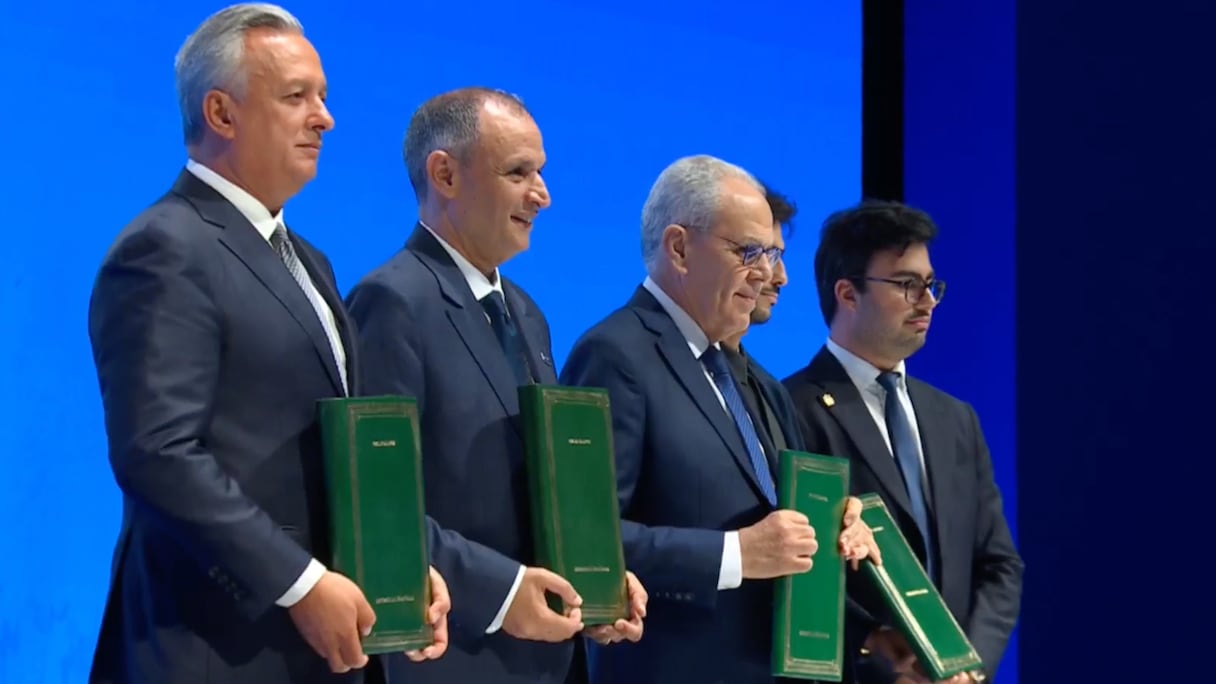
The agreement was signed by Industry and Trade Minister Ryad Mezzour, Minister Delegate in charge of National Defense Administration Abdellatif Loudiyi and Investment Minister Karim Zidane, along with Harmattan AI co-founder and chief executive Mouad M’Ghari and Harmattan AI Morocco managing director Amir Benmahjoub.
It follows the company’s June agreement with the Royal Armed Forces, which provided for local production of next-generation defense systems and a research center specializing in artificial intelligence for defense.
A separate letter of intent signed on Wednesday takes that partnership into deep strike.
The document covers the acquisition, development and manufacture in Morocco of IRIFI, Harmattan’s autonomous long-range strike system.
IRIFI is designed for precision strikes at ranges of up to 2,000 kilometers in contested environments. Human commanders select authorized targets and approve missions before launch, while the system is designed to execute the mission autonomously once under way.
The company says the system combines autonomous execution, precision and the ability to be produced and deployed in numbers. IRIFI is to be among the first strategic systems developed and manufactured through Harmattan’s new Moroccan industrial platform.
Away from defense, Safran committed MAD 120 million to a Moroccan plant producing lubrication and fluid-management systems for aircraft engines. The project is expected to create 100 jobs.
The memorandum of understanding was signed by Mezzour, Zidane, Moroccan Investment and Export Development Agency director-general Ali Seddiki and Safran Oil Systems deputy managing director and purchasing and supply-chain director Mekki Kabbaj.
Another agreement brings Boeing, Lockheed Martin, Airbus and Safran into a joint advanced-manufacturing research platform with Moroccan academic and industrial partners.
The consortium will work through the Africa Center for Manufacturing Excellence, or ACME, on collaborative research and development in advanced manufacturing.
UM6P, ACME and Cetim Maroc are among the Moroccan partners, with Boeing, Lockheed Martin, Safran Nacelles and Airbus represented on the industrial side.
The arrangement puts some of the world’s biggest aerospace and defense manufacturers around the same research platform, with the work intended to feed technological capabilities into Morocco’s aerospace manufacturing base.
Royal Air Maroc, meanwhile, signed an agreement with the Industry and Trade Ministry to bring more Moroccan suppliers into the airline’s procurement chain.
Under the deal, the two sides will identify products and services currently needed by the national carrier that could be sourced or developed locally, opening part of RAM’s purchasing requirements to Moroccan companies. Mezzour and Royal Air Maroc chief executive Hamid Addou signed the agreement.