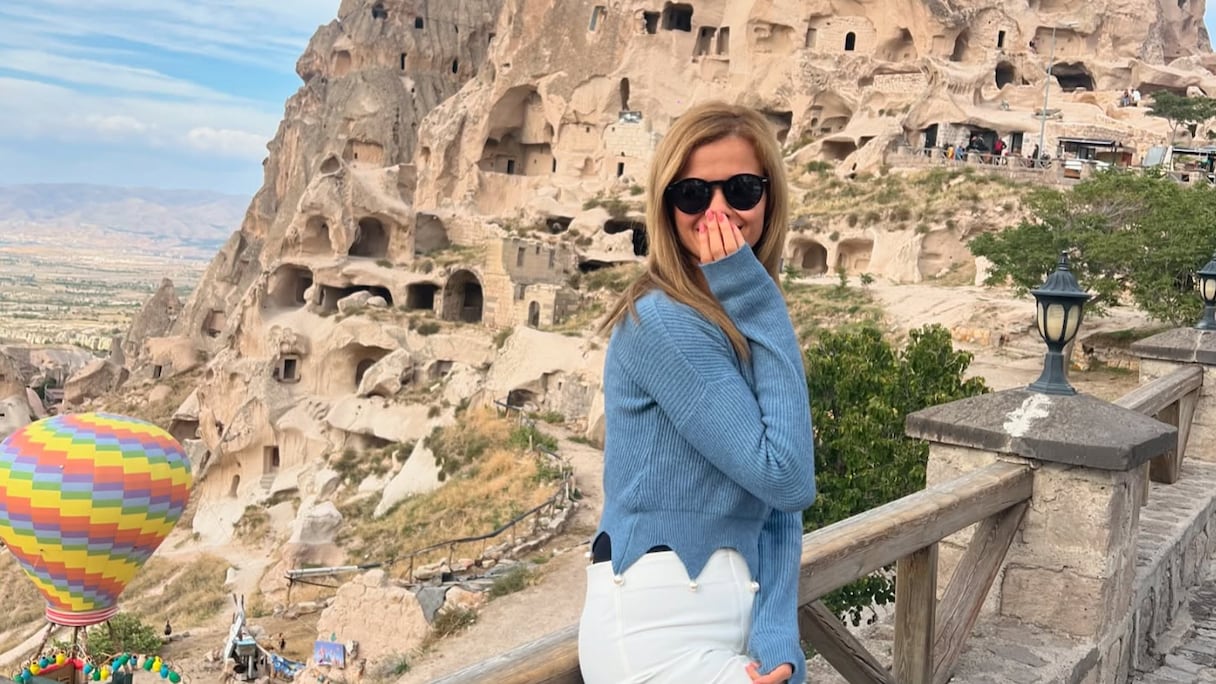
In just a few days, Wafae Atid has gone from being a virtually unknown migrant to what some have dubbed a “harraga influencer” (irregular migration influencer), becoming first an unwilling, then an increasingly active, central figure in a story followed by thousands online.
The label is anything but flattering.
Every new statement sparks another wave of reactions. Every video offers another version of events, and every attempt at clarification appears to raise another contradiction.
Public attention is no longer focused solely on her situation in Ceuta. People are now scrutinizing her travels, old social media profiles, professional background and responses to those who questioned her initial account.
The story began on August 19, when El País published an interview with the 28-year-old Moroccan woman, who entered Ceuta by swimming on July 30.
In the interview, Wafae said her family had prevented her from studying, travelling and freely choosing how she dressed.
“Women are considered inferior to men,” she said in the video. She also claimed that her parents had taken her out of school and refused to allow her to leave and continue her education elsewhere.
Read also : El País’s portrait of Moroccan woman who swam to Ceuta collides with her online past
The article presented an unambiguous narrative: that of a young woman forced to remain at home and subject to the decisions of a religious family.
Internet users, however, were quick to uncover another part of her life that was absent from the video.
Her own social media accounts documented stays in Qatar, the United Arab Emirates, Turkey and several other countries. Information also emerged about a period of study in Dubai, professional experience in hotels and restaurants, as well as modeling work.
“So That People Like You Can Bark”
Wafae responded to the resurfacing of her old profiles without denying that she had traveled.
“I went to Saudi Arabia, Qatar and African countries, but I don’t want to live in those countries. I want to live in Europe. What’s your problem?” she says in a new video.
She explains that she was able to travel after leaving her family home. While she was living with her parents, she claims, she could neither travel nor make decisions freely about her own life. After leaving home, she says she began working and paying for her own trips abroad.
“I didn’t lie,” she insists.
Her response is directed both at the media and at internet users who uncovered posts that appeared inconsistent with her initial account.
Wafae says that if she were to tell her entire story in detail, those criticizing her would eventually understand her and might even apologize.
She then accuses the media of deliberately editing interviews.
“The press cuts things and doesn’t always publish the entire message. Some do it deliberately so that people like you can bark in the comments,” she says.
In a single sentence, Wafae accuses journalists of manipulating her testimony while dismissing readers who pointed out the contradictions in her story as people who “bark.”
“I don’t care about public opinion, but I know exactly what I’m doing,” she adds.
On that point, at least, her position appears clear.
Since arriving in Ceuta, she has told her story to several cameras and repeatedly spoken out on social media. Footage has also shown her sitting on the ground alongside other migrants, calling for asylum in front of numerous media outlets.
From “I’m Not Poor” to “I’m the Poorest”
In another video, Wafae puts forward a new argument to distinguish her situation from that of the other migrants.
This time, she presents herself as the poorest person in the entire camp and among everyone who entered Ceuta.
“I am the poorest of all the migrants who entered. The people here have restaurants and houses. I am the poorest of all,” she says.
Wafae does not explain how she knows the financial circumstances of thousands of people, or what information allows her to claim that others own houses and businesses.
The message, however, is clear. While downplaying the vulnerability of other migrants, she presents her own situation as the most precarious and, therefore, the one most deserving of attention and assistance.
Yet this statement contradicts her own comments in the new El País article.
“I am not poor, but I am not rich either. I’m somewhere in between,” she says, describing herself as an ordinary person.
In one version, she rejects being portrayed as an economic migrant or a poor person. In the next, she declares herself the poorest of them all.
This is not simply a contradiction about her financial circumstances. Wafae establishes a hierarchy among the new arrivals and places herself in the most vulnerable position.
The others, according to her, own property and businesses, while she is the one who is genuinely vulnerable.
It is a particularly striking distinction to make in the same camp where migrants were filmed demonstrating in front of cameras while chanting that “all migrants are equal.”
El País’ “Full Interview” Reduced to Two Minutes
On Friday, El País published a much longer second article about Wafae.
The new piece includes information absent from the initial portrayal, covering her travels and work abroad, her time in the United Arab Emirates, her attempts to obtain a visa and her departure from the family home.
The timeline presented by the Spanish newspaper is revealing.
El País first met Wafae on Saturday, when she told them about her past. On Monday, the newspaper returned for what it describes as a “long conversation” and recorded her testimony.
On Wednesday, it published a video lasting barely two minutes, presented to readers as the “full interview.”
On Thursday, as the controversy was in full swing, the newspaper spoke to her again. The second article was published on Friday.
Read also : Ceuta and Melilla migrant abuses: Moroccan rights group seeks international action
This new account explains that Wafae left her family several years ago, worked as a receptionist, learned English and acquired some knowledge of French. She also lived in the United Arab Emirates, tried to obtain a student visa and held several jobs in Dubai.
After failing to secure a visa for Europe, she reportedly saw the mass entry of July 30 as an opportunity to achieve her stated goal: reaching Ceuta and then attempting to settle in Spain.
The story therefore takes on an entirely different dimension.
In the first video, Wafae appeared as a young woman whose family prevented her from studying and traveling. The second article reveals that she had left that environment years earlier, lived in several countries, worked and had been trying for a long time to find a way to reach Europe.
The newspaper does not specify which of this information it already knew following the Saturday conversation and the lengthy interview on Monday, or which details only emerged after internet users uncovered her travels.
It also does not explain why it initially chose to highlight statements portraying Wafae as a woman deprived of all freedom while leaving out the years that followed in her life.
If this information was part of the initial conversations, it was omitted despite being essential to understanding her story.
If Wafae only disclosed these details later, it becomes even more difficult to understand why the first video was presented as the “full interview.”
A Controversy That Pushes Other Migrants Into the Background
While Wafae’s life turns into an ongoing online saga, hundreds of migrants in Ceuta continue to face far more urgent difficulties.
For nearly three weeks, more than a thousand people slept outdoors on El Trampolín beach and around the Temporary Migrant Reception Center. Some relied on the solidarity of local residents and a single daily food distribution.
Others faced difficulties accessing supermarkets in areas heavily patrolled by military and police forces, amid checks described as “racial profiling” by several media outlets and human rights organizations.
Read also : In Ceuta, migrants endure makeshift camps, hunger, and racial profiling
Testimonies alleging harassment and assaults against migrant women have also emerged.
The public prosecutor’s office in Ceuta confirmed to Newtral that 13 complaints of sexual assault had been officially filed with the justice system as of August 17.
These women have no viral videos, no old profiles being dissected by thousands of people, and no major newspaper willing to publish successive episodes about their lives.
For days, many slept in precarious conditions, feared being assaulted and faced obstacles even when trying to buy food.
Wafae’s story deserves to be told, including the family pressures she says she experienced. But it must also be examined with the same rigor applied to any other testimony.
Her insults do not erase the contradictions in her statements, and El País’ second version still does not explain the omissions in the first.
Meanwhile, attention remains fixed on the latest “harraga influencer,” while those facing the most serious consequences of this crisis remain, once again, out of the spotlight.
