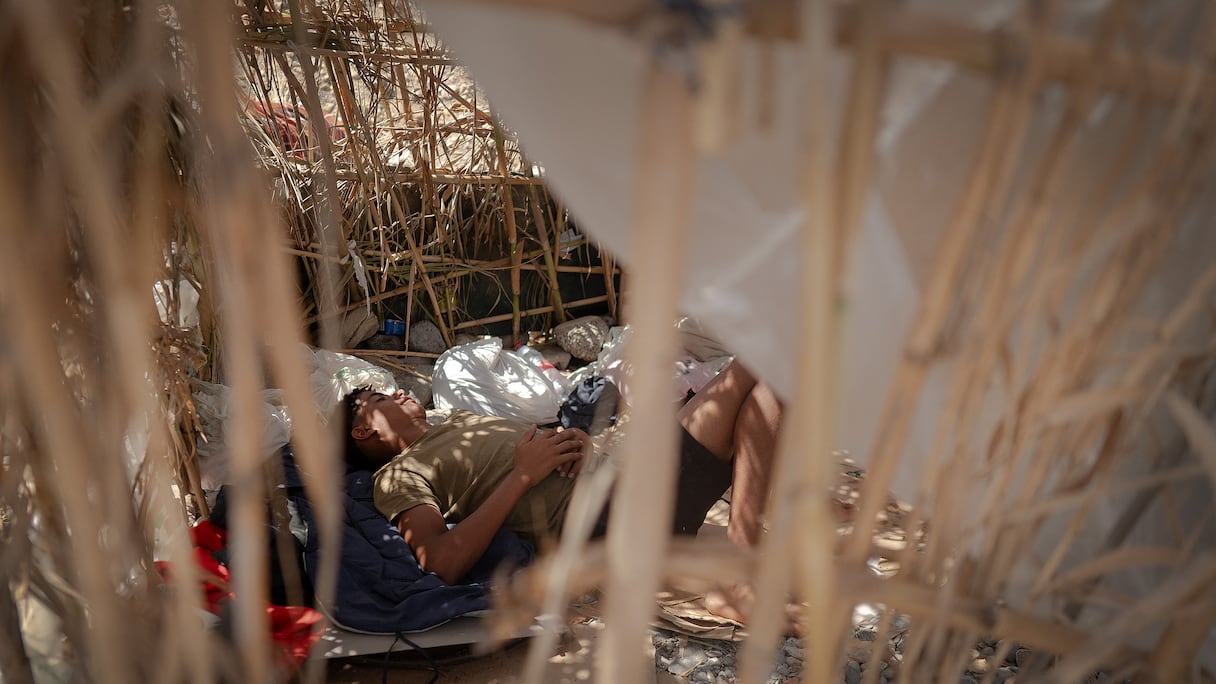
More than 1,200 migrants were moved from a makeshift beach camp in Ceuta on Thursday, nearly three weeks after a surge in arrivals overwhelmed reception capacity in the Spanish-administered city on Morocco’s northern coast.
The transfer brought an end to the sprawling encampment at El Trampolín beach, where migrants had been sleeping under makeshift shelters since the mass arrivals of July 30. But it has also brought renewed attention to the conditions they endured, including shortages of food and water, inadequate sanitation, racial profiling and reports of sexual assault.
Spanish National Police surrounded the beach early Thursday as migrants gathered their belongings and walked under police escort to two temporary reception sites opened by the Spanish government.
Migrants from sub-Saharan Africa were taken to Loma Margarita, less than a kilometer from the beach, while those from North Africa were transferred to the El Embolsamiento parking area in Loma Colmenar.
Authorities said the groups were separated following clashes between some migrants in recent weeks. The two temporary facilities, managed by Accem and the Engloba Association, have a combined capacity of about 1,800 people, according to Spanish radio network Cadena SER.
The evacuation will allow authorities to dismantle shelters made from branches, reeds, cardboard, tarpaulins and pieces of fabric and restore the beach. But the operation comes after weeks of mounting criticism over the humanitarian response to the influx.
A Beach Turned Into a De Facto Reception Center
El Trampolín effectively became an open-air reception center after Ceuta’s Temporary Stay Center for Immigrants, known by its Spanish acronym CETI, became overwhelmed.
Around 1,500 people were initially left without accommodation, although police sources estimated that more than 3,500 migrants may have gathered at the camp during meal distributions.
When Spanish news agency EFE visited the beach on Aug. 10, it counted around 20 makeshift shelters, with as many as 15 people crowded into some of them. About 80% of those staying there were from sub-Saharan Africa.
Around 150 Sudanese migrants had organized themselves to collect rubbish and help maintain the site.
Authorities installed 10 toilets, around 30 showers, water points and a tent providing shade on a nearby esplanade. The Red Cross distributed food daily and provided some medical assistance.
Yet migrants continued to face hunger, thirst and poor hygiene conditions, prompting humanitarian organizations cited by Spanish public broadcaster RTVE to denounce what they described as “dehumanization.”
Read also : Rights violations in Ceuta: Morocco’s CNDH calls on Spanish Ombudsman to investigate
Spain’s Ombudsman opened an investigation on its own initiative after receiving several complaints. The institution sought information from the Spanish government, prosecutors and Ceuta authorities about access to drinking water, showers, clean clothes, food and healthcare, as well as the situation of unaccompanied minors left without adequate protection.
The accommodation crisis was prolonged by disagreements over where temporary facilities should be installed. Four proposed locations—including a port esplanade, a former flour mill, a football field and warehouses near Tarajal—were rejected for various reasons by either the local government or representatives of Spain’s central government.
An agreement on the sites used for Thursday’s transfers was reached nearly three weeks after the crisis began.
€500 for four nights in a storage room
Three migrants who arrived on July 30 told Cadena SER that they paid €500 to share a tiny storage room for four nights.
There was no shower, and they said they had to urinate into a bottle.
After speaking publicly about the arrangement, they said the owner expelled them without returning their money. One of the migrants, a 27-year-old construction painter from Tetouan in northern Morocco, subsequently spent the night in bushes near one of the camps.
“They didn’t like that I revealed the exact amount,” he said.
Ceuta’s local government later said landlords who illegally accommodate migrants in homes, storage rooms or other unsuitable premises could face sanctions.
Buying food under police and military watch
During the first days of the crisis, Spanish soldiers were deployed outside some supermarkets to control entry and prevent large gatherings.
Spanish outlet Diario Red on Wednesday published footage taken outside a Mercadona supermarket and denounced a security operation that amounted to racial profiling.
Similar concerns had already been raised by the Moroccan Organization for Human Rights, known by its French acronym OMDH, after a fact-finding visit to Ceuta on Aug. 8.
The organization visited neighborhoods, beaches, wooded areas and central Ceuta and reported severe shortages of food and water affecting Moroccan, Egyptian, Yemeni and Sudanese nationals, as well as migrants from other sub-Saharan African countries.
It also said soldiers and Civil Guard officers were stationed around several supermarkets, making it more difficult for migrants to enter stores to buy food and water.
Abuses Documented by Moroccan Associations
The OMDH also denounced the inadequacy of the accommodation facilities provided by the local authorities. Many migrants were forced to sleep in streets, alleyways, wooded areas or overcrowded premises. Meanwhile, Moroccan residents of Ceuta and local associations improvised shelters for women, minors and young children.
One such facility, set up in the Sidi Embarek neighborhood, accommodated as many as 300 people, including women, minors and mothers with their children. Its manager, however, warned that he could no longer continue providing shelter, as the local administration had supplied neither food, mattresses nor blankets. The OMDH warned that closing the shelter could force these people back onto the streets, exposing them to exploitation and various forms of violence.
The OMDH said it had collected testimony about alleged sexual harassment and assaults against migrants and had examined videos and statements circulating on social media in which some abuses were attributed to members of Spain’s Civil Guard and military.
Given the seriousness of the allegations, the Moroccan organization called for investigations to establish what happened and determine responsibility where appropriate.
As of Aug. 17, 13 complaints of sexual assault had formally been filed with the courts, according to information provided by prosecutors to Spanish fact-checking outlet Newtral.
Spain’s Equality Ministry has separately warned of the “extreme risk” faced by women and girls forced to stay on beaches, in wooded areas and other places without adequate protection.
The Spanish government is preparing to transfer 500 particularly vulnerable minors to the mainland, although the operation remains caught in a political dispute with autonomous regions reluctant to receive them.
Moroccan organizations have also raised concerns about what happened to minors returned across the border.
Moroccan association APISF, working with ActionAid, documented cases of minors who it said were sent to areas of southern Morocco hundreds of kilometers from their homes. Some were left without transportation or accommodation, and in some cases without phones or a way to contact their families.
The beach is clear, but questions remain
Thursday’s transfer removes one of the most visible symbols of the crisis from Ceuta’s coastline. It does not resolve the questions raised by the nearly three weeks during which hundreds of migrants slept outdoors and depended heavily on emergency assistance and local solidarity.
Nor does it settle the allegations surrounding their treatment.
Moroccan rights groups are calling for investigations into reported abuses and discriminatory practices. OMDH President Noufal El Baamri has said his organization could take its concerns to Spanish, European or United Nations human rights mechanisms if the allegations are not adequately investigated.
For the migrants moved from El Trampolín, the immediate question of where to sleep has at least been answered. Their longer-term future—whether through asylum procedures, accommodation elsewhere in Spain or return—remains uncertain.
