Should Saturday remain a regular working day in public schools? The question is moving into focus ahead of the new school year, with the National Education Union (UNE) arguing that the current practice conflicts with rules governing civil servants’ working hours.
The union is calling for a five-day working week and wants the Ministry of National Education to establish uniform rules for distributing teaching hours across schools.
At the centre of its argument is Decree No. 2.05.916, which sets the working week in public administrations from Monday to Friday, between 8:30 a.m. and 4:30 p.m.
The UNE says this makes the five-day week the general rule for civil servants and questions the legal basis for treating Saturday as an ordinary working day across the education system.
Its legal study also cites Article 6 of the Constitution, which establishes the principles of constitutionality, hierarchy and publication of legal norms. On that basis, the union argues that an administrative or ministerial arrangement cannot depart from a decree of general application without an appropriate legal basis.
The decree does, however, allow different working days or hours when required by the needs of a public service. That exception is precisely where the disagreement begins.
How far can the exception go?
What the UNE challenges is using that provision to make Saturday work a general practice across the education system.
The union says any departure from the Monday-to-Friday schedule should respond to an objective need and be applied within a clearly defined framework, rather than serving as a blanket justification for a six-day school week.
It also questions whether a 30-hour weekly teaching load makes Saturday work necessary.
To support its case, the UNE points to schools already operating with fewer teaching hours. These include establishments using a three-teacher rotation system in the same classroom and schools under the Salé Provincial Directorate where weekly teaching time reportedly stands at around 24½ hours.
The union also cites Ramadan, when weekly teaching time is reduced to around 22 to 24 hours without preventing schools from operating.
For the UNE, these examples show that maintaining a uniform 30-hour teaching load is not necessarily a prerequisite for delivering classes and that the organization of the school week could be reconsidered.
Read also : 2026-27 school year: Key dates for students and teachers
Union proposes 18¼-hour teaching week
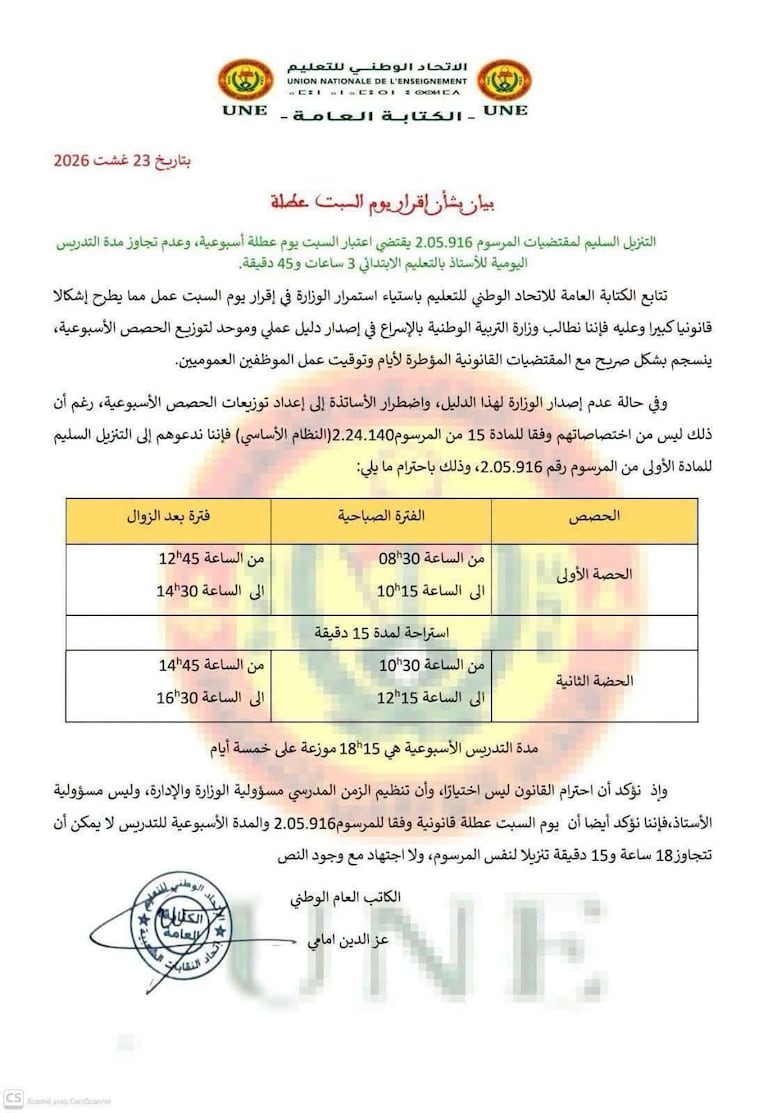
The alternative put forward by the UNE would spread primary teaching over five days and reduce the weekly teaching load to 18 hours and 15 minutes.
Under its proposal, teachers would complete three hours and 45 minutes of classroom instruction a day.
Morning classes would run from 8:30 a.m. to 10:15 a.m., followed by a 15-minute break, with a second session from 10:30 a.m. to 12:15 p.m.
Afternoon sessions would run from 12:45 p.m. to 2:30 p.m. and from 2:45 p.m. to 4:30 p.m., again separated by a 15-minute break.
The union says the arrangement would bring teaching schedules into line with its interpretation of the civil service working-hours decree while keeping instruction within the standard administrative working day.
One timetable framework for all schools
The Saturday dispute is also reopening a broader question over how teaching hours are allocated and who should be responsible for drawing up the rules.
The UNE wants the ministry to issue a national guide setting common standards rather than leaving individual schools or teachers to find their own timetable arrangements.
It cites Article 15 of Decree No. 2.24.140, which establishes the special status of National Education employees, arguing that the provision does not place responsibility for drawing up weekly class allocations on teachers themselves.
A national framework, the union says, would reduce disparities between schools and provide clearer rules on teaching loads and their distribution throughout the week.
The ministry has taken such an approach before. In 1995, it issued a practical guide governing the allocation of teaching hours. The UNE is calling for a similar document to be drawn up for the current system.
Saturday classes clash with further studies, UNE says
The union is making another case against Saturday work—its impact on teachers pursuing university studies.
It cites Head of Government Circular No. 2015/03, which encourages civil servants to continue their academic education as part of efforts to strengthen skills and human capital.
The UNE argues that Saturday work can make that difficult because some higher education institutions schedule courses and academic activities on weekends.
For the union, school timetables should therefore account not only for service requirements but also for civil servants’ ability to continue their education and professional development.
Read also : Nearly 1,700 inmates pass Morocco’s national high school exam
Teaching hours already under review
The challenge comes as teaching workloads are already on the table in discussions between the ministry and staff representatives.
During sectoral dialogue on July 28, the curriculum committee was tasked with examining a study on revising the number of teaching hours, with conclusions expected at the start of the school year.
That review now provides an opening for a wider debate over not only how many hours teachers should spend in classrooms, but how those hours should be distributed across the week.
The UNE wants Saturday included in that discussion.
