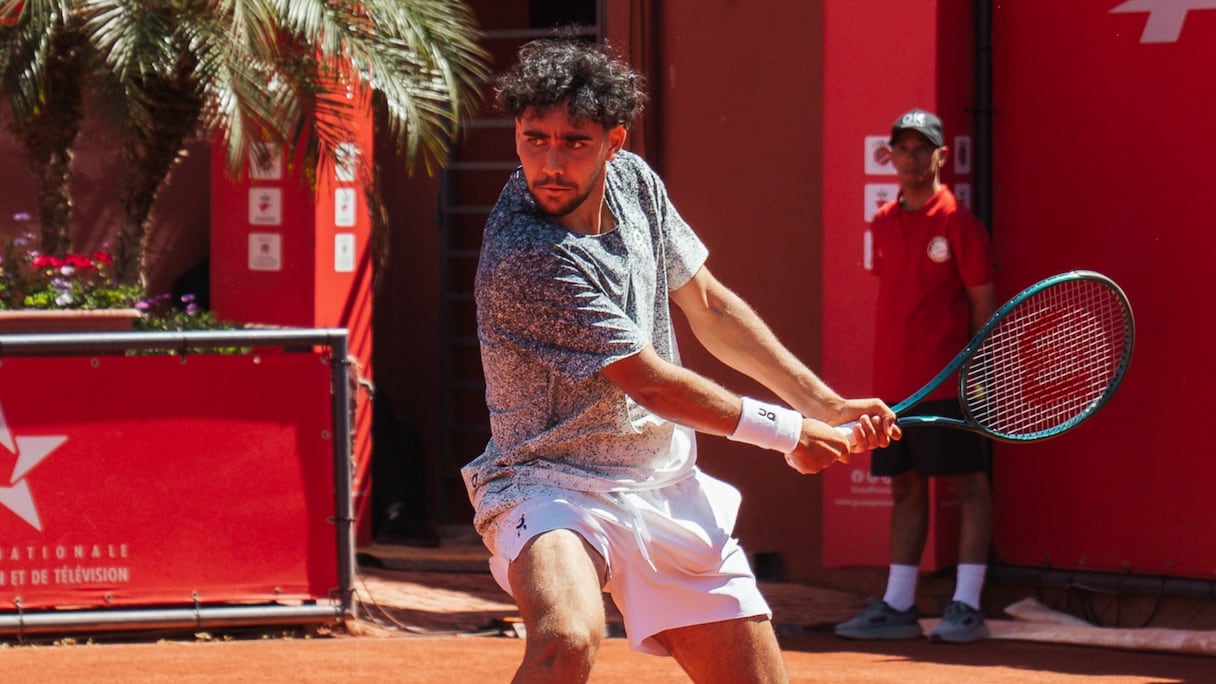
Reda Bennani had every reason to celebrate. He had just taken another significant step forward in his promising career.
The Moroccan defeated Spain’s Javier Barranco Cosano 6-3, 6-4 in the quarterfinals of the ITF M25 tournament in Dénia on July 24, advancing to the semifinals and climbing to a career-high ATP ranking of World No. 474. Minutes later, however, attention shifted away from the result.
As he celebrated, Bennani shouted profanities in Moroccan Darija. The footage quickly circulated on social media, prompting widespread debate in Morocco. Some criticized the language as incompatible with the values traditionally associated with tennis, while others, despite acknowledging it was inappropriate, viewed it as the emotional release of a fiercely competitive athlete.
Bennani himself addressed the controversy shortly afterward, apologizing to Moroccans and saying his reaction “doesn’t reflect the way I was raised.” He added that repeated provocation from his opponent during the match had contributed to the outburst.
That apology naturally raises another question: why do athletes, even in sports built on composure and self-control, sometimes react so emotionally after the final whistle or the last point?
Behind the outburst
Moroccan sports psychologist Karim Boukallouch believes those moments cannot be understood without considering what happens both psychologically and physiologically during elite competition.
“Adrenaline rises, heart rate accelerates, emotional activation reaches a very high level, and inhibitory control is temporarily reduced. In this context, the brain prioritizes rapid and spontaneous responses rather than behaviors that have been carefully thought through,” he explains. “The words spoken then become a form of emotional discharge.”
For Boukallouch, the outburst itself is only a visible part of a much longer process.
“The emotions accumulated over months, the pressure to deliver results, the sacrifices made, frustrations, internal conflicts, and personal and family expectations can all build up without always finding an outlet. Victory then becomes a breaking point where the usual mechanisms of psychological control temporarily loosen, allowing part of that internal tension to express itself spontaneously.”
He says those reactions can sometimes take the form of what psychologists describe as symbolic aggression.
“Aggressive words, facial expressions or even a look can become intermediate solutions that allow a person to regain psychological equilibrium without acting violently,” he says. “It is a way of affirming oneself: ‘I’m here. I showed up. I’m better, stronger, faster.’”
Boukallouch is equally clear that understanding those mechanisms should not be confused with condoning the behavior.
“Explaining a behavior never amounts to justifying it. Understanding the mechanisms behind a reaction helps identify the skills athletes need to develop, particularly emotional regulation, impulse control, and mental preparation.”
Insights from recent research
Boukallouch’s explanation is also supported by recent research.
A 2025 study published in Psychology International developed one of the first validated questionnaires designed specifically to examine how athletes, coaches, and recreational exercisers use swear words in sporting environments.
Surveying 513 participants, researchers concluded that profanity in sport is highly context-dependent and cannot simply be dismissed as poor behavior. Instead, they found that swearing often serves different psychological functions depending on the situation, reinforcing the importance of understanding its context rather than judging the words alone.
A second 2025 study by the same researchers went a step further. Published in Behavioral Sciences, the research identified three principal reasons athletes swear during or immediately after competition: stress and emotional catharsis, mental strength enhancement, and coping with physical discomfort and pain. Athletes were significantly more likely than coaches to report swearing as a form of emotional release, suggesting that profanity often functions less as a calculated insult than as a spontaneous outlet following periods of intense pressure.
Those findings do not suggest that offensive language should be encouraged. Rather, they indicate that moments of extreme physiological arousal can produce behaviors that, while inappropriate, are deeply human.
A familiar pattern across sport
The idea that adrenaline can produce regrettable emotional reactions is hardly unique to tennis.
One of the most notable examples came in Formula 1 during the 2018 Bahrain Grand Prix. After an intense wheel-to-wheel battle with Max Verstappen, Lewis Hamilton was heard using profanity over team radio. The exchange quickly became a talking point after the race, with journalists asking Hamilton to explain his language.
Instead, it was four-time world champion Sebastian Vettel who offered perhaps the most memorable response.
“I think it’s unfair ... We’ve all been in this situation when you’re fighting someone and we go wheel-to-wheel. It’s close, we have a lot of adrenaline going,” Vettel said, before adding, “Imagine if football players had microphones all the time. Do you think everything they say after being tackled or fouled is always nice? Sometimes we say these things. It’s a human reaction.”
Vettel’s remarks closely mirror what Boukallouch describes and what recent research increasingly suggests: emotional outbursts in elite sport are often rooted in the extraordinary physiological and psychological demands of competition rather than in a simple lack of self-control.
That does not make such reactions acceptable. Athletes remain responsible for their conduct, and offensive language has no place in sport regardless of the circumstances. But understanding the mechanisms behind those moments is different from excusing them.
Elite athletes are expected to perform under immense pressure while maintaining composure. Most of the time, they do. On occasion, however, the same emotional intensity that drives exceptional performances can also produce regrettable reactions. Bennani’s case is a reminder that behind every celebration, every defeat and every emotional outburst is an athlete navigating pressures that are often invisible to everyone else.
