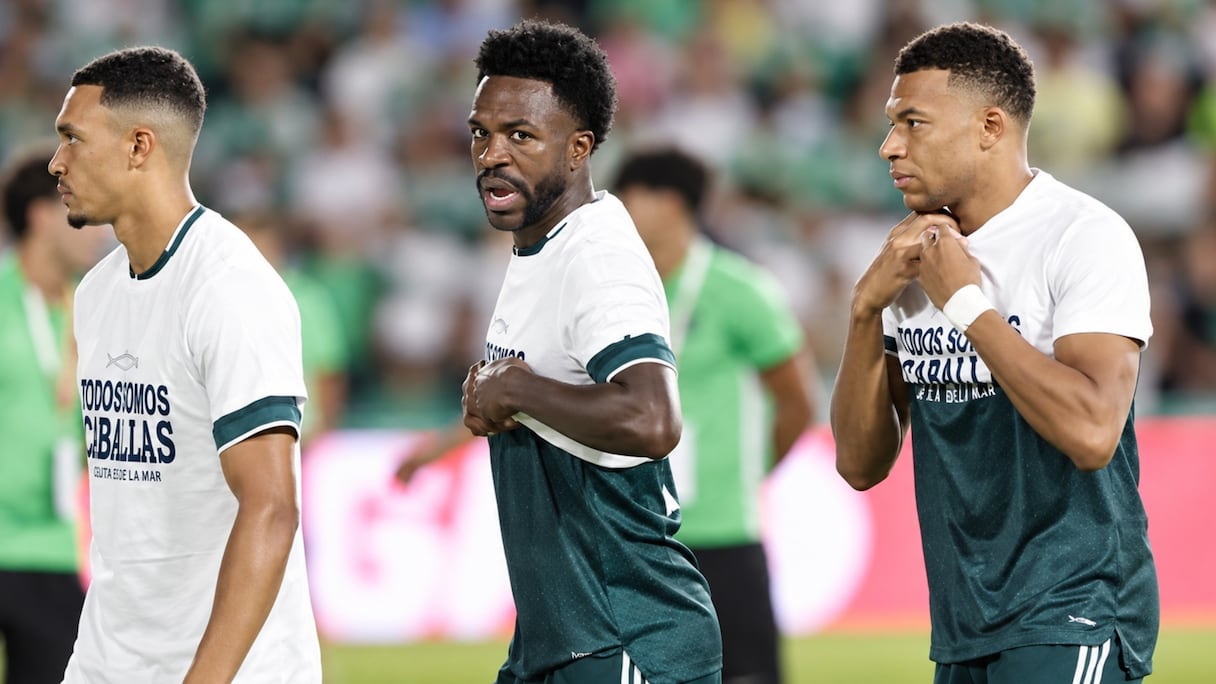
What was initially presented as an initiative in support of Ceuta and its inhabitants has since triggered a wider wave of hostility and discrimination.
As Spain steps up initiatives supporting the residents of the Spanish enclave on Moroccan territory, Real Madrid players Vinicius, Kylian Mbappé and Ibrahima Konaté have become targets of criticism from some Spanish commentators.
Before Real Madrid faced Elche on Tuesday, September 15, the three players were invited to wear T-shirts carrying messages in support of Ceuta and its inhabitants.
Mbappé, Konaté and Vinicius agreed to take part in the initiative, but the way they wore the shirts also drew criticism, with some accusing them of making the inscriptions difficult to read.
Read also : Real Madrid defends players over Ceuta T-shirts and reignites debate on individual freedom
Real Madrid subsequently defended its players and invoked the principle of individual freedom. The Madrid club said it respected “the opinion and sensitivity of each of its employees” and stressed that no one should be forced to publicly defend a message they did not believe in.
The controversy, however, has continued to grow. Insults have multiplied on social media and have now spilled over into the media itself.
One of the most serious incidents involved Federico Jiménez Losantos, a Spanish journalist who appears on EsRadio. During a live broadcast, he made racist comments targeting Vinicius while also criticizing Mbappé and Konaté.
Losantos first sought to draw a distinction between the three players and Spain. “In any case, Konaté, Mbappé and Malicius are foreigners,” he said. “Malicius” was a play on Vinicius’ name and the Spanish word “malicioso,” which refers to someone who is mischievous or malicious.
The journalist then went much further with particularly degrading remarks. “Even though Vinicius was almost born here… well, the one we knew as Vinicius. Today, I see a guy who is a fat black man, with a huge jaw, and he is not Malicius, but yes, it is him,” he said.
The remarks represent another escalation in a controversy that initially emerged around what was presented as simple “support” for the population of the Spanish enclave on Moroccan territory.
While footballers had apparently chosen to draw a line between sport and politics, the journalist instead targeted Vinicius’ skin color and physical appearance.
The Brazilian has regularly been subjected to racist abuse since arriving in Spain in 2018. This latest episode, however, carries a particular dimension because the remarks were made live by a journalist and media professional rather than by anonymous users on social media.
Vinicius far from alone
The case of Vinicius is far from isolated. Spanish football has repeatedly been confronted with racist incidents over the years, whether in the stands, around stadiums or, in this case, on radio broadcasts. Players from several generations have been targeted, showing that the problem is not a recent one.
During the friendly between Egypt and Spain at the RCDE Stadium ahead of the 2026 World Cup, Spanish supporters were heard chanting, “Whoever doesn’t jump is Muslim.”
The list of players who have faced racist insults or behavior in Spanish football is also long. It includes Vinicius, Omar El Hilali, Kazunari Kita, Lamine Yamal and Alejandro Balde.
In 2004, Cameroonian goalkeeper Carlos Kameni was notably targeted with bananas thrown at him. Samuel Eto’o, Iñaki Williams and Raphinha have also faced similar incidents at different stages of their careers.
When such incidents do not occur on radio broadcasts or inside stadiums, they can take other forms around sporting venues.
Following the events linked to Ceuta, a Moroccan flag was reportedly burned near the Santiago Bernabéu, providing another example of the tensions that can surround episodes mixing football and politics.
Another issue is that several stadiums associated with these incidents are among the venues selected to host matches at the 2030 World Cup, which will be co-hosted by Morocco, Spain and Portugal.
The Santiago Bernabéu, along with Camp Nou, is being promoted as a possible venue for the final, alongside Morocco’s Hassan II Grand Stadium.
The RCDE Stadium in Cornellà de Llobregat, where the “Whoever doesn’t jump is Muslim” chants were heard, is also among the stadiums scheduled to host matches during the tournament.
This inevitably raises questions about the measures that will need to be put in place to ensure that a World Cup intended to bring football fans together across origins, nationalities and cultures is not affected by this type of behavior.
These incidents are another reminder that racist abuse continues to surface in Spanish football, from the stands and areas around stadiums to social media and radio broadcasts.