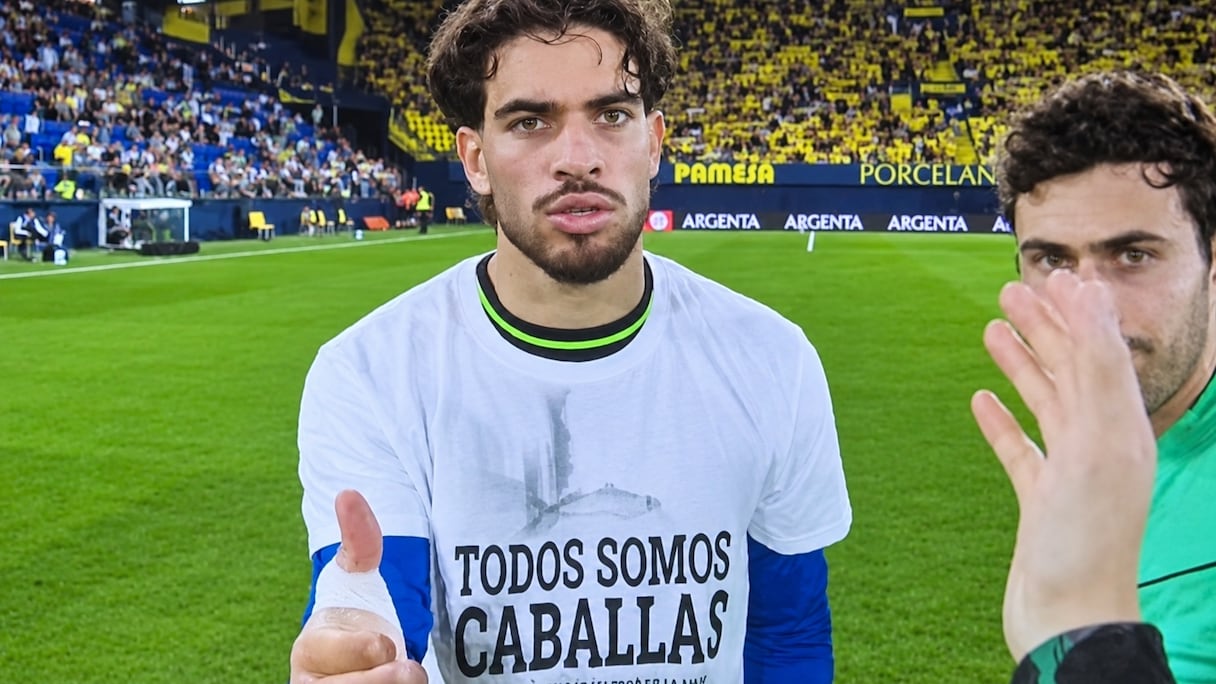
There are shirts that footballers wear to play, and then there are those that say something else even when worn for only a few minutes before kickoff.
On Monday, September 14, before the Villarreal-Betis match, players from both teams wore T-shirts bearing two inscriptions: “Todos somos caballas,” which translates to “We are all Caballas,” the traditional nickname given to the inhabitants of Ceuta, and “Ceuta (y sus caballeros) es de la mar,” which translates to “Ceuta (and its knights) belongs to the sea.” Among those players was Abdessamad Ezzalzouli.
These messages go beyond mere support for the Spanish identity of Ceuta and the narrative of victimhood promoted by the local governor and most political parties. They also contribute to the extension of this hysterical anti-Morocco campaign into areas far removed from politics.
Ezzalzouli could have asked himself a straightforward question: Was he really obliged to take part in it?
The answer is far less obvious than the image of two entire teams wearing the same T-shirt might suggest.
First, Spanish law protects ideological freedom. Article 16 of the Spanish Constitution guarantees freedom of ideology, religion, and worship and states that no one may be compelled to disclose their ideology, religion, or beliefs.
Article 20 protects freedom of expression. While a professional footballer is certainly subject to the obligations arising from his contract, he does not leave his fundamental rights at the dressing room door.
This principle does not stop at Spain’s borders either. Article 18 of the Universal Declaration of Human Rights recognizes the right of all people to freedom of thought, conscience, and religion.
Article 9 of the European Convention on Human Rights, to which Spain is a party, also protects freedom of thought, conscience, and religion. While these freedoms can be subject to certain restrictions provided by law, the principle itself remains firmly established.
However, these provisions do not grant players the right to refuse any instruction from their club. Being under contract means accepting legitimate instructions from an employer, even if they conflict with a player’s personal views. However, signing a contract does not mean that freedom of conscience disappears.
The situation is necessarily different when a player is asked not merely to wear the equipment required to do his job but also to display a message on his body that may carry political, identity-based, or territorial meaning.
Spain’s Workers’ Statute requires employees to follow their employer’s instructions when they fall within the proper exercise of managerial authority. However, Spanish labor law also protects workers’ dignity and fundamental rights.
Therefore, there is a difference between asking Abde to wear Betis’ green-and-white shirt, which is part of his job, and associating him with an unrelated slogan that could conflict with his convictions or draw him into a political issue he did not choose.
Football has its own safeguards as well. Law 4 of the IFAB regulates slogans, statements, and images displayed on players’ equipment, especially if they are political, religious, or personal in nature.
The Laws of the Game also call for sensitivity when a message relates to a national or international issue or event.
Therefore, Abde could have at least asked not to wear it.
There was no need for him to make an inflammatory statement or provoke an incident with Betis. He could simply have explained that the message concerned a sensitive issue for his country and that he would prefer not to be associated with it.
Freedom of expression is not only about being able to speak. It also means being able to refuse to endorse a message with which one does not wish to be associated. Refusing to wear a slogan does not necessarily mean opposing those who choose to wear it.
Abde is not just any player in the eyes of Moroccans. He regularly wears a red shirt bearing a green star—the symbol of the Atlas Lions. When a Moroccan international appears with a message explicitly referring to Ceuta on his chest, the image inevitably takes on a particular meaning in Morocco, whether he intends it to or not.
This may be where his mistake lies. He failed to anticipate the implications of the photograph and the stigma it carries for Moroccans.
Refusing to wear the T-shirt would not have been an affront to Betis or a sign of disrespect towards his teammates. It would simply have meant respecting their decision while making clear that he did not want his image associated with a message touching on a politically sensitive issue that is part of the relentless campaign against his country.
Abde could have said no.
