
Since August 1, 2026, applicants for a student visa to France have been required to prove monthly resources of €877.50 (around 9,480 Moroccan dirhams, 193,000 Algerian dinars, 2,940 Tunisian dinars or 575,650 CFA francs), compared with €615 previously (around 6,640 Moroccan dirhams, 135,300 Algerian dinars, 2,060 Tunisian dinars or 403,415 CFA francs). The 42.7% increase, viewed alongside data from Campus France and Decree No. 2026-526, paints a picture in which African countries are on the front line.
Read also : Visa for Belgium: the 7 biggest African applicants in 2025
According to official Campus France statistics for 2025, the two major regions of the continent, North Africa–Middle East and sub-Saharan Africa, together accounted for 53% of the 419,694 international students recorded in 2023-2024. The impact is therefore primarily African.
The decree of June 22, 2026 does more than simply raise the threshold: it changes the very nature of the criterion. For two decades, the minimum requirement had remained fixed at €615, pegged to an allowance granted to French government scholarship holders that had not been updated since the December 31, 2002 order.
By switching to 47% of the gross minimum wage, or roughly 60% of the net minimum wage, the French government has introduced an indicator that is expected to be revised at least once a year in line with inflation. This means the threshold can only rise automatically, without requiring legislative intervention.
For African families relying on personal savings, family guarantees or scholarships, the impact is immediate. Proving that they have €10,530 in annual funds instead of €7,380 represents an additional €3,150 per year. This is not merely an administrative formality. It is a barrier that filters applicants before academic merit even comes into consideration.
Read also : US visas: Nationals of these 30 African countries must now pay a bond of up to $20,000
The dashboard published by the French Ministry of Higher Education and Research, through its Sub-Directorate for Information Systems and Statistical Studies (MESR/SIES), for the 2023-2024 academic year leaves little room for doubt. North Africa–Middle East accounted for 115,863 students, or 28% of the international student population, representing a 14% increase over five years.
Sub-Saharan Africa followed closely, with 103,450 students, or 25% of the total, and growth twice the global average: 34% over five years. Together, the two regions account for more than half of all international students enrolled in French higher education.
Looking at the top 25 countries of origin, 11 African countries feature among them, and all are countries where proof of financial resources plays a decisive role. Morocco ranks first among the 25 largest contingents, with 43,354 students, or 10% of the total, despite a 4% decline over one year. Algeria comes second with 34,269 students, or 8%, up 7% year-on-year.
Senegal, ranked fifth with 16,955 students, up 11% in one year and 37% over five years, and Tunisia, ranked sixth with 15,224 students, up 7%, continue to strengthen their presence. Côte d’Ivoire, ranked eighth with 11,772 students, up 10%, and Cameroon, ranked tenth with 10,880 students, up 11%, complete the leading group of African countries, followed closely by the Republic of the Congo, ranked 11th with 8,307 students, up 11%, and Benin, ranked 15th with 7,003 students, up 24% in one year and a striking 105% over five years.
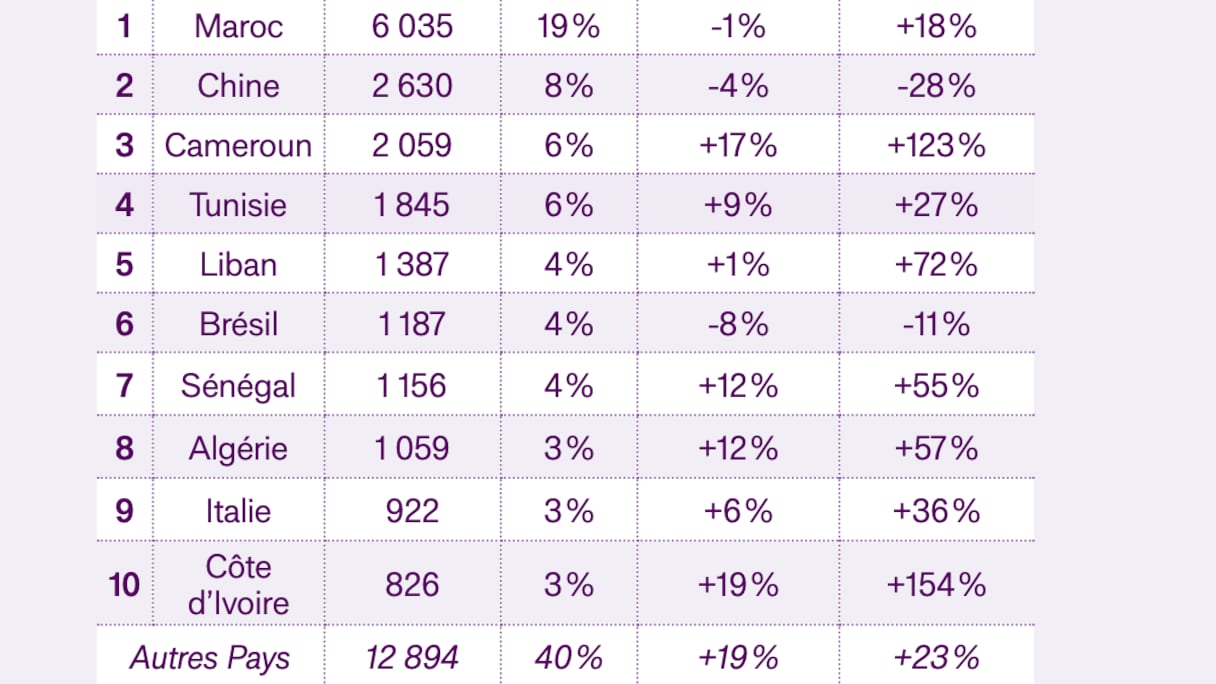

Just as Morocco tops the list of the 25 leading countries of origin for international students in France, it also ranks first among the top 10 countries of origin for international students enrolled in engineering schools.
Further down the ranking, Gabon, ranked 17th with 5,813 students, up 3% year-on-year and 17% over five years, is progressing steadily. Madagascar, ranked 18th with 5,612 students, up 11% year-on-year and 28% over five years, and especially Togo, ranked 21st with 5,424 students, up 17% year-on-year and 73% over five years, are showing remarkable growth. In these three countries, where proof of financial resources is an essential prerequisite, study plans could be jeopardized by the 42.7% increase in the minimum requirement.
It is worth stressing that these are not stable student populations, but rapidly growing flows driven by a young population and a shared French-speaking environment that makes France a natural destination. The new threshold risks abruptly cutting short these trajectories.
A multi-layered mechanism
The accepted forms of proof, including personal savings, a guarantor or a scholarship, may appear neutral, but their application is anything but uniform. In a context where African government scholarships remain limited, extended family support often makes up the difference. Yet proving that €877.50 is available every month means that a guarantor must demonstrate regular income well above that amount, in countries where the minimum wage, where one exists, bears little comparison with France’s minimum wage.
Decree No. 2026-526 of June 22, 2026 provides for no geographical adjustment and no gradual implementation. Newly created Article R. 422-2 applies uniformly to all nationals of third countries. The only safety valve mentioned is the possibility of working up to 60% of the annual working time. However, access to the labor market is conditional on obtaining the visa first, creating a vicious circle for applicants who cannot prove sufficient resources upfront.
Read also : US expands social media screening to foreign journalists applying for visas
Campus France’s 2025 report, for its part, reiterates the government’s target of 500,000 international students by 2027. With 430,000 recorded in 2023-2024, the gap was still significant but within reach. The decision to update and index the level of financial resources that third-country nationals must now prove in order to obtain a residence permit for study purposes introduces an internal contradiction. France wants more international students, but it is making access more difficult.
France, the world’s seventh-largest destination for international students, therefore finds itself at a crossroads. Campus France’s 2025 figures are clear: between 2017 and 2022, the United Kingdom increased its international student population by 55%, Canada by 60%, and Germany, which became the world’s third-largest host country for the first time, by 56%. Over the same period, France grew by just 21%.
This gap is not accidental. The report highlights the proactive measures adopted by these three competitors. Canada and the United Kingdom long offered some of the world’s most favorable post-study residence conditions, while Germany, now one of the most attractive destinations in the European Union alongside Ireland and Estonia, offers English-language programs in sought-after fields such as engineering and business, while also performing strongly in international rankings.
Campus France notes that “in a number of French-speaking countries, where student mobility is largely directed toward France, the country faces strong competition from destinations such as Canada and Germany, particularly in the fundamental sciences.”
Add to this declining attractiveness a financial barrier that has risen abruptly by 42.7%, and the most qualified students, particularly those with strong French and science skills, could opt for Canadian or German universities instead, where the financial conditions are more flexible and the prospects for their professional futures more promising.
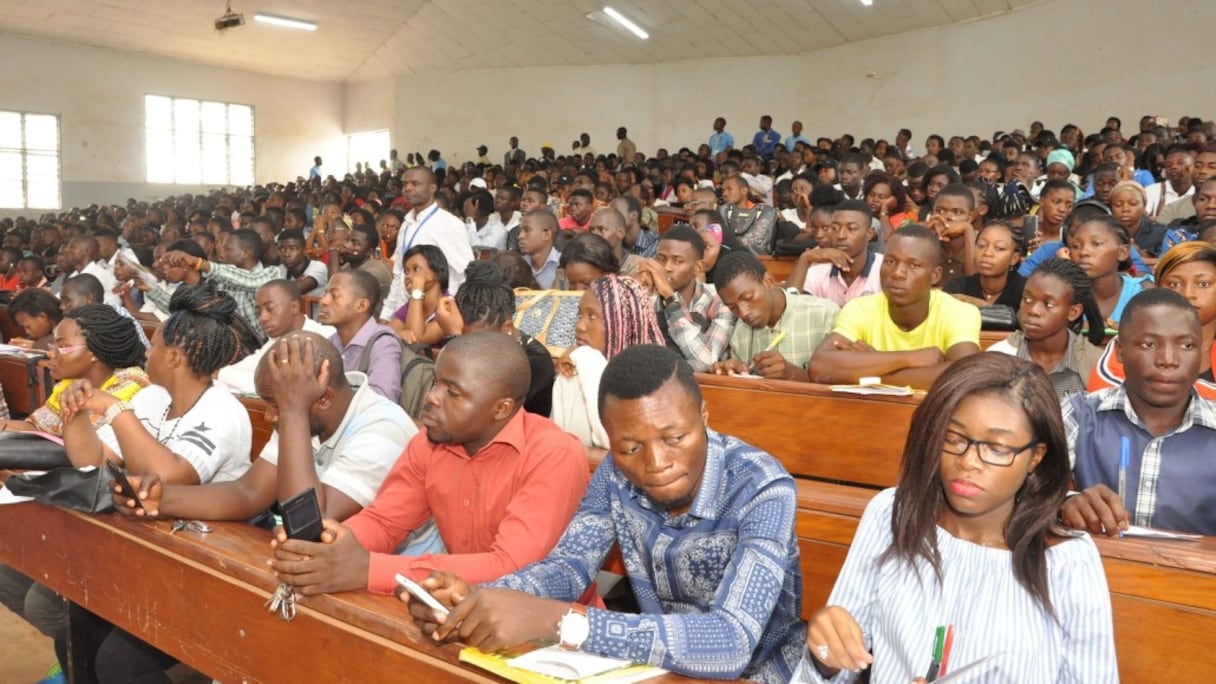
The consequences could also be felt on African campuses themselves: fewer students leaving would mean greater pressure on local universities that are already overcrowded. But that may not be the most significant effect of the measure. By filtering students based on their ability to pay, France is not simply selecting students. It is selecting socioeconomic profiles, reducing the diversity that has long been one of its strengths in the global higher education landscape.
History may well record that it was in the summer of 2026, through a simple regulatory update, that France began redrawing the map of its student ties, further shutting out those who had chosen its universities for decades in the hope of building a better future.