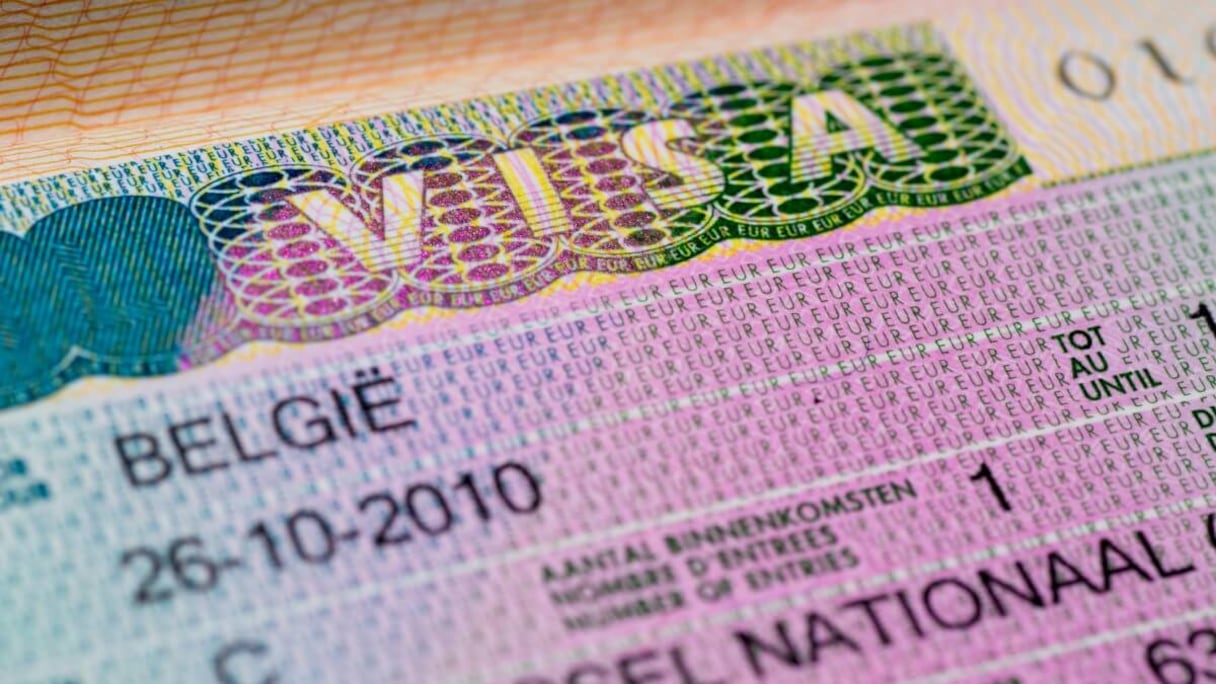
In 2025, Belgium recorded 275,519 applications for short-stay (C) and long-stay (D) visas. Official statistics from the Immigration Office, finalized in July 2026, show that Africa occupies a central place, not only in terms of the volume of applications but also because of the diversity of migration strategies they reveal.
Seven countries on the continent rank among the biggest applicants, with sharply contrasting profiles that, in themselves, illustrate the state of family ties, educational ambitions and economic disparities between Africa and Europe.
The African podium: Morocco, DR Congo, Algeria
Combining short-stay (type C) and long-stay (type D) visa applications, where the data are available, Morocco clearly leads the African ranking. With a total of 20,937 applications, including 16,435 short-stay and 4,502 long-stay applications, it ranks ahead of every other country on the continent, as well as countries such as Turkey and the Philippines.
The Democratic Republic of Congo ranks second, with 12,211 C visa applications and 1,621 D visa applications, for an overall total of at least 13,832 applications. Algeria, whose long-stay visa applications do not appear among the top 10 — they are lower than the D visa applications recorded by the DR Congo, at 1,621 — nevertheless recorded 8,802 C visa applications, placing it third in Africa by total number of applications.
African aspirations toward Belgium
Behind this trio, Egypt (7,791 C visas), Senegal (5,866 C visas) and Cameroon (3,834 D visas, with its C visa applications remaining below the 5,866 threshold) complete a revealing picture. Burundi, meanwhile, stands out for a spectacular rise in long-stay visa applications: from 456 in 2021 to 1,630 in 2025, more than tripling in four years. The surge raises questions about migration patterns in East Africa.
The Immigration Office’s report breaks down applications by purpose, offering a revealing snapshot of the aspirations behind each application. For Morocco, C visas are primarily about family visits: 10,047 applications in 2025, accounting for 61% of short-stay applications. Tourism, with just 2,515 applications, comes far behind, showing the strength of the transnational ties maintained by Belgium’s Moroccan diaspora.
Read also : US visas: Nationals of these 30 African countries must now pay a bond of up to $20,000
For D visas, Morocco presents a more mixed picture: family reunification with a Belgian national (1,455 applications under Article 40ter) and higher education at a public institution (1,255) are the two main categories, followed by salaried employment (485). Thus, for Morocco, the visa could be described as first and foremost a family bridge, and then a tool for upward social mobility. Both dynamics are deeply rooted.
The DR Congo presents a very different profile. For C visas, tourism (8,148 applications) overwhelmingly dominates, accounting for two-thirds of short-stay applications — an unusual figure for an African country, often indicative of multifaceted travel plans. For long-stay visas, higher education (639) and family reunification with a Belgian national (359) are the leading categories. Another Congolese-specific feature is the 118 applications for training at private institutions, a reason that is almost nonexistent among the other major African applicants.
Algeria, whose D visa data are not detailed, shows a structure similar to Morocco for C visas, with family visits taking the lead (3,291), followed by tourism (2,559) and an almost specific category, medical reasons (935). The latter, nearly three times higher than in Morocco, points to a reliance on the Belgian healthcare system that warrants further investigation.
Read also : US consolidates visa processing into 20 African hubs, ending services in 25 countries
Egypt and Senegal, by contrast, are destinations dominated by tourism, with 5,327 and 4,266 C visa applications respectively. This places them closer to a pattern of upward economic mobility than to the already deeply established diaspora ties seen elsewhere.
Cameroon, absent from the top 10 for C visas in 2025 but well represented with 3,834 long-stay applications, is an exception: 2,197 applications were for higher education at public institutions, representing 57% of the total. It is the only country where D visas are clearly driven by education, pointing to a country investing heavily in Belgian universities.
Burundi, finally, stands out as the leading country for family reunification. Of the 1,630 long-stay (type D) visa applications filed in 2025, 1,115 concerned family reunification with a foreign national admitted for unlimited residence, a refugee or a beneficiary of subsidiary protection (Article 10). This overwhelming proportion illustrates the migration consequences of the political and humanitarian crises that have shaken the country.
The five-year trend reveals major underlying patterns. Moroccan C visa applications increased more than eightfold between 2021 (1,979) and 2025 (16,435), with growth continuing uninterrupted. The DR Congo experienced a similar surge, rising from 3,445 to 15,738 short-stay applications in 2024, before falling sharply to 12,211 in 2025. This Congolese drop of 22% in one year is one of the report’s most notable findings: is it the result of saturation, tighter visa conditions or a shift in flows toward other Schengen destinations? The document does not say, but the break in the trend is too pronounced to be merely temporary.
Read also : Henley Passport Index: Strongest to weakest African passports
By contrast, Algeria’s growth has been steady, rising from 1,249 to 8,802 C visa applications. The relative stability of Morocco’s D visa applications, at around 4,500 since 2021, contrasts with the continued rise in short-stay applications, suggesting that these ties have now become strong enough that they no longer systematically require permanent settlement. Cameroon, meanwhile, saw its D visa volume fall from 4,224 in 2021 to 3,058 in 2024, before rising again to 3,834 in 2025, a fluctuation that likely reflects the ups and downs in diploma recognition and student admission policies.
Family, studies, work: a fragile balance
Looking at the purposes behind the applications reveals a much more nuanced map of Belgium-Africa ties than a simple “migration pull factor.” Morocco combines all three pillars — family, studies and salaried employment — with family visits overwhelmingly dominating short stays. Cameroon relies almost entirely on education. The DR Congo adds a tourism component to these two dimensions that is harder to interpret. Burundi and the DR Congo both show a strong reliance on family reunification on humanitarian grounds, reflecting populations uprooted by conflict.
These figures are more than statistics. Every application tells a story: that of a Moroccan father who has not seen his children for three years, a Cameroonian student who wants to become an engineer in Liège, or a Burundian refugee who has finally secured legal status and can bring his wife over. Behind the percentages are lives hanging in the balance over a stamp.
Short-stay applications for professional or business purposes remain marginal in French-speaking Africa, with the notable exceptions of Algeria (654 business trips) and Morocco (735). The contrast with India is striking, with 3,689 professional trips and 5,259 business trips recorded under C visas. Africa’s weak showing in the economic dimension of short-stay travel reflects a still limited integration into European business networks and, conversely, the use of visas more as a means of subsistence than of commercial exchange. The use of medical grounds in Algeria and, to a lesser extent, the DR Congo also points to national healthcare systems under pressure.
Read also : Kenya: One year after their unlawful relocation, two Moroccan children remain separated from their father
Student flows (Articles 58 and 9), meanwhile, serve as a barometer of African youth’s confidence in Belgian education. With 2,197 Cameroonian applications, 1,255 Moroccan applications, 639 applications from the DR Congo and 538 from Pakistan (which is not an African country but serves as a point of comparison), Belgium attracts students well beyond its former colonies, even though the Maghreb and Central Africa remain its main pools of applicants.
For Belgium, these movements raise a double question: how can it facilitate already substantial legal mobility without creating administrative bottlenecks, and how can it make the most of the talent trained there while meeting its humanitarian obligations? The answers are not provided in the report, but the figures speak for themselves.
