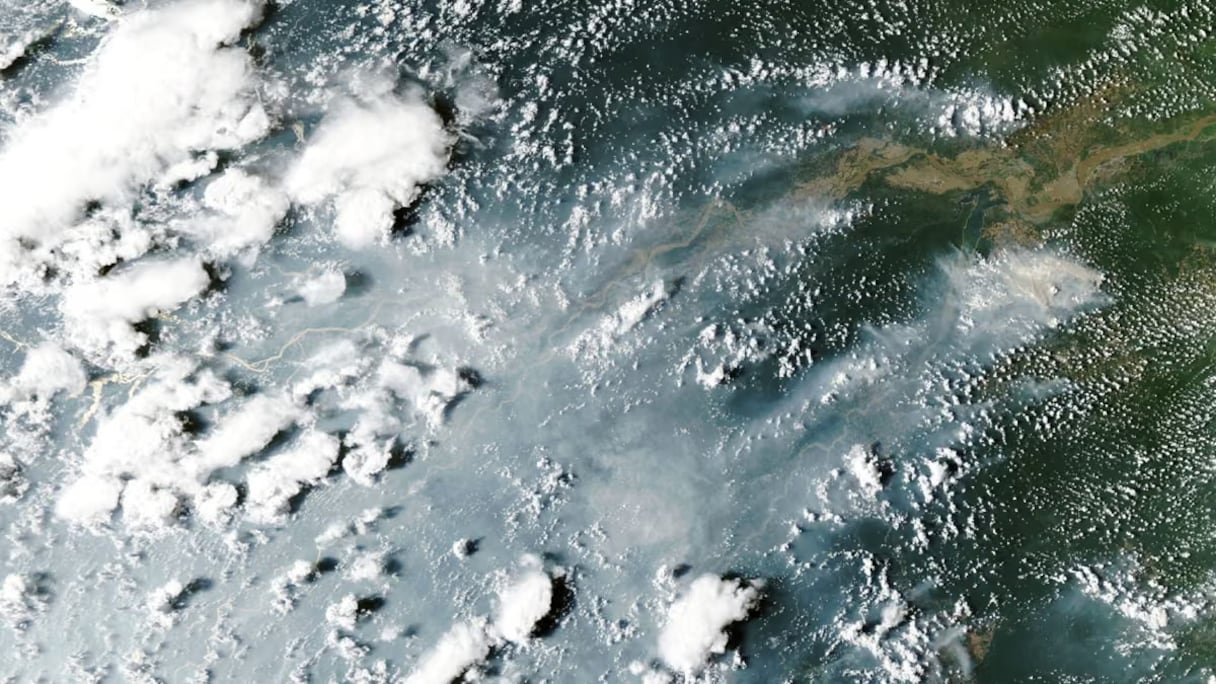
Satellite observations recorded 9,045 fire hotspots across the Amazon during the first half of October, a 62% increase from the same period last year, according to data cited by Spanish newspaper El País. In the state of Amazonas, Brazil’s National Institute for Space Research (INPE) recorded 1,921 hotspots between October 1 and 19, up 202% year-on-year.
The crisis is being driven by a combination of drought, human activity and the effects of El Niño, which is disrupting rainfall patterns across the tropics. Scientists warn that the fire season could remain severe in the coming months.
Manaus struggles with hazardous air
The smoke has made daily life difficult in Manaus, where authorities have suspended classes and issued public health warnings. On October 12, fine particulate matter levels exceeded 135 micrograms per cubic meter, placing air quality in a hazardous range, according to NASA’s Earth Observatory.
Read also : Europe’s extreme summer heat linked to more than 50,000 deaths in 2026
The health effects extend beyond the city. In nearby municipalities, including Autazes and Careiro da Várzea, residents have reported respiratory problems, while families have struggled to protect children and older people from smoke entering their homes.
The fires have also affected local livelihoods. Farmers have reported damage to crops and fruit trees, while smoke has disrupted work and outdoor activities. In riverine communities, severe drought has compounded the crisis by lowering water levels and making access to nearby towns more difficult.
Most fires are linked to human activity
Although drought has left the forest highly vulnerable to burning, scientists say most fires in the Brazilian Amazon are started by people. Landowners often use fire to clear vegetation from pastures and agricultural plots, but flames can spread into surrounding forest when conditions are exceptionally dry.
Fires that begin as land-management practices can escape into the forest understory, where they spread through dry vegetation.
The damage can persist long after the flames are extinguished. Many Amazonian species are not adapted to fire, and forests damaged during earlier fire seasons can become more susceptible to subsequent burning.
In the Manaus metropolitan area, a Mongabay analysis found that 28.8% of recorded hotspots between October 1 and 19 occurred in landscapes where forest and agriculture coexist. The proportion was higher in Careiro da Várzea, Autazes and Careiro, where agricultural activity and forest cover overlap.
Read also : El Niño is back: How a warming Pacific could reshape the world
Authorities investigate suspected arson
Brazilian environmental agencies and police have opened investigations into whether some of the fires were deliberately set. Authorities have examined reports of people using fuel to ignite vegetation near roads and residential areas, while the federal government has asked security and intelligence agencies to look for evidence of coordinated activity.
On October 17, authorities arrested 11 people in Autazes suspected of setting criminal fires, according to Mongabay. The arrests came after a series of investigations into suspected environmental crimes across the state.
The possible connection between the fires and Brazil’s presidential election has also drawn attention. The first round took place on October 4, and fire hotspots in Amazonas rose sharply in the following days. Some environmental researchers have suggested that expectations of a possible change in government may have emboldened people who believed illegal land clearing would face fewer consequences.
That explanation remains a possibility under investigation. Authorities have yet to confirm that the fires were part of a coordinated campaign.
El Niño raises the risk of further fires
The drought has made the current fire season more dangerous. Brazil’s National Institute of Meteorology reported that rainfall in Manaus was 95% below normal in August and 60% below normal in September.
NASA scientists have identified a recurring pattern in which El Niño-related changes in rainfall are followed by increased fire activity in different tropical regions. The sequence can begin with drought and peat fires in Indonesia before fire activity rises in the central and eastern Amazon.
Morton expects fires around Manaus and Santarém to continue until the rainy season arrives, potentially in December 2026 or January 2027. Scientists also anticipate elevated fire risk farther north in parts of Brazil and neighboring countries later this year, followed by increased risk in the southern Amazon in 2027.
Deforestation falls despite the fire crisis
The current fires are occurring even as Brazil reports a substantial decline in Amazon deforestation. Between August 2025 and July 2026, approximately 3,335 square kilometers of rainforest were cleared, the lowest annual figure since satellite monitoring began in 1988.
Read also : World’s oceans absorb record heat as scientists warn of profound changes
Deforestation fell by about 42% compared with the previous reporting period and by roughly 71% from 2023, reflecting stronger monitoring and enforcement under President Luiz Inácio Lula da Silva’s administration. The government has pledged to eliminate deforestation by 2030.
However, falling deforestation rates do not mean the forest is safe from degradation. Fires can damage standing trees without clearing an entire area, while drought and repeated burning can leave previously affected forests more vulnerable.
The fires have also become a point of contention in the presidential campaign. Flávio Bolsonaro and his allies have criticized the federal government’s handling of the crisis, while environmental protection remains a disputed issue between the candidates.
For communities living in and around the rainforest, the immediate concerns are more practical: breathing clean air, protecting homes and crops, and preventing fires from spreading further. Scientists say avoiding unnecessary burning will be crucial while drought conditions persist.
