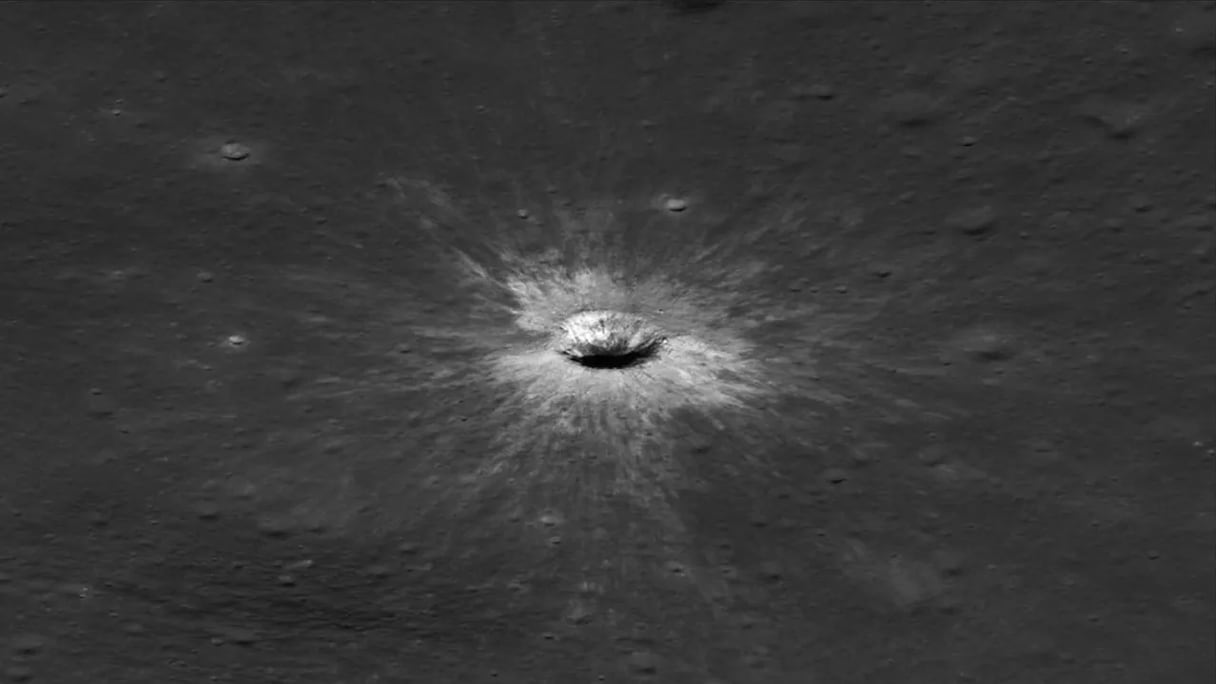
NASA scientists have identified a massive new crater on the Moon that formed following a powerful impact in 2024 but went unnoticed by telescopes on Earth and in space at the time.
Measuring about 222 meters across and up to 43 meters deep, the crater is the largest known impact crater formed in the solar system in recent times. Its diameter is roughly equivalent to the length of two football fields.
The crater formed on the Moon’s near side sometime between April 11 and May 22, 2024, when a fragment of an asteroid or comet struck the surface. NASA estimates that the incoming object was roughly the size of a three- to six-story building.
The impact was not detected as it happened. NASA’s Lunar Reconnaissance Orbiter (LRO) photographed the area shortly after the collision, but the relevant wide-angle images remained buried in the spacecraft’s large volume of data until August 2025. More detailed images were collected later that year, with the discovery confirmed in early 2026.
The crater was named McGetchin after Thomas McGetchin, a former director of Houston’s Lunar and Planetary Institute. It is about three times larger than the previous record-holder discovered by LRO roughly a decade ago.
The findings were published on September 16 in two separate studies in the scientific journal Science Advances. The first, titled “A new 222-m diameter lunar crater,” was led by Mark Robinson, chief scientist for the LRO cameras at Intuitive Machines. The second, titled “New lunar crater reveals extensive distal regolith modification,” was led by Tyler M. Powell, Tyler M. Powell, a planetary scientist who earned his doctorate from the University of California, Los Angeles.
The two studies examine different effects of the same impact, from the material thrown across the lunar surface to changes in the Moon’s loose surface soil and rock, known as regolith.
Researchers estimate that an impact capable of producing a crater of this size occurs on the Moon roughly once every 132 years, making the event an unusually rare opportunity to observe the effects of a fresh lunar impact.
“This event constitutes a statistically rare, effectively once-in-a-lifetime observation,” the researchers wrote in one of the two studies.
The impact also sent dust and rocky material more than 100 kilometers across the lunar surface, with some of the material travelling at a higher angle than expected, according to Robinson.
The second study found that the impact also affected the lunar surface beyond the immediate area of the crater. David Paige, a co-author of the study from the University of California, Los Angeles, described the process as a way to “garden the regolith — churning the sediments and putting stuff above that’s usually below the surface.”
The findings could help scientists better understand how impacts reshape and redistribute material across the Moon, while providing useful information for future missions and planned lunar infrastructure.
According to the researchers, studying the spread of impact debris could also help engineers assess the risks to structures built on the lunar surface.
“That information will help engineers harden structures so one won’t have to worry about damage, or maybe worry less,” Robinson said.