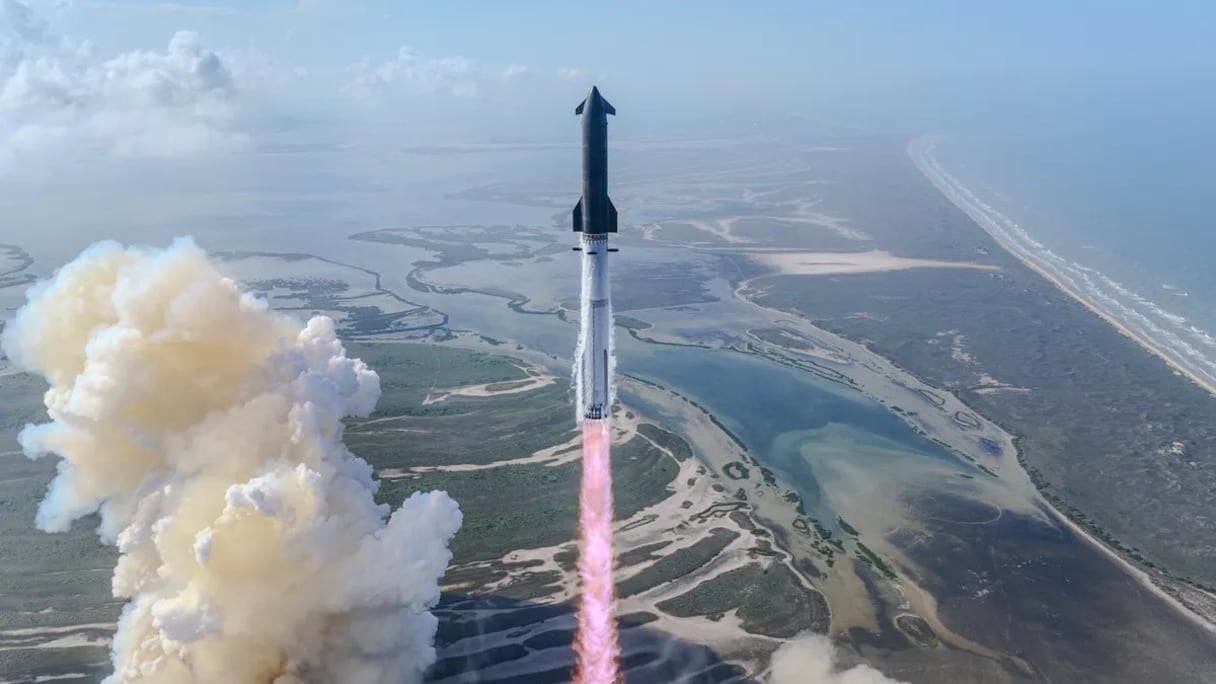
The 75-minute launch window is scheduled to open at 7:15 a.m. Central Time, pending regulatory approval.
Until now, Starship test flights have followed suborbital trajectories designed to maximize safety and allow engineers to collect data. Flight 14 will mark the next stage of the program, with the spacecraft expected to enter orbit and remain in space for nearly 10 hours.
The mission is planned to reach an altitude of about 275 kilometers and complete roughly six orbits before a controlled reentry and splashdown in the Pacific Ocean west of Chile.
Read also : NASA and IBM launch AI model to map the Moon and hunt for lunar ice
The flight will also deploy 26 Starlink V3 satellites, marking the first planned orbital deployment of the new-generation satellites.
Each Starlink V3 satellite is designed to add 1 terabit per second of capacity to the constellation. The 26 satellites would therefore add 26 Tbps of capacity in a single mission, according to SpaceX.
Three of the satellites will carry cameras designed to scan Starship’s heatshield and send images back to operators. The data will be used to study the condition of the heatshield and help assess its readiness for future return-to-launch-site attempts.
Changes after Flight 13
The Super Heavy booster will face several modified objectives on Flight 14, including launch, ascent, stage separation, boostback and a landing burn at an offshore location in the Gulf of America.
During Flight 13, the booster used all 33 engines for its boostback burn for the first time. However, three center engines showed signs of ice clogging, bringing the maneuver to an early end.
The booster later attempted a landing burn, with eight of the 13 planned engines reigniting before it made a hard splashdown.
SpaceX has since introduced hardware changes to improve engine filtering and software changes intended to improve engine relight reliability.
The Starship upper stage will also test several systems during the mission, including its first orbital insertion maneuver, deployment of the 26 satellites, a deorbit burn using a single Raptor engine and controlled reentry.
SpaceX says it will only attempt orbital insertion after flight controllers determine that critical hardware has enough redundancy to support the deorbit burn at the end of the mission.
Testing a reusable spacecraft
Starship and its Super Heavy booster are designed to be fully and rapidly reusable. The booster is powered by 33 Raptor engines, while the Starship spacecraft uses six engines, including three Raptor Vacuum engines designed for operation in space.
The system stands 124 meters tall and has a diameter of nine meters. SpaceX says it is designed to carry more than 100 metric tons to orbit in a fully reusable configuration.
The company is also testing changes to Starship’s heatshield based on data collected from Flight 13.
The modifications include additional mechanisms to hold tiles in areas considered most vulnerable to falling during ascent, changes to areas where plasma could flow behind the tiles, and curved tile designs intended to reduce heating between tiles.
Read also : Astronomers discover fastest known star in the Milky Way, and it could unlock a black hole mystery
Two heatshield tiles recovered from Ship 40 are also planned to fly again on Ship 41, marking the first planned reuse of Starship heatshield tiles.
If Flight 14 goes ahead as planned, it will be a major test of Starship’s ability to operate for an extended period in orbit while deploying an operational payload and preparing for controlled reentry.