The NASA-IBM Lunar Foundation Model was trained mainly on 17 years of data from NASA’s Lunar Reconnaissance Orbiter (LRO), which has built an almost complete high-resolution picture of the Moon. The model is now publicly available for researchers to use and adapt.
The LRO dataset used to train the model includes roughly 2 million image tiles, with more than 1 million high-resolution camera images and nearly 964,000 multispectral images. Data from other lunar missions, including NASA’s GRAIL and Lunar Prospector and Japan’s SELENE mission, were also included.
NASA says the model can be adapted to different research tasks using relatively small amounts of labeled data. One of its applications is mapping the Moon’s craters. Because impact craters help scientists determine the age of different parts of the lunar surface, automatically identifying and measuring them could speed up research that would otherwise require extensive manual work.
Read also : Space robotics startup targets autonomous Mars city construction in the 2030s
The model can also help identify unusual volcanic formations known as irregular mare patches. Some of these features appear relatively young, raising questions about how and when the Moon cooled and became geologically inactive.
Searching for lunar ice
Another application involves the Moon’s polar regions, where permanently shadowed areas can remain cold enough to preserve ice for billions of years.
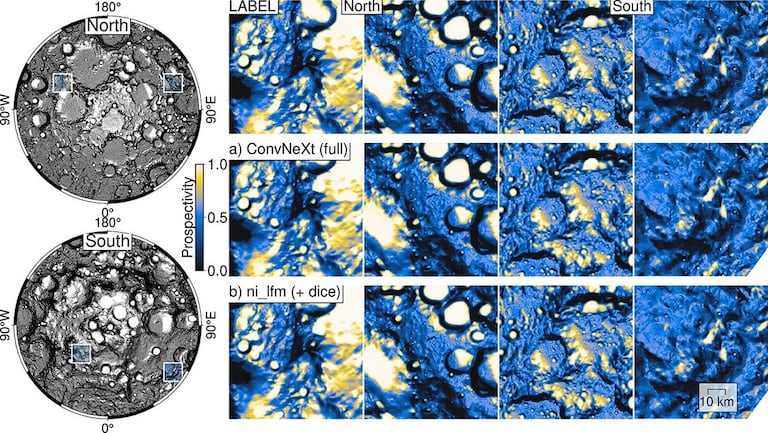
The NASA-IBM model can estimate where ice deposits are likely to remain stable, both on and below the lunar surface. NASA says the capability could help researchers map potential water resources for future exploration while also providing clues about the Moon’s history.
The model was also tested on images showing the area around the Einstein crater before and after a SpaceX rocket body struck the Moon. It successfully identified existing craters and highlighted the newly formed impact crater, suggesting that the system can be adapted to detect changes between observations.
“NASA has spent decades building an extraordinary scientific record of the Moon, but collecting data is only part of the job,” Kevin Murphy, NASA’s chief science data officer and acting chief data and AI officer, said in NASA’s announcement.
“We also have to make data easier for scientists to explore and use,” Murphy added.
Read also : SpaceX launches three satellites designed to connect ordinary smartphones from space
NASA said the model matched or exceeded several baseline systems across the tasks it was tested on, with a clear advantage in estimating polar ice stability.
NASA and IBM have released the lunar model, training datasets and benchmark collections as open resources, allowing researchers to test and develop their own applications for lunar science.
