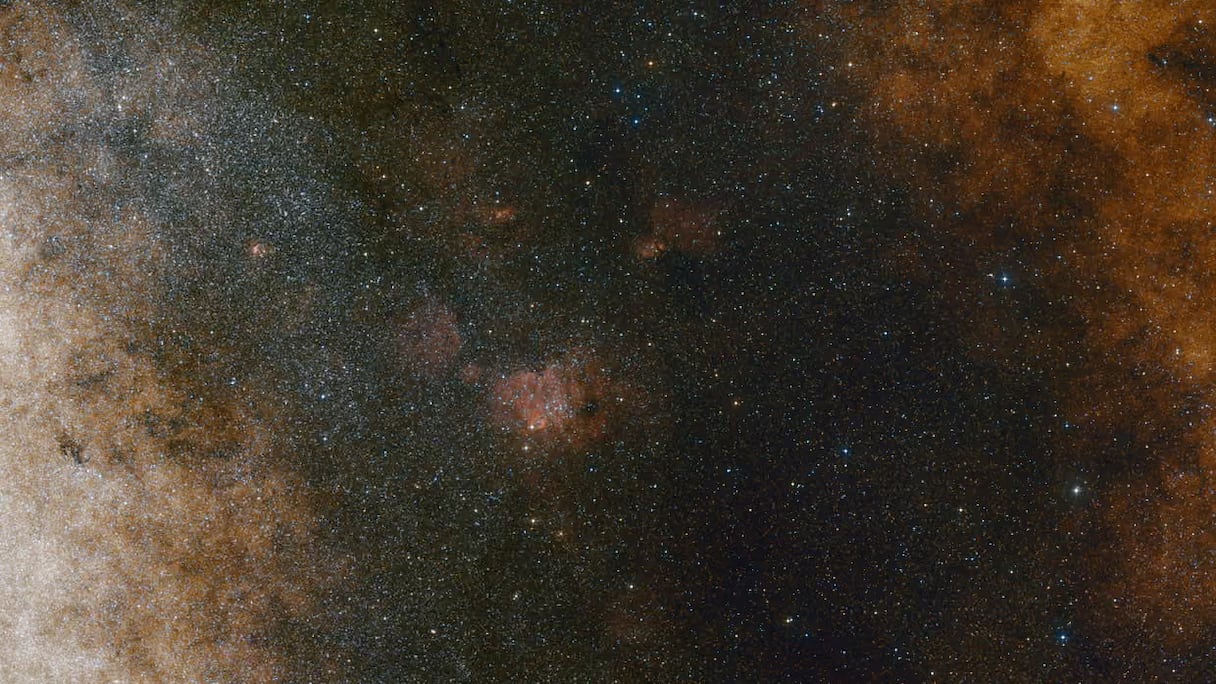
Named S301, the star is the subject of a new study published in Nature by researchers from the Max Planck Institute for Extraterrestrial Physics and other institutions. Using observations from the European Southern Observatory’s Very Large Telescope Interferometer, the team traced the star’s highly elongated orbit around Sagittarius A*, the roughly 4.3-million-solar-mass black hole at the heart of the Milky Way.
The study found that S301 completes an orbit in just 8.7 years and comes within about 12 times the distance between Earth and the Sun of the black hole. At its closest approach, it reaches speeds of about 25,000 kilometers per second, making it both the fastest known star in the galaxy and the closest known star to Sagittarius A*.
Read also : Milky Way swallowed a smaller galaxy about 11.8 billion years ago, study finds
“What is special about this star is that it’s orbiting Sagittarius A* on a very tight orbit, taking just 8.7 years to complete it, and is approaching the black hole at a mere 12 times the distance of Earth to the Sun. That is unprecedented,” said Felix Mang, a PhD student at the Max Planck Institute for Extraterrestrial Physics and an author of the study.
The discovery could give scientists a new way to investigate one of the black hole’s fundamental properties: its spin.
According to Einstein’s general theory of relativity, a rotating black hole should drag the surrounding spacetime along with it, subtly altering the orbits of nearby objects. Because S301 travels so close to Sagittarius A*, researchers believe they may eventually be able to detect this effect, known as Lense-Thirring or frame-dragging precession.
“With this star we hope to measure, within the next 10 years, the spin of the black hole,” Mang said.
The team detected S301 using the GRAVITY instrument on the European Southern Observatory’s Very Large Telescope Interferometer in Chile. Although the star was first identified in observations made in 2023, researchers were able to trace it through archival data dating back to 2017, allowing them to reconstruct much of its orbit.

The star’s orbit also shows the effects of general relativity already known from observations of other stars near Sagittarius A*. Researchers expect the black hole’s mass to produce a larger shift in S301’s orbit, while the effect of its spin should be considerably smaller and therefore harder to detect. Continued observations over the coming years could help separate the two effects.
Reinhard Genzel, a Nobel Prize-winning astrophysicist and director at the Max Planck Institute for Extraterrestrial Physics, described S301 as a promising object because of its proximity to the black hole.
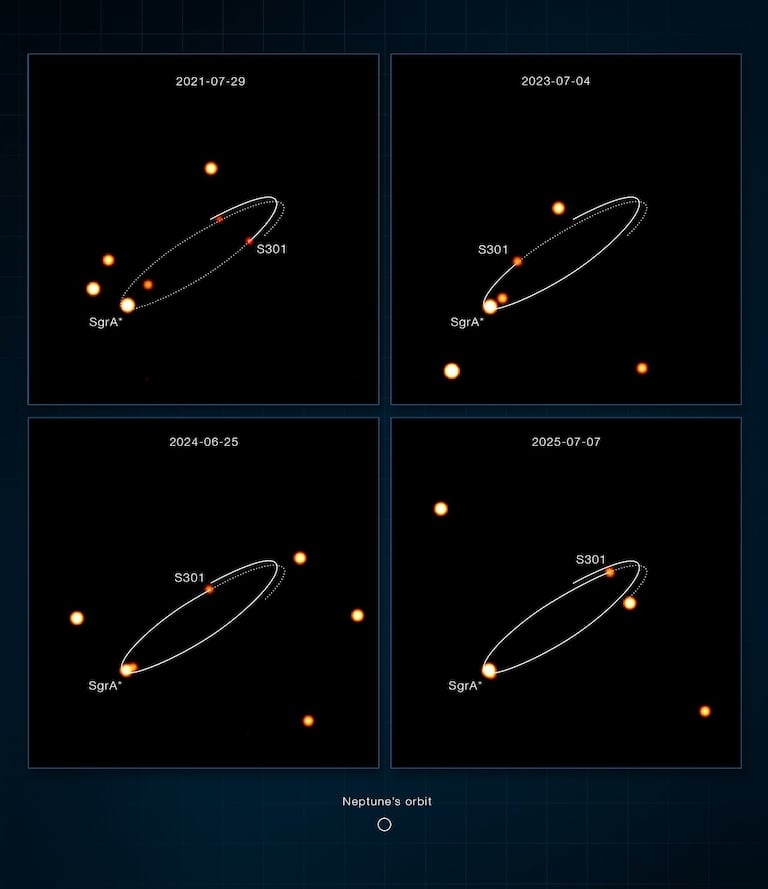
“Because it orbits so close to Sagittarius A*, S301 opens a new window to the fundamental properties of spacetime in this extreme black-hole environment,” Genzel said.
S301 is not expected to fall into the black hole. Despite its extreme proximity, its orbit keeps it outside Sagittarius A*’s event horizon.
Researchers are also investigating how the star ended up on such an unusual orbit. One possibility is that S301 was once part of a binary system that ventured too close to Sagittarius A*. The black hole’s immense gravity could have separated the two stars, capturing S301 while sending its former companion speeding away. That scenario remains a hypothesis and will require further observations to confirm.
Read also : Space robotics startup targets autonomous Mars city construction in the 2030s
The researchers plan to continue monitoring S301, particularly as it approaches its next close encounter with Sagittarius A* in 2031. Those observations could ultimately determine whether the star’s motion contains the subtle signature of the black hole’s rotation — potentially providing the first direct measurement of the spin of the Milky Way’s central black hole.
