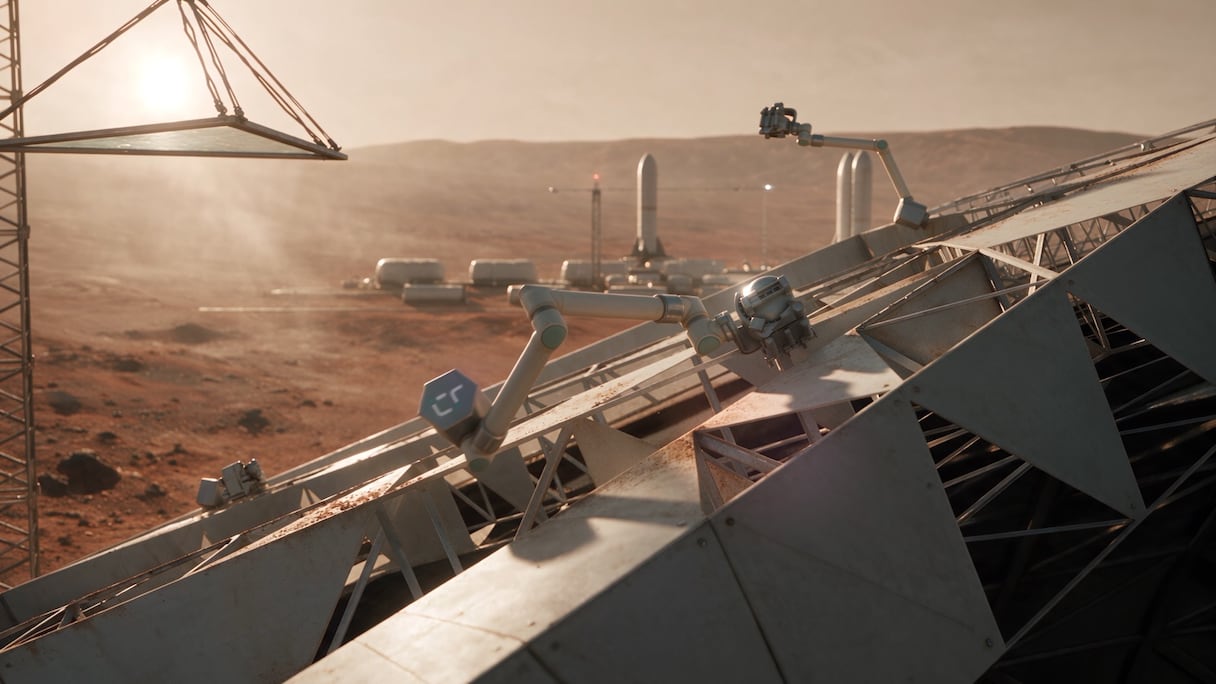
Founded in 2024 by Lewis Jones and James Emerick, the company says its goal is to address one of the major challenges of a permanent human presence on Mars: labor. Rather than relying on a large workforce, Cosmic Robotics wants autonomous machines to handle much of the construction, manufacturing, agriculture and maintenance work needed to support a Martian settlement.
The company is targeting a city of around 10,000 people, compared with estimates that a self-sufficient settlement could require up to 1 million people to staff its essential functions. Cosmic Robotics argues that dramatically increasing worker productivity through automation could make a smaller settlement viable.
Its roadmap is built around four technological layers.
The first is hardware: large, fully electric construction robots capable of operating at up to 300 kilowatts. Cosmic Robotics says conventional diesel-powered construction equipment would be difficult to use on Mars because of the planet’s thin atmosphere and the challenges of transporting and maintaining fuel-based machinery there.
The second is a robot controller capable of adapting to changing environments while maintaining safety. The company says this would allow its machines to move beyond the rigid, preprogrammed behavior common in industrial robots today.
The third is an AI operator that would give individual robots the ability to reason, prioritize and adjust tasks while working. The fourth is a city-scale AI orchestrator designed to coordinate multiple robots, construction activities and resources.
Read also : SpaceX launches three satellites designed to connect ordinary smartphones from space
Cosmic Robotics says it has already begun developing the first two layers on Earth. Its Cosmic-1 robot has achieved twice the labor productivity of manual methods in terrestrial solar farm construction, while the company is now working to expand its technology to other construction applications.
The company also says it won a NASA contract in 2025 to develop edge-reasoning vision-language models for in-space and lunar applications. It has additionally begun deploying its Constellation planning and mission-control software, which it plans to use as the foundation for AI agents coordinating construction work.
Cosmic Robotics argues that autonomous construction will be necessary because communication between Mars and Earth can take up to 22 minutes one way, making it impractical to rely on Earth-based operators for many tasks requiring quick decisions. Its goal is to use AI agents to significantly increase the productivity of the support staff needed to manage a Martian construction operation.
Read also : Could tiny human organs spell the end of animal testing?
The company says its roadmap is ultimately aimed at allowing a small initial crew to build much of the infrastructure before larger numbers of settlers arrive.
For now, however, the plan remains an ambitious technological target. Cosmic Robotics itself describes the 10,000-person Mars city objective as highly ambitious, even as it says advances in physical AI and its own development work have made autonomous construction by the mid-2030s increasingly achievable.
