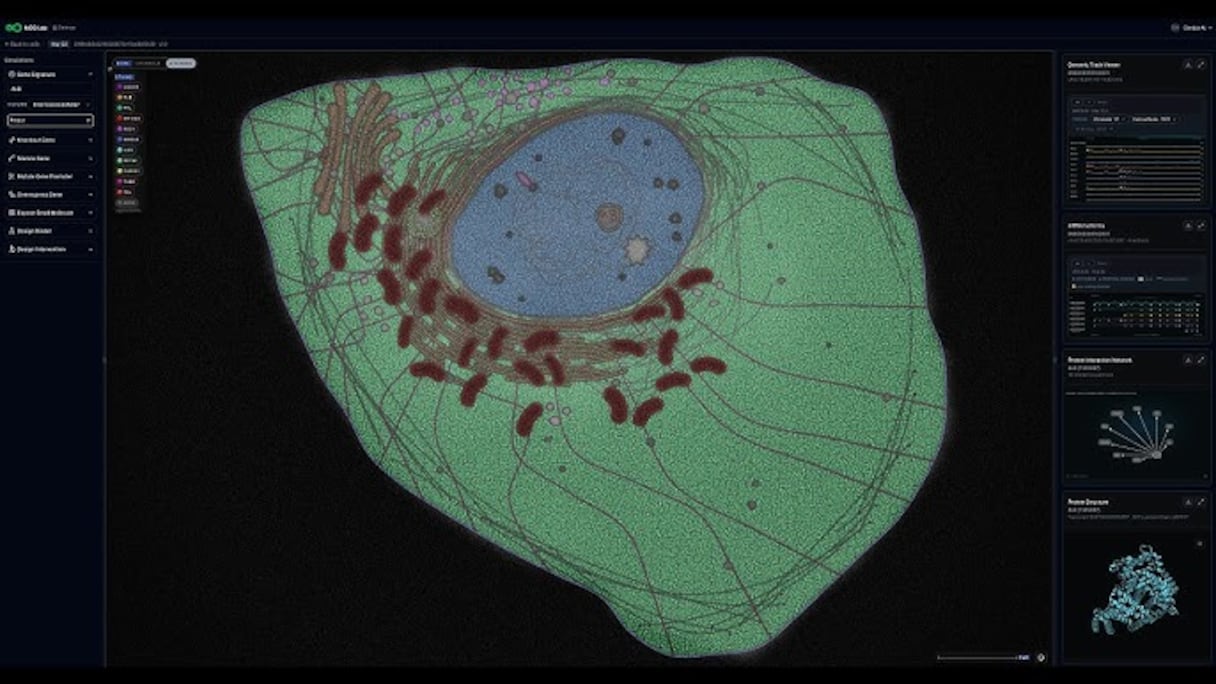
GenBio AI has unveiled AIDO Cell, an artificial intelligence system designed to simulate the behavior of a human cell and how it changes in response to different interventions.
The Palo Alto-based company describes AIDO Cell as a “world model” of the human cell. Unlike AI systems designed to study individual biological components, the model aims to connect several levels of cellular biology, from DNA and RNA to proteins and whole-cell behavior.
The idea is to give researchers a virtual environment in which they can make changes to a simulated cell and observe how those changes are expected to affect it.
For example, a researcher could introduce a genetic or molecular change and ask the model to predict what happens next. AIDO Cell is also designed to simulate the effects of drugs and other interventions, potentially allowing researchers to explore biological responses before testing particular hypotheses in the laboratory.
A key feature of the system is that it is designed to retain the effects of previous interventions. This means researchers can simulate a sequence of changes rather than treating every experiment as an isolated event. The model attempts to carry the cell’s resulting state into the next simulation.
GenBio AI says this approach could eventually help move biological research away from relying solely on trial-and-error experiments and toward more systematic computer-based testing. The company sees virtual cells as a potential tool for drug discovery, disease research and the study of how biological systems respond to different interventions.
The technology is still at an early stage, however. The current AIDO Cell system focuses on two human cell lines, K562 and HepG2, with additional cell types planned for development. Researchers also caution that accurately simulating the complexity of real biological systems remains a major challenge, particularly because of limitations in the scale, diversity and quality of the data available to train and validate such models.
For now, AIDO Cell is not a digital copy of a human cell and does not replace laboratory experiments. Rather, it represents an attempt to build a computational model that can help researchers explore how cells work and how they might respond to changes before those questions are tested in the real world.
