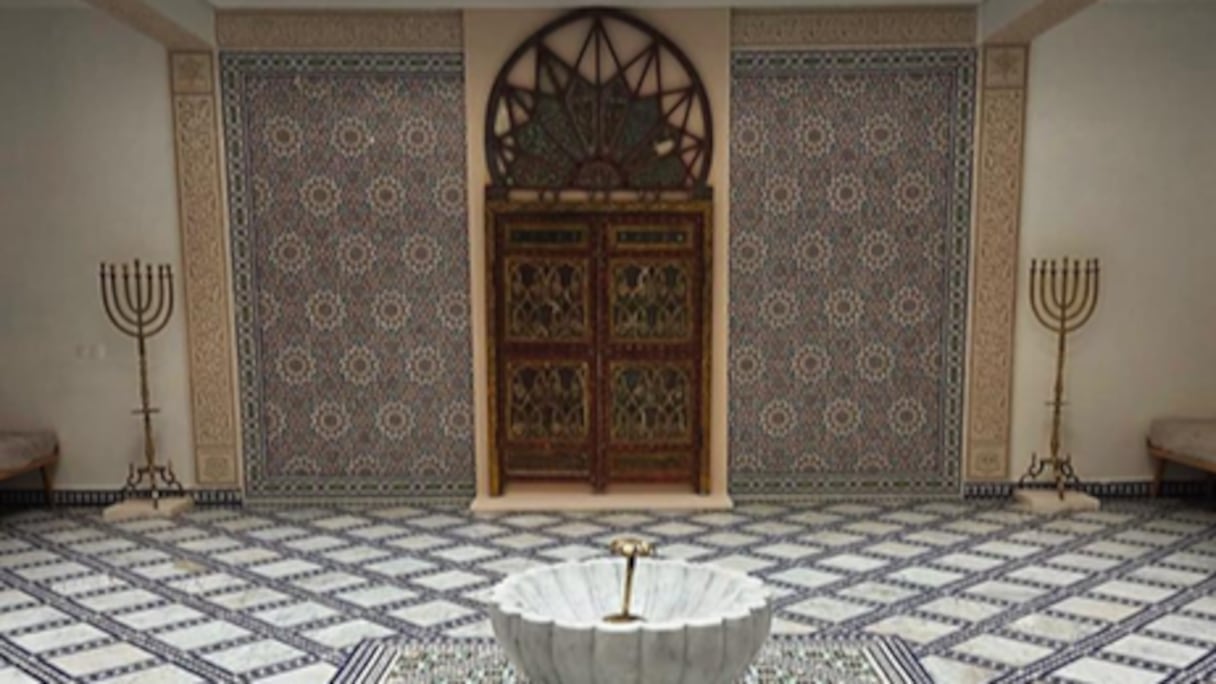
The Museum of Moroccan Jewish Culture will open its doors on Monday, October 12, 2026, in the heart of the Mellah of Fes.
Developed with the involvement of Morocco’s Jewish community, the museum brings together a collection of ritual objects, rare manuscripts and ethnographic artifacts tracing the history, traditions and cultural expressions of Morocco’s Jewish communities.
The institution will become the first museum entirely dedicated to Hebrew culture to be financed with public funds in the history of an Arab-Muslim country.
The project was launched by King Mohammed VI on April 15, 2019, alongside the restoration of the Al Batha Palace, as part of a broader program to rehabilitate and preserve the historic medina of Fes and safeguard its architectural, cultural and spiritual heritage.
After extensive restoration work, the Al Batha Palace reopened to the public in February 2025 as the Al Batha Museum of Islamic Arts.
Built in the late 19th century under the reign of Sultan Moulay Hassan I and completed under Moulay Abdelaziz, the palace had housed a museum dedicated to the arts and traditions of Fes and its region since 1915.
The two museums now form part of Fes’ cultural landscape, reflecting the city’s history of coexistence and exchanges between different religious and cultural traditions.
A first in the Arab-Muslim world
The Museum of Moroccan Jewish Culture represents a first in the history of the Arab-Muslim world, as no country in the region had previously allocated public funds to create a museum entirely dedicated to Hebrew culture.
The project received 10 million dirhams in public funding for its construction and was developed with the involvement of Morocco’s Jewish community and several organizations committed to preserving this heritage, including the Judeo-Moroccan Cultural Heritage Foundation, chaired by Serge Berdugo.
Designed as a place of memory, preservation and transmission, the museum brings together religious and everyday objects, archaeological, ethnographic and artistic pieces, as well as archives and manuscripts. The collections document the history and cultural heritage of Morocco’s Jewish communities.
A museum in the heart of the Mellah
Built on land made available by Fes’ Jewish community, the museum stands in the heart of the Mellah, close to the Jewish cemetery. Its architecture draws extensively on traditional Moroccan craftsmanship, with zellige, carved plaster, painted wood and a marble fountain forming key elements of the reception courtyard.
The project was overseen by the Agency for the Development and Rehabilitation of the Medina of Fes (ADER-Fès), in coordination with the National Foundation of Museums (FNM). Construction and fitting-out work was completed in March 2023, followed by the installation of the exhibition design and collections.
The museum covers more than 1,700 square meters, including around 1,200 square meters dedicated to exhibition spaces. Its displays offer historical, religious, social and anthropological perspectives on Moroccan Judaism.
The permanent exhibition spans two levels and is organized around several thematic sections, including “Morocco, a Land of Encounters,” “Community Institutions,” “The Life Cycle,” “The Yearly Cycle” and “Traditional Crafts.”
On the ground floor, a timeline traces more than 2,500 years of Jewish presence in Morocco. It covers the creation of the Mellah of Fes in the 15th century and the arrival from 1492 onward of Jews expelled from the Iberian Peninsula.
It also highlights several religious and intellectual figures, including prominent rabbis from the Moroccan tradition. Openings along the route provide direct views of the Jewish cemetery, creating a visual link between the collections and the memory preserved at the site.
Upstairs, the exhibition explores the community’s institutional and social organization through the synagogue, Hebrew school, rabbinical court and Mellah. A section devoted to the life cycle presents the main rites and stages, from circumcision to funeral rituals, as well as bar mitzvah and marriage.
Another section is devoted to the festivals of the Hebrew calendar and their expressions within the Moroccan context. The exhibition concludes with traditional trades and craftsmanship, including a reconstructed jeweler’s workshop. Costumes, jewelry and musical instruments illustrate the regional diversity of Judeo-Moroccan heritage.
Preserving, transmitting and showcasing
Beyond the permanent exhibition, the museum has spaces designed to meet preventive conservation and collection security requirements. Audiovisual and digital tools complement the exhibition, making its content accessible to different audiences. Educational workshops are also planned, particularly for children and school groups.
The new institution will strengthen Fes’ museum network and form part of the broader effort to preserve and promote Morocco’s heritage led by the National Foundation of Museums under the guidance of King Mohammed VI. It will also provide a permanent space for preserving and transmitting the Moroccan Jewish heritage that forms part of the Kingdom’s history.
