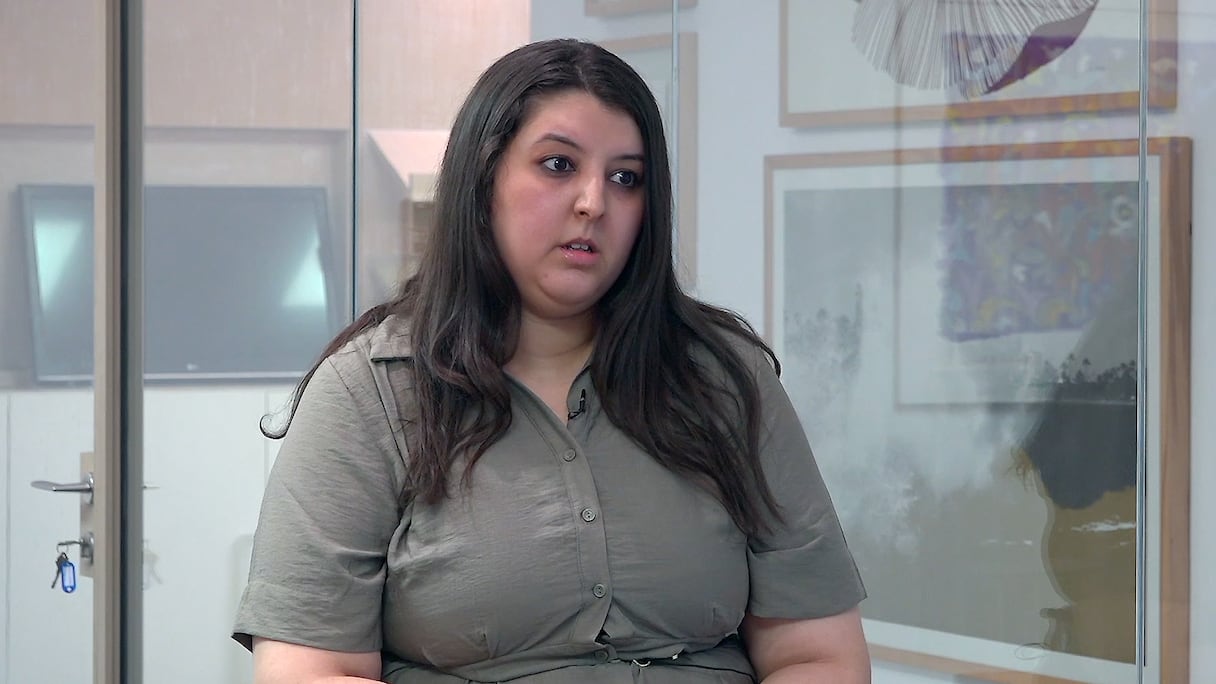
Over the past few years, Mahdar has worked on adapting books for film and television through development agreements involving works published by major international publishing houses, including HarperCollins and Simon & Schuster. She has also pitched projects to leading studios such as Netflix, Disney, Sony, DreamWorks, WildBrain, Nickelodeon, and LAIKA.
Originally from Khouribga, the creative producer, who is also an active member of Women in Animation (WIA) and the Children’s Media Association (CMA), is currently developing Aïsha Qandicha, an animated feature inspired by the famous Moroccan legend. In this interview with Le360, she reflects on her career change, her passion for storytelling, her dyslexia, the challenges of animation, and her ambition to bring Moroccan stories to an international audience.
Le360: Today, you are a creative producer developing a feature film with DreamWorks collaborators. Yet nothing initially pointed you toward this career. How would you describe yourself?
Fatima Ezzahra Mahdar: I am 34 years old, originally from Khouribga, and I graduated from ISCAE with a degree in auditing and management control. For a long time, my path seemed destined for the corporate world. But deep down, I had a much older passion: telling stories.
Today, I develop animation projects with artists and screenwriters from around the world. I have had the opportunity to exchange ideas with professionals from studios such as Disney and DreamWorks, and I am currently working on my first animated feature film, Aïsha Qandicha. My journey may seem unconventional, but in reality, it is quite coherent. I simply ended up listening to what truly inspired me.
When did you decide to leave everything behind?
The turning point in my life goes back to my childhood. As a little girl, I was fascinated by Mulan. That character profoundly impacted me because she was unlike traditional princesses. She was brave, imperfect, and faced her fears. I didn’t realize it at the time, but Mulan first ignited my desire to tell stories.
After graduating, I worked for several companies in Casablanca before continuing my academic journey at Nanjing Audit University in China. On paper, everything pointed toward a conventional career. Yet, despite that reassuring path, I always felt something was missing.
Eventually, I realized that animation was the only thing that truly made me happy. Looking back, my auditing background has been incredibly valuable. Producing a film isn’t just about creativity; it also involves managing budgets, securing financing, negotiating with partners, and overseeing production.
You have spoken about your neurodiversity. How has it shaped your perspective?
I am dyslexic. At school, something as simple as being asked to write my name on the board felt like a real ordeal. I already wanted to tell stories, yet ironically, I struggled with writing. That often exposed me to ridicule and made me feel different.
Over time, I came to understand that this difference was not a weakness but a strength. It taught me to see the world differently. My neurodivergence allows me to notice details, emotions, and nuances that others sometimes overlook. Today, that unique way of seeing things has become one of my greatest creative assets.
Your first feature film focuses on Aïsha Qandicha, a mythical figure that has shaped Morocco’s collective imagination for generations. Why did you choose her?
Because everyone knows Aïsha Qandicha—but very few people actually know her story. Like many Moroccans, I grew up hearing about her as a frightening figure. Later, I began wondering what lay behind the legend. Together with my co-writer, we wanted to give her a voice again. We tell her story from her own perspective rather than through the lens of those who have interpreted her for centuries.
Beyond the folklore, it is a deeply human story about grief, motherhood, guilt, self-acceptance, and redemption. Ultimately, we all carry a shadow within us. In a way, we are all a little like Aïsha Qandicha.
You are working alongside internationally renowned animation professionals. How did these collaborations begin?
I work with Alyssa Harden, a production supervisor at DreamWorks, who is my co-writer and co-development partner. We also collaborate with Chris Pearn as executive producer. To me, these partnerships prove that there are no real borders when a story resonates with the right people.
At the moment, we are at a crucial stage: securing financing and partners to bring the project to life. That is often the most difficult phase of making an animated feature.
You work from Morocco with teams based in Los Angeles, Tokyo, and other countries. What does your daily routine look like?
Above all, it requires a great deal of organization. Some meetings begin at dawn because of the time difference with Japan, while others continue late into the night to accommodate colleagues in the United States.
The days are long, but perhaps the hardest part is learning how to deal with rejection. In this industry, you receive far more refusals than acceptances. A project can move forward for months before suddenly being questioned. You have to learn to accept those setbacks without losing confidence in your story or your vision.
In Morocco and elsewhere, animation is often seen as something made only for children. How can that perception change?
Animation is not a genre—it is a cinematic language. It can tell lighthearted stories as well as deeply emotional ones. Directors such as Hayao Miyazaki and Studio Ghibli have demonstrated this for decades. Through animation, you can explore war, grief, loneliness, or family without losing emotional depth.
The real world can be dark, and animation should be able to reflect that complexity. Children are capable of understanding much more than we often assume, and that is something adults need to recognize.
You have said that a simple message sent to an American showrunner during the Covid-19 pandemic changed the course of your career. Was it really that simple?
It was simple—but you have to be willing to take the chance. During the pandemic, I sent a message directly to Bill Motz, the showrunner of Disney Channel’s The Ghost and Molly McGee. I simply told him that I wanted to write for his series. To my surprise, he replied.
That experience taught me one thing: we are often the ones who place limits on ourselves. The worst that can happen when you knock on a door is that it stays closed. But sometimes, it opens. Studios are constantly looking for new voices and new stories, and Morocco has an extraordinary storytelling heritage.
Ultimately, what message do you hope to convey through your films?
I hope people leave with greater empathy. We are all different, but we share the same humanity. No one should be excluded because they think, feel, or function differently.
My sister, for example, is one of my greatest sources of inspiration. I find a part of her in every character I create. She taught me that storytelling is not simply about connecting events.
Storytelling is an act of kindness. If my films can help someone better understand others or encourage a more compassionate view of the world, then I will have achieved what I set out to do.